
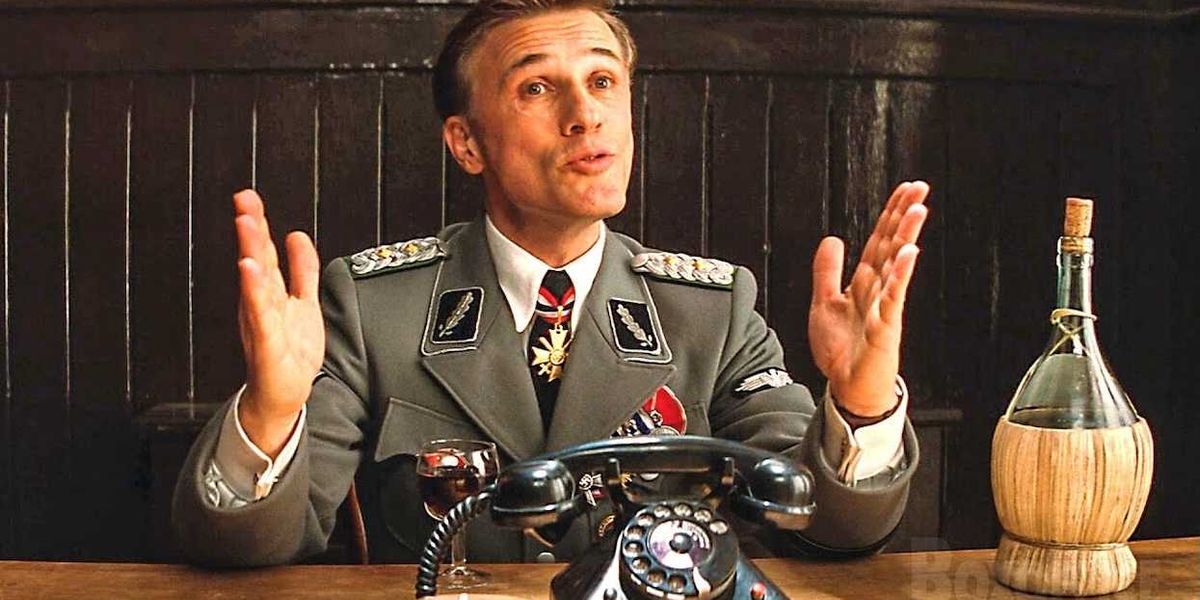
From script to screen, how Christoph Waltz made the line legendary.
'Inglourious Basterds' (2009)
The “Bingo” scene in Inglourious Basterds (2009) is about leverage, power, and one man’s remarkable ability to smile his way through treachery.
Opposite Aldo Raine (Brad Pitt) and Smithson Utivich (B.J. Novak), the alleged winners of history, SS Colonel Hans Landa (Christoph Waltz) sloppily alters the war’s conclusion as if it were his own screenplay. The stakes are extremely high: giving away the Nazi government in return for safe travel and a new identity in the U.S. It’s a combination of theater, extortion, and diplomacy.
Then, as he describes the most daring transaction of the century, he exclaims, “That’s a bingo!” and wiggles in his chair with the joy of a child winning at a carnival game. It’s simultaneously funny, strange, and terrifying.
Although it shouldn’t, the phrase works flawlessly in a war drama. Waltz’s remarkable talent for making words dance and Tarantino’s ability to use dialogue as a weapon are both encapsulated in that one line.
Was it a bit of improvisation, Waltz’s own invention, or was it always supposed to be there? That’s what this article is going to do: provide an insight into the creation of this memorable cinematic moment.
It’s not uncommon for us, the audience, to want such memorable cinematic elements to come from spur-of-the-moment brilliance. The idea is reassuring: the actor is moved, blurts something out, and the history (and a bit of trivia) is created. Makes for a good “bloopers” video.
So people assumed Waltz must have improvised this unexpected and gleefully bizarre delivery of “That’s a bingo!” on the spot. To be fair, it seems too eccentric to have been scripted.
Tarantino’s shooting script contains the proof to the contrary. Word-for-word, the line includes Landa’s follow-up query: “Is that the way you say it? (pause) That’s a bingo!”
Tarantino wanted the contrast between a murderous Nazi and a young game-winner to be ingrained in the dialogue, so he wasn’t leaving this up to chance. The script demonstrates his meticulous planning of this rhythm, down to the peculiar phrasing that contributes to the moment’s lasting impact.
Waltz has made it clear that he doesn’t improvise. He has stated in interviews that he dislikes improvisation. “Creating a script is a writer’s job. Mine is to interpret it,” Waltz said at an interview at the Cannes Film Festival. He believes his role is to remove all of the layers that are already on the page, not to add any more.
Therefore, you are dreaming of something that never happened if you think Waltz was slinking into the scene, saying, “That’s a bingo!” His brilliance was in making the line land like no one else could, not in writing it.
The café scene is more of a performance than a surrender. In addition to haggling, Landa is proving that he is always one step ahead. He demonstrates that his survival is due to his design rather than luck by transforming what ought to have been a desperate moment into a cocky power move. The exclamation point for that show of superiority is “That’s a bingo!”
Why ‘bingo’?
Simple. It’s American, casual, and silly. As though to demonstrate that he is more familiar with his adversary’s culture than they are with his, Landa interjects it into the conversation. It’s patronizing because he is demonstrating his fluency in cultural games rather than language.
Additionally, he makes the entire situation grotesquely humorous by using it while dictating the terms of worldwide surrender. His monstrous intent is concealed by the childish enthusiasm he tactically displays.
The most effective part of Tarantino’s dialogue is this startling contrast. Even though the topic of discussion is war crimes, treachery, and rewriting history, the punctuation is appropriate for a retirement home game night. It sticks because of that clash. For precisely this reason, it belongs there even though it doesn’t.
The actor in Waltz tells the story with his whole body. He incorporates the strudel into the choreography of the scene in the café. He eats slowly, enjoying the cream, and then he casually says something that alters the outcome of the war. The verbal punchline hits even harder because of this physical relaxation.
It’s all about tone. Waltz says, “That’s a bingo!” with an almost ridiculous sense of joy. It’s lighthearted, almost like a teacher congratulating a pupil, and not ominous. He emphasizes how much he undervalues Raine and Utivich by acting as though he is explaining American idioms to them. There is a persistent dissonance as the childlike inflection contrasts with the moment’s deadly seriousness.
What follows is equally significant. Utivich and Raine don’t chuckle. Beyond disgust, they don’t even react. Their silence conveys the audience’s feelings of disgust and incredulity. The line could sound silly without those reaction shots. It becomes threatening with them. The joke is unsettling because it is one-sided.
Tarantino’s reputation is one of the reasons why viewers thought the line was an ad-lib. Even if they aren’t actively thinking so, Tarantino’s films frequently have an improvised feel. Characters ramble, the dialogue is informal, and the scenes are longer than any director would permit. Viewers are led to believe that the actors are making things up because of that feeling of looseness.
The reality is that Tarantino is renowned for his meticulousness, which results in what we call a “tight” script; a script that is lengthy, definitive, and whose dialogue is unchangeable.
Waltz’s multilingual delivery is another factor contributing to the improvised feel. Throughout the movie, Landa alternates between German, French, Italian, and English, and he does it with such ease that viewers hardly notice the script. It feels like a real-time error fixed in character when Landa exclaims the line and then stops to inquire if the line is said as he said it.
Even though this sequence was meticulously written, it has the feel of a real, genuine conversation, all because of that linguistic ambiguity.
Lastly, the distinction between spontaneity and structure is muddled throughout Waltz’s performance. His Landa is erratic, a man who can suddenly turn from courteous small talk to violence. Waltz gives a rehearsed dialogue an air of spontaneity by exhibiting that volatility.
The most obvious example of this magnetic trick is this line, where some audience members might laugh, freeze, and then wonder if they truly heard what they were told. The genius isn’t in improvisation; it’s in making it seem that way.
This line is Hans Landa distilled. He possesses the ideal balance of cunning, shrewdness, and odd charm. By the time he utters these words, we have witnessed every aspect of him, including his pragmatism and brutality. The last point is his readiness to make treachery seem like a joke, as though history was just another game he had mastered.
“That’s a bingo!” has been out of context ever since the movie came out. People frequently forget that it originated in a smug negotiation by a Nazi officer and instead incorporate it into jokes, memes, and casual conversation. The irony is that a phrase that once summed up one of the most sinister transactions in movie history is now used as a playful way to acknowledge minor triumphs. It’s the most bizarre example of pop culture detachment.
The charm that surrounds Landa’s brutality is what makes him a terrifying villain. Instead of growling, he smiles. He congratulates rather than threatens. The line establishes a new benchmark for villains in movies: the most terrifying ones disguise their feelings with wit, humor, and a dash of ridiculousness rather than outright revealing them. Actors and writers alike realized that menace isn’t always loud; it can be joyful at times.
The secret to the success of “That’s a bingo!” is accuracy, not improvisation. Together, Tarantino and Waltz transformed a scripted phrase into a memorable cultural relic. The line is a microcosm of Hans Landa, a monster who enjoys trivialities while planning atrocities; it’s more than just dialogue.
It endures because it is the pinnacle of collaboration: a writer who understood exactly what the story needed and an actor who could make the story sing without altering a single word. Waltz exposed every aspect of Landa’s distorted sense of victory in a single outburst of fake joy.
The real reason we can’t stop quoting the line lies in the chilling contradiction it carries: the world ended for millions, but for Landa, it was just another round of bingo.