
Road Bike Rider Cycling Site
Expert road cycling advice, since 2001
Sign up for our informative, free weekly email newsletter. (Always easy to unsubscribe.)
Jim’s Tech Talk
By Jim Langley
Let’s start with why last week’s Tech Talk was for beginners traveling with bikes with disc brakes (here’s that article) and then we’ll share an additional tip.
It seems important to explain the “why,” because there were multiple anti disc-brake comments to last week’s article. It’s completely understandable why disc brakes – especially hydraulic discs aren’t popular with roadies – and several of you elegantly made the case in your remarks – thank you. But there’s an excellent reason for us (“us” as in we editors of RBR and you readers who ride disc brake road bikes) to provide help with disc brakes anyway.
That reason is because many (maybe most) new road riders may not have a choice of purchasing a rim brake road bike when they visit their local shops. Since most of the major bike brands are only offering bikes with discs. If these buyers are brand new to cycling, they might never even realize that there’s anything out there except disc brakes. So the chances are high that a new road rider’s new bike will be one with hydraulic disc brakes.
Part of our mission at RoadBikeRider is to help new cyclists get the most out of road riding. And as components on road bikes have changed, we’ve always helped with the new gear too like hydraulic disc brakes. If we didn’t we’d be ignoring issues a lot of roadies are and will be experiencing.
This wasn’t included in last week’s tips because with a little luck, you might not experience it. But luck goes both ways and this tip will help if yours goes badly.
The problem you can run into removing and reinstalling wheels when traveling with bikes that have hydraulic disc brakes is rubbing. What happens usually is that something changes slightly and the rotor starts rubbing against a brake pad when the wheel spins. If you lift and hold up the front or rear wheel and spin it and it stops spinning abruptly, the rotor is probably rubbing.
You might hear the rotor make a little brushing sound as it rubs against the rotor when it’s spinning. Or it can make a little squeaking noise if you move the bike slightly like when leaning it against a wall, etc.
This rubbing can be frustrating if you notice it. If it’s barely noticeable, you probably won’t feel it when you’re riding, but you probably want to fix it just to ensure you aren’t wasting energy riding. And if it’s making noise, that can drive you crazy.
There are 2 ways to fix it. With both, the idea is to center the disc brake caliper over the rotor. The calipers are the parts attached to the fork in front and frame on the rear. The rotors are the parts attached to the center of the wheel. Applying the brake levers causes the brake pads inside the calipers to close on the rotors, which slows and stops the bike.
The following instructions assume that the rotors are straight, not bent. To tell, spin the wheel with the rubbing rotor and focus on its edge. It should spin true without any lateral wobbles. If it’s bent, the following adjustments won’t fix your rubbing issue. Instead you need to fix the bent rotor or replace it with a new one.
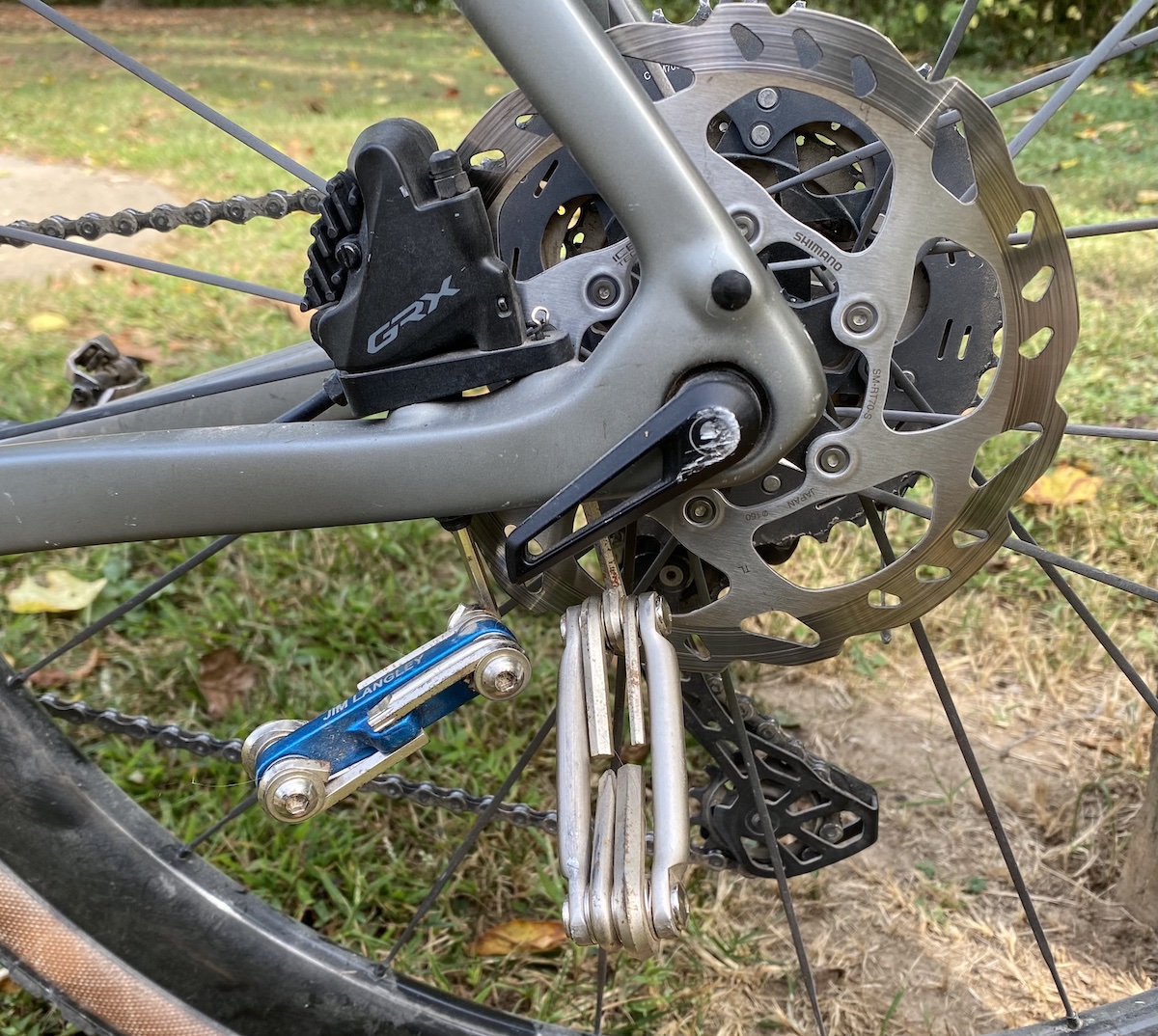
On newer bikes this procedure usually stops rubbing disc brakes. And it’s worth trying even on older or well-used bikes. There are only 2 steps. First, find and loosen the 2 bolts that attach the calipers to the frame or fork. Just loosen them, do not remove them. When they’re the right looseness you will be able to hold and wiggle the caliper a bit, it won’t be held tightly in place by the bolts to the frame.
In the photos I placed 2 multi tools on the 2 bolts I loosen on my bike to give an idea where yours will be. Note that older hydraulic disc brakes may have more complicated setups with spacers and shims on the bolts and even other bolts. So look carefully to be sure you’re working on the right bolts before loosening anything. If you’re not sure, I recommend asking a shop to do it for you the first time and ask them to show you which bolts to turn. It will be worth whatever small fee they charge you.
Once the bolts are loose the second step is to squeeze and hold on the lever of whichever brake was rubbing. Don’t let go. If you can’t hold the brake lever on and reach the caliper that you just loosened, then use a Velcro strap or a toe strap (remember those?) or whatever you have to keep the lever squeezed – even a strong elastic band can work. And with the lever squeezed like this, retighten the disc brake caliper bolts. The recommended torque is about 6-8 Newton meters, which is a bit less than how tight you get thru axles, which we talked about last week.
When tightening these bolts, tighten a bolt gradually, then do the same to the other bolt. Then add a little more tightness on one bolt and then the other. Repeat until both bolts are fully tightened. Doing it this way will prevent rocking the brake out of position.
Now, when you let go of the brake lever or release the strap, there’s an excellent chance that what you just did will have recentered the brake and stopped the rubbing.
If the first procedure (#1 above) did not stop the rubbing, the rubbing may be due to another issue with the brake, such as uneven pad wear or a caliper out of alignment. On some bikes the problem might be the mounts on the frame poorly aligned from the factory. To fix the rubbing, again you loosen the correct two bolts holding the caliper on the frame, but this time, you don’t want to loosen them too much. You actually want a little tension on the bolts to hold the caliper from moving on its own. Because you’re going to move it into place with your hand or by gently tapping with a rubber mallet or similar. So loosen them little by little until the caliper isn’t fully tight.
Next hold a piece of white paper beneath the caliper and look down through the caliper to spot where the rotor rubs against the brake pad. Use a flashlight if it’s difficult to see and move the paper around and change your position or the bike’s position until you can see through the brake caliper, in between the brake pads.
Once you’ve spotted the rubbing area, tap on the caliper in such a way to create clearance and stop the rubbing. Usually you will tap near one bolt or the other to rock the caliper in either direction. It will take a little experimentation and practice to learn how to get it where it needs to go, but you can do it if you keep trying.
Once you have created clearance where it was rubbing and feel good that it’s fixed, you can retighten the 2 bolts. But, do this gradually because if you just torque them fully, the caliper could move back to where it was before since it’s been there for awhile already. So, to tighten it gradually, tighten each bolt a ¼ turn or so at a time, going back and forth until both bolts are tight again to 6-8 Nm. Then, give the wheel a spin and apply the brake and see if the adjustment stuck and the rubbing is gone. Congrats if so. If not, then repeat the procedure a second time. Sometimes it might take a few tries to get it just right and you’ll get better at it each time you do it.
That’s a lot of words that I hope helps you fix your rubbing disc brakes. I realize it’s a lot and especially if you’re new to your bike and/or working on it. So, I searched and found a great video showing these steps by my friends at Park Tool. Here it is:
In my opinion, manufacturers of hydraulic disc brakes should address the rubbing issue and invent an easy built-in adjustment to recenter a caliper and stop the rubbing when it occurs. To me, it’s crazy to have to break out wrenches and loosen, reset the caliper and retighten the bolts every time a brake rubs, especially since it’s such a common issue. How long will it be before you strip the threads on a bolt?
It seems like there ought to be a way to provide a mechanical centering screw on calipers sort of like the limit screws on derailleurs only they would push the caliper just so to recenter it. Maybe it could be turned by hand too so no tools would be needed, wouldn’t that be a great improvement? How about it disc brake makers?
Jim Langley is RBR’s Technical Editor. A pro mechanic & cycling writer for more than 40 years, he’s the author of Your Home Bicycle Workshop in the RBR eBookstore. Tune in to Jim’s popular YouTube channel for wheel building & bike repair how-to’s. Jim’s also known for his cycling streak that ended in February 2022 with a total of 10,269 consecutive daily rides (28 years, 1 month and 11 days of never missing a ride). Click to read Jim’s full bio.
Your email address will not be published.
Our cycling expert editors and writers choose every product we review. We may earn an affiliate commission if you buy from one of our product links, at no extra cost to you. This income supports our site.
Privacy Policy
Copyright © 2025 · Magazine Pro on Genesis Framework · WordPress · Log in