
Chicago Reader
Chicago’s alternative nonprofit newsroom
Military veterans often face numerous challenges when reintegrating to civilian life, including physical injuries, mental health struggles, and financial hardship. For many of these American heroes, though, a little support can go a long way. That’s why in 2006 the Illinois Lottery launched the first Instant Lottery ticket in the country that designated 100 percent of its profits toward organizations that support veterans in Illinois, working with the Illinois Department of Veterans Affairs (IDVA) to manage and distribute grants. To date, the Illinois Lottery has raised more than $24 million to fund the Veterans Cash program, which has awarded grants to more than 400 local veteran support organizations who provide various services, such as housing assistance, disability benefits, food and clothing pantries, and mental health treatment. In 2024, the Illinois Lottery introduced a new joint specialty ticket where a portion of the profits raised go toward ten worthy causes, including veterans support programs in Illinois. This year’s ticket, the 7X Bingo Multiplier Instant Ticket, costs $5 and is available for purchase at more than 7,000 Illinois Lottery retailers throughout the state. With its festive green color, it’s the perfect gift for people 18+ this holiday season or a way to treat yourself. Visit the Illinois Lottery website for more information, and read on to learn about the BraveHearts, which provides equine-assisted services to veterans at their three Illinois farms and beyond.
In 2022, Brandon Spandet arrived at BraveHearts Therapeutic Riding and Educational Center in Harvard, Illinois, unsure of what to expect. The firefighter-paramedic had served four years as a combat medic in the U.S. Army, but since returning home in 2020 he’d struggled to readapt to civilian life. When his doctor suggested connecting with the nonprofit organization, Spandet initially shrugged it off, but two days later, a chance meeting with a Vietnam veteran who recommended BraveHearts based on his own experiences there convinced him to give it a chance—despite his lack of experience with horses. “I was kind of at the end of my rope,” he says. “I went out there, just because I didn’t know what else to do.”
Three years and countless rides later, Spandet describes BraveHearts as “life-changing.” He is active at all three of the organization’s farms, which along with Harvard, include locations in Poplar Grove and Rockford and says he rides twice a week (including a weekly “built-in date” ride with his wife), serves as a volunteer for outreach events, and assists with lessons for fellow veterans and children with disabilities. “My wife says that she could see there was an immediate change from the first day that I went,” he says. “She says she feels like she got her husband back.”
Spandet’s story is remarkable, but he is only one of thousands of veterans whose lives have been positively impacted by BraveHearts. The organization was founded in 2002, initially with the intention of serving children with special needs by providing therapeutic horseback riding. Then in 2007, BraveHearts became a premier accredited center for the Professional Association of Therapeutic Horsemanship International (PATH Intl.), becoming one of the first organizations in the country to specialize in equine-assisted therapeutic riding services for veterans. The program has grown ever since.
While BraveHearts primarily serves veterans from Illinois and Wisconsin, they’ve developed a national reputation for excellence. “Last year, we served veterans from 28 different states across the United States, and we also served a veteran from Puerto Rico,” says BraveHearts president and CEO Meggan Hill-McQueeney. “We served 1,111 individual, unique veterans and provided close to 10,000 hours of various services—that was a 14 percent increase from the year prior in just our services to veterans.”
BraveHearts’ farms operate six days a week with 62 therapy horses and a variety of programs that can be customized for the individual, which Hill-McQueeney says has enabled the organization to serve veterans up to 102 years old. Along with offering riding and groundwork training, they also provide equine-assisted psychotherapy (EAP) services, and opportunities for veterans to work with and gentle wild mustangs. The programs are provided at no cost to veterans, each of whom is invited to bring a member of their immediate family to support their therapeutic goals. That makes outside funding, such as the Illinois Department of Veterans Affairs (IDVA) grant they receive through the Illinois Lottery’s specialty ticket program, essential. “That grant has been a godsend to our programming,” Hill-McQueeney says.
But what is it about horses that can make such a difference in veterans’ lives, whether they are struggling with post-traumatic stress disorder, suicidal ideation, or other physical or mental health challenges, even when conventional therapies or medications cannot? It all starts with the heart.
“Horses have this incredible energy that radiates from their heart about three meters around.” Hill-McQueeney says. “A horse’s heart is five times larger than a human being’s and can influence straight into our heart. There’s what science identifies as a coherent heart rate, or a heart rate pattern that can explain why we feel better when we’re close to horses.”
That feeling of well-being corresponds with physiological benefits. A 2022 study in the International Journal of Nursing Science noted that participants who attended 8–12 weeks of equine-assisted therapy programming experienced increased levels of serotonin, decreased levels of cortisol, and improved brain function.
Hill-McQueeney cites research that shows people who interact with horses can also experience higher levels of beta endorphins—neurotransmitters produced by the brain that naturally suppress stress and pain. “So many times veterans are like, ‘The only time I’m not in physical pain is when I’m with a horse.’” she says. “That’s a big deal. Horses can give us a decrease in stress levels. They decrease our feelings of anger, hostility, tension, and anxiety. There are all these greater feelings of empowerment and confidence and patience, and all these tremendous skills that come from spending time in the presence of horses.”
Shorty Ogden-Moles enlisted in the Army in 2001, three days after 9/11, and spent a year in Afghanistan as a mechanic working on Apache helicopters. During her time in the service, she experienced significant traumas and injuries, whose lasting effects created significant hardships following her return to the U.S., and eventually led her to consider taking her own life.
“I was almost a ’22,’ because at that time, 22 veterans a day were committing suicide. . . . Now, we’re hovering around 20 per day—which is still too many,” she says.
In 2020, Ogden-Moles and her family relocated from Oregon to Rockford, Illinois, where her wife attended medical school. After hearing BraveHearts offered free riding lessons for veterans, she brought her then six-year-old daughter out for a farm tour. “As we walked in, we immediately felt like we were home and we were with family. Like, ‘This is where we want to be.’”
That instinct proved to be right. Today, Ogden-Moles rides at BraveHearts twice a week and participates in EAP. Her progress has been so significant that her family chose to stay in Illinois following her wife’s graduation so they could remain close to the farm. “I’ve unlocked more of my trauma through EAP in five years than I have since 2003 with the VA,” she says.
Ogden-Moles says one reason for that is that conventional psychotherapy can be awkward or uncomfortable, especially without a trusted relationship between patient and practitioner. “The other part of it is that horses are mirrors of us,” she says. “I can lie to you and tell you I’m great, I can lie to myself and tell myself I’m great, but if I come [to BraveHearts] and am really anxious or antsy or whatever, that horse is going to mirror that behavior. So I have to find my center and be grounded in the moment so I can be the best partner I can be with the horse.”
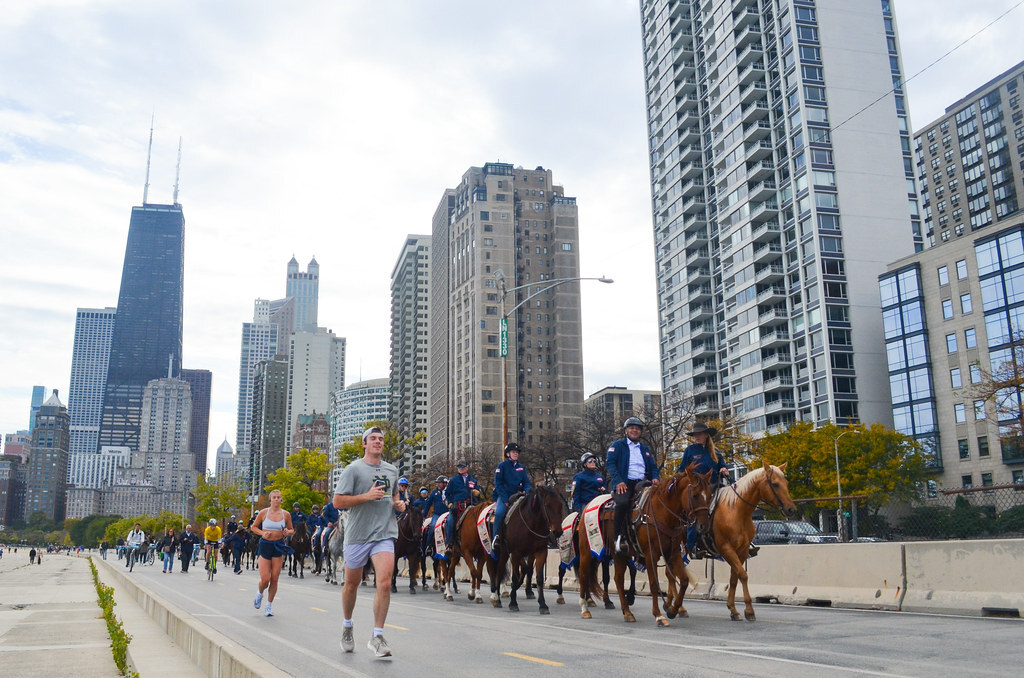
BraveHearts veterans support work extends into outreach events, such as Trail to Zero, a series of 20-mile rides in cities throughout the U.S., including Chicago, which honor the 20 veterans a day who commit suicide, spread awareness about the veteran suicide crisis, and highlight the healing power of equine therapy. Ogden-Moles cites her experience at October’s Trail to Zero ride in New York as particularly poignant. “I’m in Times Square on the back of a wild mustang in the middle of New York City, bringing awareness to something that is very serious and very important to me,” she says. “I was just overtaken by emotion because it was just so awesome and powerful.”
With your purchase of a 7X Bingo Multiplier Instant Ticket, you can help organizations like BraveHearts continue their crucial work supporting local veterans. “We’re so grateful,” Hill-McQueeney says. “We have the Lottery ticket stickers up around our farms because we’re always trying to encourage [people to purchase tickets].”
Spandet encourages veterans to connect with BraveHearts, whether they are interested in riding, EAP, or volunteering around the farm. “Give it a shot,” he says. “Get yourself in the door and let the horses do the rest.”
For more information about BraveHearts, visit braveheartsriding.org.
The news you should know in the city you love.
Bylines labeled “Chicago Reader Staff” are used for features that contain nonwritten, nonreported information like listings, for event and organization announcements by noneditorial personnel, and for advertiser content. Additionally, when multiple authors collaborate on an article, the byline “Chicago Reader Staff” is displayed, while individual contributions are credited throughout the feature.
About the Chicago Reader
Contact us
Find the paper
Subscribe
Contests/Giveaways/Promotions
Shop the Reader store
Classifieds
Advertise
Promote your event
Privacy Policy | Terms of Use