
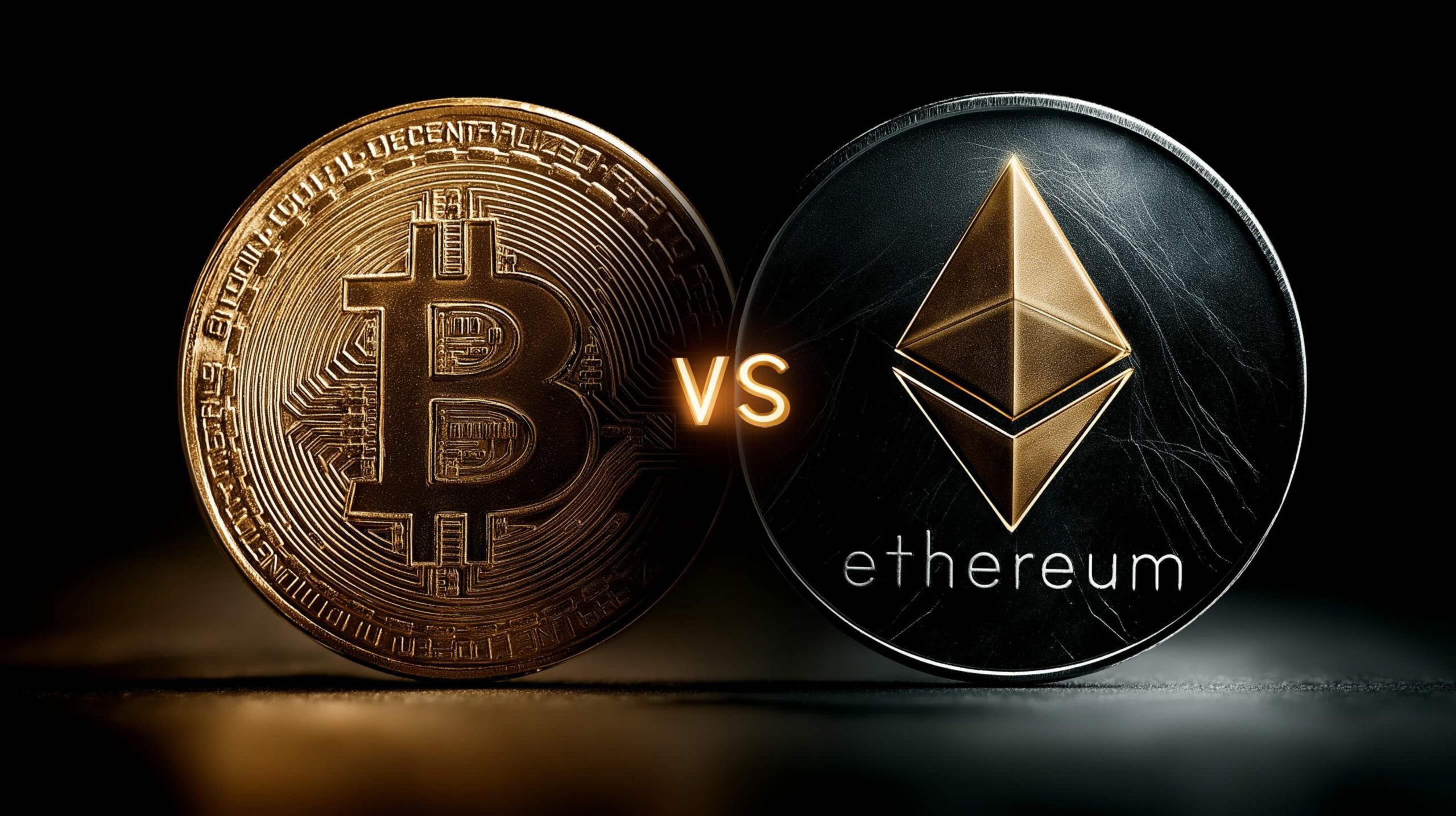
Bitcoin: 2025 has been a landmark year for Bitcoin’s price. Following the April 2024 halving (which cut new BTC supply in half), Bitcoin showed resilience and entered 2025 with bullish momentum. By late 2025, Bitcoin hit all-time highs, trading around $117,000 – a dramatic climb from prior years nasdaq.com. Year-to-date, BTC is up roughly 24% nasdaq.com despite intermittent pullbacks. Bitcoin’s rally has been steadier and less turbulent compared to Ethereum’s swings, reinforcing its reputation as the more stable of the two majors. Part of Bitcoin’s strength is its status as a macroeconomic hedge – it’s often called “digital gold” because during times of financial stress or inflation, investors flock to BTC as a store of value nasdaq.com. For example, a BlackRock analysis found Bitcoin has “lived up to its billing as a safe asset,” eventually outperforming gold in the aftermath of shocks like the 2020 COVID crash nasdaq.com. This safe-haven appeal helped Bitcoin retain value through 2025’s market fluctuations.
Ethereum: Ethereum’s price journey in 2025 has been more volatile. After a strong 2024, Ethereum initially stumbled, dropping nearly 50% from its highs by early 2025 vaneck.com. By March 2025, ETH was significantly underperforming BTC. However, that narrative flipped dramatically in Q2: within a single week in April, Ethereum surged over 50% vaneck.com amid renewed market optimism, protocol upgrades, and improving sentiment. This “rip-roaring summer rally” saw ETH climb back toward $4,500 nasdaq.com, putting it up roughly 37% for 2025 (outpacing Bitcoin’s gains) nasdaq.com. As of mid-2025, Ethereum’s price had almost doubled from its spring lows. Even so, it remained below its late-2021 all-time high (~$4.8K), reflecting both its higher volatility and the unique challenges it faces. Analysts note that Bitcoin’s singular role as a store of value gave it a steadier bid in early 2025’s uncertainty, whereas Ethereum’s price is tied to network utility and saw “dramatic swings” due to sector-specific headwinds vaneck.com. By late 2025, confidence in Ethereum had returned alongside DeFi growth and technical improvements, but ETH continues to trade with greater volatility and sensitivity to crypto market cycles than Bitcoin.
Relative Performance: Over the long run, both assets have delivered strong growth (and occasional sharp corrections). In 2025, Bitcoin’s price stability and post-halving supply shock helped it hold value during downturns, while Ethereum’s higher beta meant deeper dips but also sharper rebounds. It’s a pattern seen before: in boom times Ethereum can outrun Bitcoin, but it also incurs bigger drawdowns in bear phases. So far in 2025, Ethereum has slightly outperformed BTC in percentage terms nasdaq.com, yet many analysts still favor Bitcoin for capital preservation. One analyst noted that despite ETH’s bigger YTD gain, “it’s easy to see why Bitcoin is the preferable investment” for resilience, as BTC “holds up so well under extremely challenging market conditions” nasdaq.com nasdaq.com. In summary, Bitcoin has offered a smoother ride in 2025’s market, whereas Ethereum rewarded investors with higher returns at the cost of higher volatility.
Bitcoin Spot ETF Approval: A defining development for 2025 was the long-awaited arrival of U.S. spot Bitcoin ETFs (Exchange-Traded Funds). After over a decade of delays, the U.S. SEC finally approved the first spot Bitcoin ETF in January 2024, marking a historic milestone reuters.com. By September 2025, U.S. regulators went further – streamlining rules to “enable…generic listing standards” for a whole slate of crypto spot ETPs reuters.com reuters.com. This watershed regulatory shift, championed by a more crypto-friendly administration, “overturn[ed] more than a decade of precedent” in the U.S. and opened the floodgates for institutional crypto products reuters.com. The initial Bitcoin ETF launches in 2024 were met with strong demand, drawing in significant institutional capital. Analysts observed that the halving plus ETF catalyst in early 2025 “drew investor capital toward BTC” at the expense of altcoins like ETH vaneck.com vaneck.com. Bitcoin’s price strength in Q1 2025 was partly attributed to these ETF-fueled inflows, as traditional investors finally had an easy, regulated vehicle to gain Bitcoin exposure.
Ethereum ETF and Upgrades: Ethereum also saw important developments in 2024–2025. The first U.S. spot Ethereum ETFs were reportedly approved by mid-2024 bitpanda.com, following on Bitcoin’s heels. This made it much easier for institutions to invest in ETH, boosting liquidity and credibility. By August 2025, Ethereum ETFs had attracted about 6.7 million ETH in holdings (nearly $30 billion worth) forklog.com, with over $1B of net inflows in a single week as enthusiasm grew forklog.com. The CEO of one major asset manager even dubbed ETH “Wall Street’s token” given this surge of institutional involvement forklog.com. On the technology front, Ethereum underwent a major protocol update in 2025 called the “Pectra” upgrade – its most significant advancement since the 2022 Merge. Activated on May 7, 2025, Pectra included a bundle of improvements (11 EIPs) aimed at boosting network efficiency and user experience bitpanda.com. Notably, one change raised the staking limit per validator from 32 ETH to 2,048 ETH bitpanda.com, allowing large stakers (like institutions or custodians) to run validators with bigger stakes. This consolidation can improve network performance and reduce overhead. Another tweak drastically cut the time to activate a new validator (from ~12 hours down to ~13 minutes) bitpanda.com, making it far easier to spin up staking nodes. And critically for usability, Ethereum introduced “smart accounts” (account abstraction) and a feature allowing transaction fees to be paid in tokens other than ETH bitpanda.com. This means users and businesses can more seamlessly use Ethereum without managing ETH for gas, narrowing the convenience gap between Ethereum and newer rival chains. These upgrades, combined with growing Layer-2 adoption, helped drive down Ethereum’s fees in 2025 and address some scaling pain points vaneck.com bitpanda.com.
Regulatory Moves: 2025 brought a mix of crypto regulatory developments worldwide. In the United States, beyond the SEC’s ETF pivot, there were discussions on clearer crypto legislation. By 2025 the U.S. had still not passed comprehensive crypto laws, but specific efforts gained traction – for example, stablecoin legislation started to move forward, aiming to regulate dollar-pegged tokens (a key part of the Ethereum ecosystem) nasdaq.com. The changing political climate played a role: a reform-minded approach replaced the prior hardline stance, creating hopes for more regulatory clarity. Meanwhile, the European Union’s landmark MiCA (Markets in Crypto-Assets) regulation fully came into effect in early 2025, instituting a uniform framework for crypto across EU member states. MiCA provides clear rules for crypto-assets like Bitcoin and Ether (which are categorized as non-security “other crypto assets”), as well as stablecoins and service providers. This regulatory clarity in Europe is expected to foster wider institutional adoption, since companies can operate under a single rulebook across the EU. Asia’s regulatory landscape in 2025 is varied: China still maintains its ban on crypto trading and mining, but Hong Kong (a special administrative region) has pivoted to embrace crypto under a strict licensing regime. In 2025 Hong Kong introduced new rules for exchanges and even passed a Stablecoin Ordinance (effective August 2025) to oversee stablecoin issuers medium.com. Japan continued refining its already robust crypto regulations – in mid-2025 Japan’s parliament passed reforms to integrate crypto into securities laws, enable licensed crypto brokerages, and even lay groundwork that could allow spot Bitcoin ETFs domestically in the future medium.com medium.com. South Korea likewise enacted a comprehensive law in 2024 focused on investor protection, and by 2025 was drafting a Digital Asset Basic Act to legalize spot crypto ETFs and formally regulate stablecoins medium.com medium.com. Singapore had earlier established clear rules for crypto exchanges and a framework for stablecoins, maintaining its status as a crypto-friendly financial hub. In summary, 2025’s news cycle has been notably positive for Bitcoin and Ethereum: major technical upgrades, the rollout of long-awaited investment vehicles (ETFs), and a trend toward clearer regulations in key markets. These developments collectively accelerated institutional adoption and helped both BTC and ETH mature as asset classes.
When comparing Bitcoin and Ethereum as investments, there are stark differences in their market characteristics and risk profiles:
Bullish Price Predictions: Reputable analysts and institutions have put forth some eye-popping forecasts for both Bitcoin and Ethereum in the coming years. Many experts remain optimistic that both BTC and ETH will set new record highs as adoption grows. For Bitcoin, some of the most bullish calls come from major investment firms: Standard Chartered’s crypto research team projected Bitcoin could reach $120,000 by mid-2025 and around $200,000 by the end of 2025 thedefiant.io thedefiant.io – implying a doubling or more from early-2025 levels. Their head of digital asset research, Geoff Kendrick, even told investors it’s “hard to be bearish” on BTC given the macro trends and ETF-driven demand, urging to “buy bitcoin now” in anticipation of these targets thedefiant.io. Looking further out, Standard Chartered later suggested Bitcoin could soar to $500,000 by 2028 if trends persist theblock.co. Perhaps the most famous long-term forecast comes from ARK Invest (led by Cathie Wood), which has modeled that Bitcoin’s price could surpass $1 million by 2030 nasdaq.com (and in some scenarios even $1.5 million+ by 2030, according to ARK’s 2025 “Big Ideas” report) newsweek.com. This bullish thesis is based on Bitcoin capturing a share of multiple markets (global wealth storage, emerging market currency, institutional portfolios, etc.). While $1M might sound extreme, the “growing consensus” among many crypto investors is that Bitcoin can indeed achieve a 10× increase by 2030 from early 2025 levels nasdaq.com, as it matures into a globally recognized asset.
Ethereum also has bold predictions backing it. Standard Chartered forecast that ETH could reach $7,500 by the end of 2025 and roughly $25,000 by 2028 nasdaq.com, projecting substantial multi-year gains as Ethereum’s utility and institutional adoption expand. Several crypto fund managers have floated the idea that Ethereum’s market cap could eventually “flip” Bitcoin’s, given enough time. Notably, in August 2025 Fundstrat’s Tom Lee argued that Ethereum will surpass Bitcoin in market capitalization as institutional use of Ethereum’s network grows – a stance that Ethereum co-founder Joseph Lubin enthusiastically agreed with forklog.com. Lubin went so far as to predict “ETH will grow 100 times from its current level. Maybe even more.” forklog.com in the long run, as Wall Street and the global economy increasingly rely on Ethereum’s decentralized infrastructure. Lubin believes today’s forecasts aren’t “optimistic enough,” suggesting no one can fully imagine the scale of a future economy built on Ethereum – he envisions Ethereum as “the most powerful resource of decentralized trust” that could ultimately “surpass all other resources in the world.” forklog.com This ultra-bullish view implies massive upside for ETH (100× would mean an eventual price in the hundreds of thousands of dollars per ETH, if it ever came to pass).
Context and Caution: Not every expert sees only blue skies, however. Crypto markets are notoriously hard to predict, and forecasts vary widely. Some analysts maintain more conservative or even bearish outlooks, emphasizing the execution and competitive challenges facing Ethereum and the historical boom-bust cycles of crypto. For instance, a number of analysts in mid-2025 warned that after Ethereum’s big spring rally to ~$2,700, ETH could retrace below $2,000 again before year-end bitpanda.com. Forecasts cited competition from faster, cheaper chains (like Solana or Sui) and potential regulatory hurdles as reasons ETH’s price might “fall to $1,850” in a pessimistic scenario bitpanda.com. Similarly for Bitcoin, while the predominant sentiment is bullish, one can find contrarian voices – some market skeptics or technical analysts occasionally project that Bitcoin could face steep drawdowns (50–70%) if, say, a macro recession hits or if a regulatory shock occurs forklog.com. It’s worth noting that past cycles have seen Bitcoin drop over 80% from peak to trough before eventually recovering. So far, each cycle’s lows have still been higher than the last, but the volatility is ever-present.
Long-Term Drivers: The generally positive long-term outlook for both Bitcoin and Ethereum hinges on continued adoption and technological progress. For Bitcoin, key drivers include scarcity (post-halving supply squeeze) vaneck.com, institutional accumulation (corporate treasuries, nation-states, ETFs) vaneck.com forklog.com, and the narrative of Bitcoin as digital gold in a digital age nasdaq.com. As long as more investors see BTC as a prudent portion of their portfolio (a hedge uncorrelated with stocks/bonds), demand could outpace the slow-growing supply, pushing the price upward over time. For Ethereum, the drivers are network utility and innovation: if Ethereum successfully scales (via sharding and layer-2 rollups) and remains the default platform for DeFi, NFTs, and tokenization, demand for ETH should rise in tandem with global blockchain activity. The fact that major institutions are now building on Ethereum – e.g. banks tokenizing assets or settling trades on Ethereum-based networks – bolsters the case for long-term value bitpanda.com. In one notable example, State Street (a major U.S. custodian bank) partnered with fintech firm Taurus in 2025 to help tokenize real-world assets on Ethereum, a move that could “stabilize Ethereum’s value performance in the long term” by bringing in traditional finance usage bitpanda.com. Developments like these suggest Ethereum is weaving itself into the fabric of mainstream finance.
Bottom Line: Many analysts foresee strong long-term growth for both assets – with Bitcoin often seen as the more certain “sooner or later six-figure” asset, and Ethereum as having a possibly even larger upside (proportionally) if it fulfills its Web3 platform destiny. However, all emphasize that uncertainty remains high. As one industry report concluded, crypto forecasts are not an exact science – unforeseen events, from regulatory crackdowns to major technological breakthroughs (or failures), can dramatically alter trajectories bitpanda.com bitpanda.com. Prudent investors are encouraged to consider multiple scenarios: a bullish case (new highs, broader adoption), a bearish case (competition or regulation undermines growth), and a middle ground (more gradual, range-bound growth) bitpanda.com bitpanda.com. Historically, those who believed in the technology and held through volatility have been rewarded, but position sizing and risk management remain crucial given the extreme swings possible on the road ahead.
Bitcoin’s Roadmap & Scaling: Bitcoin’s protocol development is famously conservative and security-focused. Over its 14-year history, Bitcoin has changed very little compared to Ethereum. There is no “Bitcoin 2.0” on the horizon; instead, improvements come as incremental upgrades that maintain backward compatibility. A prime example was the Taproot upgrade in 2021, which enhanced Bitcoin’s privacy and smart contract flexibility by introducing Schnorr signatures and Merkelized abstract syntax trees vaneck.com. Taproot was a significant yet modest step, aligning with Bitcoin’s philosophy of doing a few things well (securely store and transfer value) rather than adding complex new features. As of 2025, developers continue to explore ways to extend Bitcoin’s functionality without altering its core consensus much. Projects like sidechains (e.g. Liquid, Rootstock) allow experimentation with new features (like faster transactions or asset issuance) in parallel to the main chain vaneck.com. The main strategy for scaling Bitcoin’s throughput is via Layer-2 networks, the most prominent being the Lightning Network. Lightning allows users to transact Bitcoin instantly and with negligible fees by opening payment channels off-chain. By 2025, the Lightning Network has grown substantially – it’s being used for everything from everyday micro-payments (e.g. buying coffee with BTC) to innovative applications like streaming payments. This has enabled “fast, low-cost micro-transactions” and expanded Bitcoin’s use cases beyond simple store-of-value vaneck.com vaneck.com. In fact, by 2025 Lightning supports advanced use cases and microtransactions at scale vaneck.com, helping Bitcoin overcome its base layer limitation of ~7 transactions per second. However, it’s worth noting that Bitcoin’s on-chain capacity remains intentionally limited (block size and frequency haven’t changed significantly), so Bitcoin’s roadmap relies on off-chain and second-layer solutions to boost performance rather than controversial on-chain scaling changes. This approach prioritizes decentralization and security at the base layer, while gradually improving user experience via layers built atop Bitcoin.
Looking forward, Bitcoin’s technical roadmap remains minimalist. There is discussion in the community around things like schnorr signature aggregation (to further improve efficiency), OP_CTV (CheckTemplateVerify) for enhanced smart contract capabilities, and potentially new sidechain mechanisms. But any such changes undergo rigorous scrutiny and often years of debate. The focus is on preserving Bitcoin’s role as the most secure, censorship-resistant value network, even if that means other blockchains will handle more complex transaction types or higher volumes. In essence, Bitcoin is evolving carefully – it’s more about solidifying its role as digital gold and a global settlement layer than adding new bells and whistles. This cautious approach “keeps complexity low” on the main chain vaneck.com vaneck.com, which many argue is critical for a network now securing trillions in value.
Ethereum’s Roadmap & Ethereum 2.0: Ethereum’s trajectory is the polar opposite of Bitcoin’s in terms of change velocity. Ethereum has been undergoing a multi-year transformation often referred to (historically) as Ethereum 2.0 – though now it’s just Ethereum’s ongoing roadmap. The marquee upgrade was “The Merge” in September 2022, where Ethereum switched its consensus mechanism from Proof of Work to Proof of Stake. This was a huge change: it reduced Ethereum’s energy usage by ~99% and fundamentally altered how blocks are produced (validators staking ETH instead of miners expending electricity) vaneck.com. The Merge set the stage for a series of further upgrades aimed at making Ethereum more scalable, secure, and decentralized. In April 2023, the Shanghai/Capella upgrade (“Shapella”) went live, finally enabling staked ETH withdrawals – meaning those who had locked up ETH to secure the network could withdraw their stake and rewards. This completed the transition to PoS by giving validators full liquidity of their funds, and it increased confidence in staking (indeed, staked ETH has only grown since).
Ethereum’s 2025 upgrades focused on scalability and user experience. As mentioned, the Pectra upgrade (May 2025) introduced important improvements like account abstraction and gas fee flexibility bitpanda.com. It effectively made Ethereum more user-friendly (e.g. wallets can pay fees on behalf of users in whatever token they’re using, which is a big UX win). Another anticipated upgrade around 2024–2025 has been proto-danksharding (EIP-4844), aimed at reducing layer-2 fees by introducing “blob” data transactions that make rollups cheaper – this wasn’t explicitly named in sources, but Ethereum’s developers have been progressing toward full sharding in stages. Sharding remains a key component of Ethereum’s roadmap (“The Surge” phase): eventually Ethereum aims to partition its load across 64 or more shard chains, massively increasing base layer capacity. However, the strategy evolved such that layer-2 rollups (like Optimism, Arbitrum, zkSync) will carry the bulk of transaction load, with shards mainly providing data availability. By 2025, Ethereum is well into this “rollup-centric” roadmap vaneck.com. The network already benefits from several live L2 networks that have “increased throughput and reduced costs” for users vaneck.com vaneck.com. For example, popular rollups allow thousands of transactions per second collectively, settling on Ethereum for security.
Staking and Security: Under Proof of Stake, Ethereum has over 700,000 active validators by 2025 (per on-chain data), each required to stake 32 ETH (though Pectra allows big players to consolidate stakes). Staking has become an integral part of Ethereum’s investment appeal – with 4–6% annual rewards vaneck.com, institutions are interested in staking yields on their ETH holdings, effectively earning a “crypto dividend.” The Pectra upgrade’s increase of validator stake limits could potentially reduce the total number of nodes long-term, but it also makes it simpler for large operators (like exchanges or custodians) to manage staking operations, possibly encouraging more institutional staking participation bitpanda.com. To counter centralization, features like decentralized validator technology and proactive community monitoring are in place.
Ethereum’s ongoing challenges include ensuring that as more activity moves to Layer-2, the value and security of the Layer-1 (ETH mainnet) remain strong vaneck.com. Some in the community have debated whether, if most transactions happen on L2, Ethereum’s base layer might capture less fee revenue or influence – potentially rendering ETH less valuable. Ethereum core developers are actively working on mechanisms to ensure the base layer’s economic sustainability, even as throughput scales via L2.
In summary, Ethereum’s roadmap is ambitious and continues beyond 2025: after the Merge (PoS) and recent upgrades, it still has the Surge, Verge, Purge, and Splurge phases (as Vitalik Buterin cheekily labels them). These involve full sharding implementation, statelessness (to make running a node easier), and various clean-ups and optimizations to make Ethereum more scalable and decentralized simultaneously. Each step carries execution risk – as noted, Ethereum must execute this challenging roadmap to sustain its growth vaneck.com. The upside is that if successful, Ethereum could maintain its position as the premier smart contract platform even as the user base expands by orders of magnitude. By contrast, Bitcoin’s simpler roadmap aims to solidify its position as the trustworthy settlement layer and let secondary layers handle expansion. Both approaches have merit, catering to different use cases: Bitcoin prioritizes stability and Ethereum prioritizes adaptability vaneck.com.
One key to understanding the investment outlook is examining what Bitcoin and Ethereum are actually used for and how they derive utility:
🔑 Bitcoin’s Core Uses: Bitcoin was originally created as peer-to-peer digital cash, but by 2025 its primary use has evolved into store of value and macro hedge. Investors, companies, and even some governments hold Bitcoin as a reserve asset – a kind of digital gold in treasury – due to its scarcity and independence from any central bank vaneck.com. For example, El Salvador made Bitcoin legal tender in 2021 and holds BTC in its national reserves, and a few other nation-states and numerous corporations (like MicroStrategy) also accumulate Bitcoin as part of their balance sheet strategy vaneck.com. This “hodling” behavior, where holders store BTC for the long term, underscores its store-of-value utility.
At the same time, Bitcoin still functions as digital money for transactions, especially in cross-border contexts. It’s used for remittances and payments in regions with unstable local currencies or limited banking access vaneck.com. In those scenarios, Bitcoin’s censorship-resistance and global reach are invaluable. The Lightning Network has significantly boosted Bitcoin’s medium-of-exchange utility by enabling fast, low-fee payments. By 2025, Lightning is being used in emerging market payment apps and even some retail pilots, letting people buy everyday items with BTC instantly. While Bitcoin’s base layer handles only ~7 transactions/second, Lightning and other solutions now support high-volume microtransactions, making Bitcoin more practical for small payments than it was a few years ago vaneck.com vaneck.com.
However, despite these gains in payment capability, Bitcoin’s dominant role in 2025 is as “digital gold.” It’s widely held as an inflation hedge or insurance against financial instability nasdaq.com. The narrative strengthened whenever traditional markets wobbled – e.g. during inflation spikes or bank crises, Bitcoin often saw upticks as it is seen as a hedge outside the banking system. Bitcoin’s finite supply and lengthy track record give it a level of trust among crypto assets that it will likely remain the go-to asset for wealth preservation in the crypto space. In short, Bitcoin’s utility is somewhat narrow but robust: a secure store of value and a decentralized currency that can be transmitted globally without middlemen. This limited scope is by design; Bitcoin does not natively handle smart contracts beyond simple scripting, so it doesn’t directly power complex applications.
🔗 Ethereum’s Diverse Utility: Ethereum, on the other hand, was designed as a general-purpose blockchain, effectively a decentralized world computer. Its biggest innovation was introducing smart contracts – self-executing code on the blockchain – which opened up a world of use cases beyond what Bitcoin could do vaneck.com vaneck.com. By 2025, Ethereum is the bedrock of an entire decentralized economy. Its uses are extraordinarily diverse:
In sum, Ethereum’s utility is that it’s a decentralized application platform – effectively the open-source backbone for a new financial and digital system. This gives ETH (the token) an intrinsic utility: you need ETH to pay for gas (transaction fees) on the network. As long as people want to use Ethereum-based applications, there will be demand for ETH. Moreover, with upgrades like EIP-1559 burning some ETH for every transaction, heavy usage can even make ETH supply deflationary at times vaneck.com vaneck.com, as seen during NFT or DeFi booms when more ETH is burned than issued. This dynamic has led some to call ETH “ultrasound money” (a playful contrast to Bitcoin’s “sound money”), because under the right conditions ETH’s supply could decrease over time.
Comparative Perspective: Bitcoin’s more singular use (value storage and payments) might seem limited next to Ethereum’s endless possibilities, but that singularity is also a strength: Bitcoin does one thing extremely well. It provides unparalleled security for holding and transferring value, with minimal attack surface. That’s why large institutions are comfortable with Bitcoin as a reserve asset – there’s not much that can go wrong with Bitcoin itself (no complex contracts to exploit, etc.). Ethereum’s breadth of utility means higher complexity and sometimes growing pains (e.g. network congestion when a new dApp is wildly popular, or hacks in poorly coded DeFi contracts that indirectly affect sentiment). Still, Ethereum’s vast ecosystem gives it a kind of network effect moat: so many users, developers, and assets reside on Ethereum that competitors have a high barrier to displace it. As of 2025, despite competition, Ethereum remains the leader in smart contracts and decentralized applications bitpanda.com, much like how Bitcoin remains the leader in decentralized store-of-value.
For investors, the use-case difference often translates to Bitcoin = value asset, Ethereum = utility asset (with value accruing from that utility). It’s akin to comparing digital gold vs. a digital economy platform. This is why many investment advisors suggest holding both for different reasons: Bitcoin as a hedge and long-term value store, and Ethereum as a tech investment with exposure to the growth of decentralized finance and web3 innovation vaneck.com.
Wall Street and Institutional Adoption: In the early days, crypto was dominated by retail investors and tech enthusiasts. By 2025, however, institutional adoption of Bitcoin and Ethereum is at an all-time high. A clear indicator was the entrance of the world’s largest asset managers into the space. BlackRock’s 2024 Bitcoin ETF launch was a tipping point, symbolizing that Bitcoin had been “de-risked” in the eyes of many big players. Larry Fink, BlackRock’s CEO – once a skeptic – publicly lauded Bitcoin as “an international asset… [that] can represent an alternative” to traditional hedges like gold nasdaq.com. He described Bitcoin’s role as “digitizing gold” and noted its appeal as a global store of wealth not tied to any single nation’s currency nasdaq.com. When such endorsements come from figures overseeing trillions in assets, it dramatically increases confidence among pension funds, endowments, and corporate treasurers to consider crypto allocations.
As a result, institutional capital flows into Bitcoin have surged. Beyond ETFs, there are now countless crypto-focused funds, venture capital investing in the crypto sector, and traditional banks offering crypto products to clients. Many hedge funds and family offices hold Bitcoin as part of diversified portfolios. Surveys indicate rising percentages of institutions plan to increase their crypto exposure. Even some retirement accounts (401k providers, etc.) have begun allowing Bitcoin investments in a limited capacity, reflecting growing mainstream acceptance.
For Ethereum, institutional adoption, while a bit slower than Bitcoin’s, has picked up significantly post-Merge. The advent of staking made ETH resemble a yield-bearing asset, which is attractive to institutions in a low-rate environment. We’ve seen European investment firms launch Ether ETPs (exchange-traded products) as early as 2021, and by 2025 even U.S. institutional investors can access Ethereum through futures, trusts, and now spot ETFs vaneck.com. CME Group offers both Bitcoin and Ether futures, giving traditional traders regulated avenues to gain exposure. The presence of Ether ETFs and ETPs is cited as clear evidence that “institutional interest is growing” in Ethereum vaneck.com.
Additionally, a new phenomenon emerged: corporate Ethereum treasuries. Companies specifically dedicated to holding ETH (akin to how MicroStrategy holds BTC) started to accumulate large positions. By late 2025, corporate entities held about 3.7% of all ETH in circulation in their reserves forklog.com. The largest such holder, Bitmine Immersion, manages 1.8 million ETH (worth nearly $8 billion) and plans to eventually accumulate 5% of all ETH forklog.com. Other major holders include SharpLink Gaming and The Ether Machine, each with hundreds of thousands of ETH on their balance sheets forklog.com. These firms act as Ethereum holding companies, betting on ETH’s long-term appreciation and usage – analogous to early corporate adopters of Bitcoin. Their presence provides a steady source of demand (and reduced circulating supply), supporting the market.
Use by Financial Institutions: Beyond holding crypto, institutions are using the technology in their operations. Large banks and exchanges are exploring blockchain settlement. For instance, JPMorgan developed its own Ethereum-based permissioned network (Quorum) for interbank transactions. In 2023–2025, multiple pilots for interbank payments and cross-border transfers using crypto networks (including Lightning for Bitcoin and Ethereum-based chains for other assets) were underway. Payment giants like Visa and Mastercard began leveraging stablecoins (often on Ethereum or stablecoin-specific networks) for settling transactions, which indirectly drives Ethereum activity.
One of the most notable trends is tokenization: institutions are increasingly interested in issuing tokenized versions of traditional securities. Ethereum, being the most mature smart contract platform, is a natural choice for many such projects. As mentioned, State Street’s collaboration to tokenize funds on Ethereum in 2025 demonstrates how even conservative financial firms are embracing Ethereum tech bitpanda.com. Goldman Sachs, Fidelity, and others have similarly experimented with tokenizing assets or building digital asset platforms.
ETFs and Investment Products: The ETF story is central to institutional adoption. By late 2025, multiple Bitcoin spot ETFs are trading in the U.S., offered by names like BlackRock, Fidelity, and others – making it easy for any brokerage client or retirement account to get Bitcoin exposure. Europe and Canada had already led with crypto ETFs earlier (Canada approved a Bitcoin ETF in 2021, Ether ETF in 2021, etc.), so globally there’s a wide array of choices now. The SEC’s 2025 rule change to allow generic listing standards is set to unleash even more products – including potentially ETFs for other top cryptos (Solana, XRP, etc.) by late 2025 reuters.com reuters.com. For Ethereum, U.S. spot ETFs arrived in 2024 as noted, and options trading on Ether ETFs is slated to begin by October 2025 bitpanda.com, enabling more sophisticated strategies for institutions. This maturation of investment products is significant: it means Bitcoin and Ether are becoming standard components of the financial toolkit, accessible in regulated wrappers.
Public Companies and Adoption: A few publicly traded companies have made Bitcoin part of their corporate strategy (MicroStrategy being the poster child, holding well over 150,000 BTC by 2025). Tesla famously bought Bitcoin in 2021 (though later trimmed its holdings). In 2025, having a small Bitcoin allocation is no longer unheard of in corporate treasuries, especially for tech-forward companies or those in regions with currency concerns. Ethereum is less commonly on corporate balance sheets, but companies with strategic interests in Web3 are holding ETH (for instance, some crypto-focused firms or those building on Ethereum keep treasuries in ETH to use for fees and staking).
Summary of Institutional Sentiment: The overall trend is increasing legitimacy and integration. Bitcoin is now frequently compared to gold by institutional investors – BlackRock’s Fink said “[Bitcoin] is no different than what gold represented for thousands of years. It is an asset class that protects you.” reddit.com reddit.com. Such statements were unthinkable a few years ago. Ethereum, too, is shedding its image as just a “risky altcoin” and is being recognized for its indispensable utility in the digital economy. When the CEO of VanEck (a major asset manager) calls Ethereum “Wall Street’s token” forklog.com, it signifies that big finance sees Ethereum as a platform it can build on and profit from.
That said, institutions are mindful of the risks. They tend to approach crypto with diversification and often keep positions modest relative to their total portfolios. Custody solutions have improved (with firms like Coinbase, Fidelity Digital Assets, and institutional custodians offering insured cold storage), addressing a key concern about holding crypto safely. Insurance and compliance around crypto have also advanced to accommodate institutional requirements.
In conclusion, institutional adoption is a major tailwind for both Bitcoin and Ethereum going forward. It brings deeper liquidity, reduced volatility (as markets broaden), and a seal of approval that can attract even more participants. It also means these networks are under greater scrutiny and will have to continue to meet high standards for security and reliability. The presence of “big money” could, in the long run, dampen the extreme volatility (as markets become more efficient), but in the medium term crypto still reacts strongly to the ebb and flow of macro sentiment and regulatory news.
Regulation remains a critical factor for crypto investment, and by 2025 we have a more evolved – though still patchwork – global regulatory landscape:
United States: After years of uncertainty and enforcement actions, the U.S. made some strides toward clarity by 2025, albeit influenced by political shifts. The biggest regulatory headline was the SEC finally allowing spot crypto ETFs, beginning with Bitcoin. In September 2025, SEC commissioners formally approved new listing standards to streamline crypto ETF approvals – a move hailed by advocates as “a huge deal” that would “open up the floodgates” for crypto investment products reuters.com reuters.com. This represented a stark change from the prior administration, which had been more cautious. In fact, the SEC under a new, more crypto-friendly leadership (the context suggests a change with the 2024 election) has taken a proactive stance to integrate crypto into mainstream finance reuters.com reuters.com. Still, the U.S. regulatory approach is far from laissez-faire: agencies like the SEC and CFTC continue to enforce existing laws. Notably, the SEC has clearly indicated that Bitcoin is viewed as a commodity (not a security), and while it hasn’t made an official statement on Ethereum’s status, CFTC officials have called Ethereum a commodity as well. Other altcoins have seen more friction, with the SEC labeling some tokens as unregistered securities in high-profile lawsuits (e.g. against certain exchanges in 2023). The regulatory consensus in the U.S. by 2025 is that Bitcoin (and likely Ethereum) are not securities, meaning they won’t be regulated like stocks – a relief for their legal standing. Instead, oversight focuses on exchanges, stablecoin issuers, and derivatives.
On the legislative front, Congress in 2025 is deliberating on comprehensive crypto bills. Stablecoin legislation is one area of progress – lawmakers recognize the need to regulate stablecoin reserves and issuers to protect consumers (given stablecoins’ growing role in payments and DeFi) nasdaq.com. A federal stablecoin law, if passed, could solidify the legality of USD-backed coins that run largely on Ethereum. Another area is defining jurisdiction between the SEC and CFTC for digital assets. By late 2025, there’s momentum in Congress to establish clearer definitions (e.g. treating Bitcoin and Ether as commodities under CFTC, and giving the SEC authority over tokens that function like securities). While final laws may still be pending, the direction is toward bringing crypto into the regulatory fold rather than banning it. The U.S. Treasury has also implemented stricter AML/KYC rules for crypto brokers and expanded tax reporting requirements (e.g. exchanges required to issue 1099 forms to users) starting 2025, which increase transparency.
Europe (EU): The European Union has been ahead of the U.S. in crafting a unified crypto framework. The MiCA regulation, passed in 2023, fully rolled out by 2025. As of January 2025, MiCA’s rules for crypto-asset service providers (exchanges, custodians) came into effect deltalegal.cz, meaning any company offering crypto services in the EU must be licensed under MiCA and comply with its consumer protection, reserve, and disclosure requirements. MiCA also specifically covers stablecoins (or “asset-referenced tokens” and “e-money tokens” in their terminology) with provisions that took effect in 2024 innreg.com, requiring issuers to have capital reserves and meet transparency standards. Importantly, MiCA treats Bitcoin and Ether as neither banned nor special – they are allowed and recognized as lawful crypto assets. This regulatory clarity has attracted crypto businesses to Europe, knowing that if they are MiCA-compliant, they have passported access to the whole EU market. By 2025, major exchanges and fintech companies in Europe have obtained MiCA licenses. There are early statistics showing a high percentage of EU crypto trading now happens on MiCA-compliant exchanges, indicating success in bringing the industry under a regulated umbrella coinlaw.io. The EU’s approach balances innovation with oversight, and it’s likely to set a benchmark for international standards sciencedirect.com. For investors, Europe’s clear rules are positive: it reduces the risk of sudden legal changes and ensures that consumer protections (like segregation of client assets, etc.) are in place when using EU-based crypto services.
Asia: Asia’s regulatory environment is heterogeneous. Some highlights from 2025:
Overall in Asia, the trend is toward regulation, not prohibition, except in China. This is positive for long-term growth: clear rules in multiple major Asian economies mean Bitcoin and Ethereum can integrate into those markets in a compliant way (e.g., easier for funds in Japan or Singapore to hold them). It also means investor protections are improving (licensed exchanges must follow security protocols, segregation of assets, etc., reducing the risk of scams and failures that plagued the industry’s early years).
Global Coordination: By 2025, global bodies like the Financial Action Task Force (FATF) have been pushing for uniform standards (like the “travel rule” for crypto transactions to include identifying info). Most major jurisdictions (US, EU, Japan, etc.) are implementing these. There’s also talk among central banks and regulators internationally to monitor crypto’s impact on financial stability. The FSB (Financial Stability Board) has recommended oversight principles. So we’re moving to a world where crypto is being slotted into existing regulatory frameworks for finance, albeit with new tweaks.
For investors, regulatory landscape developments are a double-edged sword. Positive regulation (like ETF approvals or legal clarity) often serves as a catalyst for price increases and adoption – it reduces the “legal risk” discount that might have kept some money away. We saw this with the U.S. ETF news: just the anticipation or rumor of ETF approval has historically bumped prices, and the actual approvals in 2024–25 coincided with strong rallies. On the flip side, negative actions (like a ban in one country or a lawsuit against a major exchange) can cause short-term sell-offs and anxiety. Thus far in 2025, the regulatory news has skewed positive, contributing to bullish sentiment. But investors are keenly aware that surprises can happen; they are watching, for instance, how the U.S. might treat DeFi protocols or Ethereum staking under securities laws – unresolved questions that could surface later. In the EU and Asia, continued smooth implementation of new laws will be key (e.g., will MiCA have any unintended restrictive effects? Will Hong Kong’s approach succeed and perhaps influence China?).
In conclusion, by late 2025 Bitcoin and Ethereum exist in a much more regulated and legally acknowledged environment than ever before. The U.S. embracing ETFs and the EU implementing MiCA are watershed moments. While patchy, the global trend indicates that outright bans (apart from a few cases) are off the table; instead, governments want to supervise and harness crypto. For an investor, this evolution is encouraging: it suggests these assets are here to stay and will increasingly be integrated with traditional finance, though one must stay informed and compliant with the rules in their jurisdiction.
Quotes from Experts & Analysts: Throughout this report, we’ve highlighted insights from industry experts and analysts to reinforce these points:
Each of these insights, from financial CEOs to crypto founders, paints a picture of growing acceptance and clarity around Bitcoin and Ethereum as we move beyond 2025.
As we head into 2026 and beyond, Bitcoin and Ethereum stand as the twin pillars of the cryptocurrency market, each with its own strengths. Bitcoin offers unparalleled security, scarcity, and a singular value proposition as digital gold – attributes that have attracted a wave of institutional investors and even governments to embrace it as a legitimate asset class. Ethereum, meanwhile, underpins a vibrant universe of innovation, from decentralized finance to digital collectibles, and has proven its ability to evolve (through major upgrades like the Merge and Pectra) to meet growing demand.
For investors trying to choose between the two, it’s not necessarily an either/or decision. Many experts recommend holding a bit of both, given their complementary roles vaneck.com: Bitcoin can provide stability and serve as a hedge in a portfolio, while Ethereum can offer growth exposure to the expanding blockchain economy. Of course, with the outsized returns come high volatility – both assets can swing wildly in price, and one must be prepared for that. Risk management and long-term perspective are key. As one analysis put it, staying informed, patient, and engaged has historically benefited those who believed in the long-term story vaneck.com.
The landscape in 2025 shows that Bitcoin and Ethereum are no longer on the fringes of finance; they are moving toward the mainstream. Institutional adoption is legitimizing them, regulatory frameworks are (slowly) adapting to them, and technological advancements are addressing prior limitations. Still, challenges remain – whether it’s potential regulatory shifts, technological hurdles, or competition from new innovations.
For a general investor audience, the takeaway is this: Bitcoin and Ethereum have proven their resilience and utility, and many analysts foresee significant upside as their adoption widens. But investing in them requires understanding their differences – Bitcoin, the scarce digital reserve asset, and Ethereum, the engine of a new decentralized economy – and aligning those with one’s own investment goals and risk tolerance. The next few years will no doubt bring new surprises, but if the trend of 2025 continues, Bitcoin and Ethereum are likely to keep leading the crypto market’s growth, hand-in-hand with greater acceptance in the traditional financial world.
Sources: Bitcoin vs Ethereum market analysis vaneck.com nasdaq.com; VanEck comparison report vaneck.com vaneck.com; Nasdaq/Motley Fool – Bitcoin vs Ethereum performance and forecasts nasdaq.com nasdaq.com; Reuters – SEC crypto ETF rules reuters.com reuters.com; Bitpanda Ethereum forecast bitpanda.com bitpanda.com; ForkLog – Lubin on Ethereum’s future forklog.com forklog.com; Bitcoin Magazine/Nasdaq – Larry Fink remarks nasdaq.com nasdaq.com; VanEck on investment perspectives vaneck.com vaneck.com; Ethereum upgrade details bitpanda.com bitpanda.com; and additional market data and expert commentary as cited throughout.
TS2 Space Sp. z o.o.
LIM Center, XIII floor 13.07/13.08, Aleje Jerozolimskie 65/79, PL 00-697 Warsaw, Poland
phone +48 22 364 58 00, +48 22 630 70 70
© 2025 All rights reserved.