Posted on Leave a comment

Bitcoin Price Holds $109,000 As Traders Eye November Bounce – Bitcoin Magazine

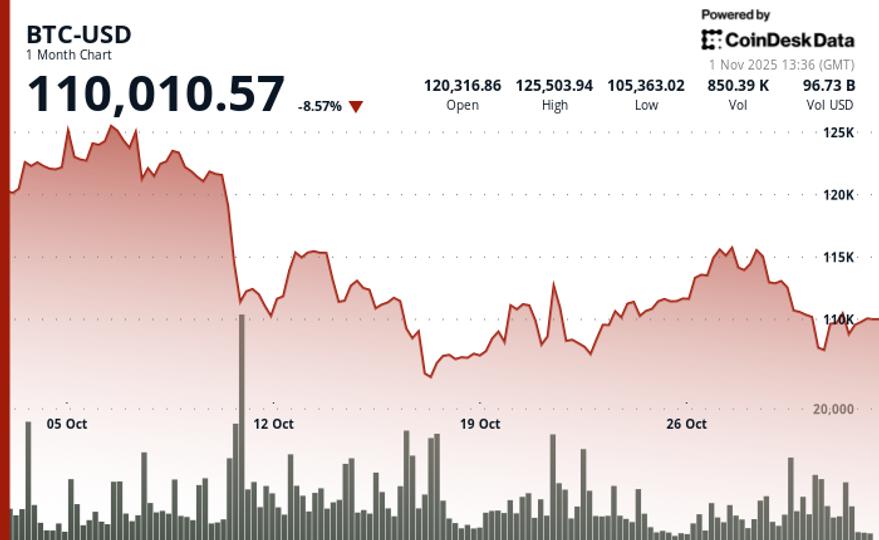
Bitcoin price has recovered to above $109,000 after a volatile October marked by a failed “Uptober” rally, Fed-driven risk aversion, and U.S.–China trade tensions.
Bitcoin price has rebounded slightly to $109,600 after yesterday’s dip to $106,000, ending what has been a tumultuous October for bitcoin.
Traders are now cautiously optimistic as the market transitions from the failed “Uptober” rally to the historically stronger month of November.
Yesterday, Bitcoin tumbled over 3% amid renewed risk-off sentiment sparked by Federal Reserve Chair Jerome Powell’s hawkish comments on future rate cuts and renewed U.S.–China trade tensions. 
The dip extended a week-long decline that began after the Fed delivered a modest 25 basis point cut but signaled uncertainty for December’s meeting.
Bitcoin entered October with high hopes for “Uptober,” a seasonal trend historically associated with double-digit gains. 
Early in the month, Bitcoin briefly touched $125,000, only to give back much of those gains amid macroeconomic jitters and slow institutional activity. On October 10, the bitcoin price dropped sharply to the $108,000 range from $117,000 as the U.S.-China trade tensions and new tariffs triggered a market-wide sell-off. 
At its lowest, Bitcoin fell about 10% on that day and other cryptocurrencies dropped 20–40%, though it later rebounded to around $113,000 amid high volatility.
Strategy (MSTR), one of the largest Bitcoin accumulators, bought just 778 BTC in October — down 78% from September — bringing its total holdings to over 640,000 BTC.
JUST IN: #Bitcoin is about to enter into it's highest performing month on average 👀

Bullish on November 🚀 pic.twitter.com/GTDUSGIhQd
Altcoins mirrored Bitcoin’s struggle this month. At times, Ethereum fell below $3,790, while Solana dipped under $187. Despite the weakness, Bitcoin dominance remains steady at roughly 57%, suggesting the market is consolidating rather than capitulating.
Looking ahead, traders are turning their attention to next month, November — sometimes nicknamed “Moonvember” — which historically follows strong October performances. 
Despite macroeconomic pressures, some analysts see potential for Bitcoin to retest all-time highs going into 2026, assuming stable Fed guidance, renewed inflows, and no new shocks.
That being said, bitcoin has traded in an unusually tight range between $106,000 and $123,000 for over four months, pushing volatility to record lows, a pattern that historically precedes major trending moves. 
If past fractals repeat, Bitcoin could see significant gains toward $170,000–$180,000 by and through  2026, though sideways trading may persist until macro catalysts like Fed rate cuts or capital rotation spur renewed volatility.
Established in 2012, Bitcoin Magazine is the oldest and most established source of trustworthy news, information and thought leadership on Bitcoin.
© BTC Media, LLC 2025

source

Posted on Leave a comment

Housing lottery launches for older adults at Grace’s Place Senior Apartments in Far Rockaway, with 56 units available – qns.com

Sign up for our weekly email newsletter to stay updated on the latest housing lotteries in New York City.
New York City has launched an affordable housing lottery for 56 units for older adults at least 62 years of age at Grace’s Place Senior Apartments, located at 13-04 Nameoke Ave. in Far Rockaway.
The 10-story residential building has 57 total units, with one at market rate. The 56 units set aside for the housing lottery are intended for those earning 50% of the area median income and with an asset limit of $81,000.
All 56 units in the housing lottery are studios. No more than two people can live in each unit, with at least one resident required to be at least 62 years old. The monthly rent for these units is equal to 30% of the eligible tenant’s monthly income. The required annual household income must total no more than $64,800.
Each unit is equipped with energy-efficient appliances, air conditioning, intercommunication devices and online options for leasing, paying rent and making maintenance requests. Tenants will be responsible for electricity, including the electric stove.
Other amenities found at the property include a shared laundry room, a recreation room, a rooftop terrace, security cameras, a security guard, an on-site resident manager, an elevator and an accessible entrance. The laundry room, which is card-operated, is subject to fees. Smoking is prohibited at Grace’s Place Senior Apartments.
The property is within close proximity to the Far Rockaway Long Island Rail Road station and the Far Rockaway-Mott Avenue subway station, which provides service for the A train, as well as bus stops for the N31, N32, Q113 and Q114 lines.
Grace’s Place Senior Apartments was designed by SLCE Architects and developed by Brooklyn Community Housing and Services, Alembic Community Development and the Love Fellowship Tabernacle.
Those who intend to apply for housing at Grace’s Place Senior Apartments must meet the housing and income size requirements. Applications must be postmarked or submitted online by Dec. 30. Qualified applicants must also meet additional selection criteria.
Anyone interested in applying for this housing lottery can do so online by clicking here. Applications can also be requested via mail by sending a self-addressed envelope to 401 Franklin Ave., Suite 314, Garden City, NY 11530.
I was born and raised on Long Island and reside in Bayside. Graduated Cum Laude from Hofstra University. Big Mets, Jets and Islanders fan.
Post an Event
View All Events…

source

Posted on Leave a comment

A Comparison of Perfectionism and Time of Sport Specialization of Division-1 Athletes – The Sport Journal

Authors: Jason N. Hughes1, Colby B. Jubenville2, Mitchell T. Woltring3, and Helen J. Gray 
1Department of Business, Accounting and Sport Management, Elizabeth City State University, Elizabeth City, NC, USA 
2Department of Health and Human Performance, Middle Tennessee State University, Murfreesboro, TN, USA 
3Department of Health, Kinesiology, and Sport, University of South Alabama, Mobile, AL, USA 
4Associate Dean of Academic Affairs, North Carolina Agricultural and Technical State University, Greensboro, NC, USA 
Corresponding Author: 
Jason Hughes, Ph.D., M.S.,  
1704 Weeksville Rd.  
Elizabeth City, NC 27909 
[email protected] 
252-335-3488 
Jason N. Hughes, Ph.D., is an Assistant Professor of Sport Management at Elizabeth City State University in Elizabeth City, NC. His research interests include sport specialization, perfectionism, and athletic burnout. 
Colby B. Jubenville, PhD., is a Professor of Sport Management at Middle Tennessee State University. His research interests include student success, leadership, and emotional intelligence in business. 
Mitchell T. Woltring, Ph.D., is an Associate Professor at the University of South Alabama. His research interests include student-athlete success and service learning. 
Helen J. Gray, Ph.D., is the Associate Dean of Academic Affairs at North Carolina Agricultural and Technical State University. Her research interests include sport management, youth sport, and pedagogy in sport, leisure, and tourism.
ABSTRACT 
Sport specialization has become increasingly popular among athletes aiming to gain a competitive edge. Despite its prevalence, there is a notable lack of research exploring the psychological impacts of sport specialization. One area that remains insufficiently studied in relation to sport specialization is perfectionism—a psychological trait known to influence both positive and negative outcomes in sports. The primary purpose of this study was to examine the previously unexplored relationship between the time in which an athlete specializes in sport with perfectionism concerns and strivings. A series of one-way ANOVAs were conducted to investigate the relationship between time of sport specialization based on the Developmental Model of Sport Participation and perfectionistic strivings and concerns.  The results of the analyses showed that there was not a relationship between sport diversification and perfectionism. However, participants did score high on perfectionistic concerns despite adhering to proper diversification, participants showed higher scores in perfectionistic concerns than strivings. This suggests that athletes, parents, and coaches need to be aware that sport diversification may not be a buffer against negative psychological consequences. The results suggest that sport specialization’s psychological repercussions are confined to whether the athlete is concurrently engaged in sport specialization 
Key Words: perfectionistic concerns, perfectionistic strivings, athletes, sport diversification, athletic development 
INTRODUCTION 
Early sport specialization among young athletes has surged, drawing increased scholarly attention. Research suggests that youth athletes are engaging in sport specialization at rates from 17% to as high as 41% (4, 30). In response, researchers have emphasized the need to examine both motives and the consequences of. Sport specialization refers to rigorous, year-round training focused on a single sport to the exclusion of others (21).  Motivations for why athletes choose to specialize include improving specific skills, securing financial reward, and aiming for professional success (37). Ironically, researchers argue that this approach might hinder rather than help these goals. The consensus among experts is that well-rounded athletic development is better achieved through sport diversification, which involves engaging in multiple sports (37).  
Advocates of sport specialization assert it plays a vital role in developing elite-level skills through deliberate practice. They argue that athletes who concentrate on one sport can attain greater proficiency than those who play multiple sports (37). Supporting this claim, one study found that both current and former elite soccer players dedicated more time to deliberate, soccer-specific training than non-elite athletes who were sport-diversified (14). This study suggested that deliberate practice during sport specialization significantly contributed to elite athlete status (14). Moreover, research on elite soccer players suggests that specialization enhances motivation, dedication, and enjoyment, leading to increased focus and commitment to improvement (36). 
Critics of early sport specialization challenge its effectiveness, arguing that intense skill development at a young age may yield ambiguous results. A study on Russian swimmers found no performance advantage for early specializers compared to those who specialized later; in fact, those who specialized later showed greater progress (2). This suggests that early specialization may not be universally beneficial. Instead, it might be more appropriate in certain sports such as women’s gymnastics, diving, women’s basketball, figure skating, and dance, where early peak performance occurs before full body maturation (22). Furthermore, a 2023 meta-analysis found that world-class athletes engaged in multi-sport diversification, started their main sport later, and accumulated less main sport deliberate practice (19). 
The pursuit of athletic scholarships and professional contracts remains a major motivator for sport specialization among young athletes. (24). Yet, the actual probability of attaining such rewards is notably low. Studies show that only 2% of high school athletes received a college scholarship, with an even lower percentage (1.2 % for females and 1.1% for males) obtaining full scholarships. The prospect of reaching professional levels is even less likely. The NCAA reports that only 0.9% – 5.1% of collegiate athletes make the professional ranks, depending on the sport. In high-profile sports like college football and basketball, only 1.34% of athletes advance to play professionally (29). Despite these sobering statistics, many athletes continue to specialize with the hope of achieving collegiate and professional success. 
Another key criticism of sport specialization revolves around the potential harmful and unintended consequences, particularly of physical and psychological health. The most cited concern of sport specialization is the prevalence of injuries. Sport specialization may expose athletes to increased risk of overuse injuries due to the frequency of repetitive motions, higher training volumes, and voluminous competitions (26, 31, 22, 12, 11). While physical injuries are often the focus, there is limited comprehensive epidemiological data on the emotional and psychological impacts of sport specialization (32). Previous research suggests that specialization can contribute to an increase in social isolation, overdependence, athletic burnout, reduced enjoyment, heightened dropout rates, and a decline in motivation (25, 27, 33, 28). 
A compelling psychological construct within the context of sport specialization is perfectionism. Perfectionism is defined as having “a commitment to exceedingly high standards combined with a tendency to critically appraise performance accomplishments” (15, 20). It is conceived as a multidimensional personality disposition construct capturing an individual’s pursuit of flawlessness in achievement and their concerns about failing to meet these high standards (13). Contemporary researchers posit that perfectionism overlaps a wide domain of ranges that fall in line with two higher-order dimensions: perfectionistic concerns and perfectionistic strivings (33). Perfectionistic concerns reflect the extent to which individuals are concerned about failing to achieve the standards that are placed on them by themselves or others, leading them to engage in harsh self-evaluation, which can negatively affect athletic performance (25). Moreover, perfectionistic concerns were positively correlated with burnout, rumination, fear of failure, amotivation, and performance-avoidance (21). The higher order of perfectionistic strivings is linked with self-oriented striving, where one places high goals on oneself intrinsically, and the setting of very high personal performance standards (18).   
Overall, research suggests that athletes who engaged in diversification were more likely to achieve sporting success. One survey of 376 Division-1 intercollegiate athletes revealed that, apart from the sport of swimming, 83% of college athletes reported participating in various sports, and many had different initial sporting experiences from their current sport (26). Diversification offers opportunities to cultivate a more versatile skill set essential for athletic success. Among elite athletes, those who participated in multiple sports during their formative years (ages 0-12) required less specialized training to acquire high-level skills in their chosen sport (1). Experts opine that early diversification, followed by specialization in later adolescence, leads to increased enjoyment, fewer injuries, and prolonged participation (2, 16, 35), which ultimately contributes to overall sport success (2). 
A framework for understanding sport involvement can be found in the Developmental Model of Sport Participation (DMSP). The DMSP is a framework that outlines pathways for youth sport involvement, emphasizing how participation can lead to different outcomes such as lifelong engagement, elite performance, or dropout. It integrates developmental, psychological, and social factors to guide sport programming and coaching practices. By outlining various pathways of sport participation, the DMSP provides insights into how individuals’ involvement in sports can potentially unfold over time. Young athletes enter the model in one of two ways: the sampling pathway or the early specialization pathway. In the early sport specialization pathway, athletes starting from age six to adulthood specialize in one sport characterized by a high deliberate amount of practice, a low deliberate amount of play, and focus on one sport. The other pathway, the sampling pathway, involves a high amount of deliberate play, a low amount of deliberate practice, and involvement in multiple sports in the initial stage (7). 
According to the DMSP, athletes who enter the sampling pathway, there are four main stages of development that align with specific ages and developmental needs. In the first stage, called the “sampling years”, there is an emphasis on deliberate play and sport diversification by participating in the sampling of multiple sports. The goal of the sampling years is that during this stage, youth athletes can either participate in sport sampling, meaning they play multiple sports, or they intensively participate in only one sport. This occurs approximately at the ages of six to twelve years old.  Proceeding this stage, at approximately age thirteen, serious athletes transition into the “specializing years”. The second stage of progression is called the “specializing years”, which happens around adolescence, during the ages of thirteen to fifteen years old, when youth athletes begin to focus on a smaller number of sports. While fun and enjoyment are still crucial features of their participation, sport-specific specialization starts in this phase, characterized by deliberate play, balanced practice, and a reduction in the involvement of other sports. During this stage, youth athletes can take three routes: continue participating in sport as a recreational activity, they can progress to the investment stage or opt to discontinue altogether (7). The final stage, known as the” investment phase”, occurs at 16+ years of age.  This stage is characterized by a high amount of deliberate practice, a low amount of deliberate play, and an increased focus on one sport (7). During this stage, the athlete becomes committed to high-performance goals in a specific sport where strategic, competitive, and skill development are the primary focus (22).  
To date, there has been insufficient research that has investigated the effects that specializing in sport might have on perfectionism. Thus, this study sought to investigate if there was a difference between athletes who specialized early or later in their athletic careers using the DMSP as a framework to construct our study (7, 8, 9). For this study, two research questions are being assessed. Research question I hypothesized that there is a significant difference between the time in which an athlete specialized in a sport during the sampling years (ages 6-11), specializing years (ages 12-14), investment years (ages 15-17), or post-investment years (ages 18+) with perfectionistic concerns. Research question II hypothesized that there is a significant difference between the time in which an athlete specialized in a sport during the sampling years, specializing years, investment years, and post-investment years. A series of one-way ANOVAs were conducted, one for each research question.  
METHODS 
Participants 
A total of 416 student-athletes (156 males, 260 females) from Division-1 colleges and universities participated in this study. Participants ranged in age of 18-25 years (M = 20.24, SD = 1.36), and competed in 15 overall sports. Participants were recruited following approval from the primary researcher’s institutional review board. Recruitment was conducted through an online survey administered via SurveyMonkey.com. Inclusion criteria stipulated that respondents must concurrently compete or be a member of an intercollegiate athletics team at a Division-1 NCAA institution.  Participants were recruited from various Division-1 NCAA schools representing all the Power Five and Group of Five conferences. Data collection from participants took place over a period of years beginning in 2018 and ending in 2024. 
Measures 
Participants completed a demographic questionnaire, a self-perceived sport specialization questionnaire, a questionnaire of subscales of perfectionistic concerns and strivings, and a questionnaire asking when athletes specialized in sports.  
Perfectionism 
Multiple measures were employed to assess the higher-order constructs of perfectionistic striving and perfectionistic concerns, following recommendations from previous studies (33, 34). The foundation for this study was provided by Hewitt and Flett’s Multidimensional Perfectionism Scale (H-MPS) (20) and Gotwals and Dunn’s Sport Multidimensional Perfectionism Scale (Sport-MPS-2) (17). Components from both inventories were amalgamated to form a 7-point Likert scale. The combined measures exhibited strong reliability (α = .892), consistent with previous findings (20, 17). 
Perfectionistic Concerns. To assess perfectionistic concerns accurately, three subscales were employed in the study. Two subscales from the Sport Multidimensional Perfectionism Scale-2 (Sport-MPS-2) (17) were utilized. The first subscale, titled “concerns over mistakes,” comprised eight items and assessed participants’ reactions to failure in competition, such as feeling like a failure as a person. The second subscale, “doubts about actions,” consisted of six items aimed at capturing participants’ uncertainties about the adequacy of their pre-competition practices. Additionally, a segment of Hewitt and Flett’s Multidimensional Perfectionism Scale (H-MPS) (20) was integrated to gauge fear of negative social evaluations. This segment, extracted from the “socially prescribed” perfectionism subscale, encompassed 15 items probing participants’ perceptions of others’ expectations of perfectionism from them, such as “People expect nothing less than perfectionism from me.” 
Perfectionistic Strivings: Perfectionistic strivings encompass self-oriented striving and the establishment of high personal performance standards. To assess this higher-order construct, two subscales were employed from both the Sport Multidimensional Perfectionism Scale (Sport-MPS-2) (17) and the Hewitt & Flett Multidimensional Perfectionism Scale (H-MPS) (20). To measure self-oriented perfectionism, the five-item self-oriented perfectionism subscale from the H-MPS was utilized. This subscale includes items such as “One of my goals is to be perfect in everything I do.” For the assessment of high personal performance standards, the seven-item personal standards subscale from the Sport-MPS-2 was employed. Example items from this subscale include “I hate being less than the best at things in my sport.” (17). Evidence supporting the internal consistency of these subscales has been provided, with reliability coefficients (α) exceeding .74 for both the H-MPS and the Sport-MPS-2 (10, 17) 
Sport Specialization 
In line with established methodologies (4, 22), a self-perceived questionnaire was utilized for this study. The questionnaire consisted of a three-point scale classification method, whereby respondents classified themselves as high, moderate, or low in terms of sport specialization. The questionnaire’s questions included: “Have you quit other sports to focus on one sport?”, “Do you train more than eight months out of the year in one sport?”, and “Do you consider your primary sport more important than others?” Respondents indicated their responses to these questions using a categorical classification system, where “yes” responses were assigned a value of 1 and “no” responses were assigned a value of 0. Based on the cumulative score from these questions, individuals were classified into different levels of specialization: a score of 3 denoted high specialization, a score of 2 indicated moderate specialization, and a score of 0 or 1 signified low specialization. 
Time of Sport Specialization 
To align with the Developmental Model of Sport Specialization, participants were asked three questions aimed at determining when they specialized in their current sport. Specifically, athletes were asked if they engaged in any other sport besides their current primary sport during their sampling years (ages 6-11), specializing years (ages 12-15), investment years (ages 15-17), and post-investment years (ages 18+). 
Data Analysis 
All data were assessed with IBM SPSS Statistics. A series of one-way ANOVAs were employed for this study.  
RESULTS 
Results for Perfectionistic Concerns 
For research question I, the research sought to investigate the hypothesis that there is a significant difference between the time in which an athlete specializes in a sport during elementary/primary school, middle school, high school, or college with perfectionistic concerns. Descriptive results from the participants for perfectionistic concerns and time of sport specialization can be found in Table 1. 
 
A one-way between-subjects ANOVA was conducted to compare the effect of when an athlete specializes in sport on perfectionistic concerns in elementary/primary school, middle school, high school, or college as conditions. There was not a significant effect on perfectionistic concerns for the four specialization time frames [F (3, 413) = .996], p > .05. Therefore, concerning the first research question, it was determined that the timing of specialization in sport did not exhibit any association with perfectionistic concerns among the participants. Regardless of whether athletes specialized during their sampling years, specializing years, investment years, or post-investment years, there was no discernible correlation with perfectionistic concerns, despite the athletes exhibiting high scores on this measure. 
 
Results for Perfectionistic Strivings 
For research question II, the research sought to investigate the hypothesis that there is a significant difference between the time in which an athlete specializes in a sport during sampling years, specializing years, investment years, and post-investment years with perfectionistic strivings. Descriptive results from the participants for perfectionistic strivings and the time of sport specialization can be found in Table 3. 
A one-way between-subjects ANOVA was conducted to compare the effect of when an athlete specializes in sport on perfectionistic strivings in the sampling years, specializing years, investment years, post-investment years. There was not a significant effect on perfectionistic strivings for the four specialization time frames [F (3, 413) = .805], p > .05. As it pertains to research question II, it was found that the time in which the participants specialized in sport was not a significant predictor of perfectionistic strivings. The analysis revealed that regardless of whether participants specialized in their primary sport during sampling years, specializing years, investment years, and post-investment years, there was no observable association with perfectionistic strivings. 
DISCUSSION 
The primary aim of these analyses was to investigate the relationship between the timing of sport specialization and perfectionism. Contrary to our hypotheses, the results indicated that regardless of the stage of sport specialization, there was no significant association observed with either perfectionistic concerns or perfectionistic strivings. Although this was not the primary focus, participants in the study displayed elevated scores on perfectionistic concerns overall. 
One potential explanation for the lack of differentiation between groups, despite athletes scoring high on perfectionistic concerns, could be attributed to the similarity in experiences among athletes. It is hypothesized that athletes may have had comparable sporting experiences, particularly since a significant portion of participants specialized during college (N = 235, ≈ 56%). This similarity in experiences might have led to the development of perfectionistic concerns in a uniform manner across the sample. 
Another potential reason for the absence of variation is due to the smaller number of participants who experienced early specialization in sampling and specialization years (N= 85, ≈ 20%) as compared to the high number of athletes who specialized later in investment and post-investment stages (N= 331, ≈ 80%). Our sample, however, parallels previous studies about when athletes tend to specialize, suggesting that sport diversification might not be a buffer or contributor to psychological constructs, either negative or positive ones. For example, a study found that athletes who engaged in sport diversification had no discernible difference in the measurement of mental toughness (5). It might be that psychological constructs develop over time and have a myriad of factors that contribute to their development, and that sport specialization and diversification play a small role, if any. 
The athletes in our study exhibited elevated levels of perfectionistic concerns but not perfectionistic strivings. According to the Development Model of Sport Participation, the ages of 13-15, yet even athletes who engaged in sport diversification prior to this stage still reported elevated perfectionistic concerns. These findings may contradict arguments that support sport diversification as a safeguard against negative psychological outcomes. However, it is important to consider that the participants in our study were current Division-1 NCAA athletes who were actively specializing in sport and no longer engaged in diversification. This suggests that concurrent sport specialization is more important than the stage of specialization. 
Given these findings, further longitudinal research on sport specialization and the timing of specialization is warranted. Understanding how specialization impacts athletes’ psychological well-being over time, particularly in comparison to those who engage in sport diversification, could provide valuable insights into the potential risks and benefits associated with different approaches to sport participation.  
These findings collectively suggest that the timing of sport specialization may not be a critical factor in determining psychological outcomes such as mental toughness or perfectionism among athletes. Instead, other variables such as individual personality traits, coaching styles, and environmental influences may play a more substantial role in shaping these psychological characteristics. 
Since our sample was limited to Division-1 college athletes and contained few individuals who specialized early, future research should examine athletes in sports where early specialization is the norm, such as gymnastics and figure skating, to explore differences between early and later specializers. Additionally, our findings imply that sport diversification may not act as a preventive measure against future psychological issues. Any psychological effects of sport specialization appear more closely tied to the current intensity and environment of specialization than to the specific age at which specialization began. 
LIMITATIONS 
While the present study contributes to the overall knowledge regarding athletes’ perceptions regarding sport specialization and perfectionism, this study is not without limitations. The sample included only Division-1 NCAA college athletes, a population considered “elite” due to their high level of athletic achievement. This homogeneity may have limited the variability of responses and reduced generalizability to broader athletic populations, such as youth, high school, or recreational athletes. Given their success, these athletes may also be more resilient to the negative effects of sport specialization and perfectionism, which may not be the case in less experienced or less accomplished athlete groups. 
Secondly, the classification of athletes into low, medium, or high levels of specialization relied on the widely used Jayanthi scale, which includes only three items. While this scale is prominent in the literature, its brevity may limit the depth and accuracy with which an athlete’s specialization history is captured. It may overlook key dimensions such as training intensity, emotional investment, or motivational drivers behind specialization, potentially leading to overly simplistic classifications. 
Third, the study utilized a cross-sectional and retrospective design based on self-report surveys. Participants were asked to recall past experiences and report on them at a single point in time, introducing potential recall bias and limiting the ability to draw causal inferences. A longitudinal design, tracking athletes’ specialization and perfectionism over time, would likely yield more robust and temporally sensitive data. 
Finally, purposive-homogeneous sampling was used, selecting participants from a distinct and specific subpopulation. While this method allows for targeted recruitment and can yield insights from a well-defined group, it may introduce researcher selection bias and limit generalizability. That said, this study was not designed to generalize to the broader population but rather to provide insight into a specific group of athletes who have achieved a high level of competitive success. 
CONCLUSION 
While the results of the study were contrary to our research hypothesis, the results of this study are not without merit. Findings from the current study add to the literature but also provide areas to be further studied. Athletes are continuing to specialize in sport at an increasing rate, despite current research showing that sport specialization is a non-adaptive behavior that yields very little benefit while carrying many potential negative consequences. Sport management professionals, coaches, parents, and athletes should be fully aware of the consequences of sport specialization, both physically and psychologically, before having athletes become specialized. The results of the present study indicate that even if an athlete follows the Development Model of Sport Participation by practicing proper sport diversification by the recommended age, it might not be enough to blunt the effects of maladaptive perfectionism, even if they reach the highest levels of competition, such as Division-1 athletics. Our results suggested that there was no difference between the athletes who specialized early or later in their athletic career.   
APPLICATIONS IN SPORT AND FUTURE RESEARCH 
Sport specialization continues to provoke debate among scholars, coaches, and parents, particularly regarding its efficacy and developmental impact. Similarly, perfectionism remains a focal point in sport psychology research, with ongoing research surrounding its adaptive and maladaptive dimensions. The current study aimed to add to the current body of knowledge for the sport community regarding both perfectionism and sport specialization.  
The Development Model of Sport Participation Model serves as a guiding framework for  
for coaches, athletes, and researchers to examine the implications of sport specialization and diversification. This study aimed to enhance understanding of how DMSP related to perfectionism in sport. The results of the analysis indicated that there was not a significant relationship between when an athlete specializes in sport, whether in their sampling, specialization, investment or post-investment years with perfectionistic strivings and perfectionistic concerns. While the null hypothesis was accepted, the finding still offer valuable insight for scholars, coaches and parents. Notably, even among elite Division-1 athletes are prone to maladaptive perfectionism, despite engaging in sport diversification properly. The lack of differentiation based on specializing timing raises concerns, given perfectionism association with negative psychological outcomes. Although these athletes achieved the highest levels of success, suggesting resilience, it remains uncertain whether similar patterns, or more severe psychological consequences, would manifest in less accomplished or younger athletes lacking the same resilience or comparable coping mechanisms. The need to further investigate this issue is clear. 
The physical consequences of sport specialization remain well documented, but its psychological ramifications warrant more research. Our findings support earlier research that the timing of sport specialization may be less impactful than concurrent sport specialization. Coaches and parents may benefit from using this information to better support athletes’ mental health, particularly while engaging in sport diversification. Despite an overwhelming percentage of participants adhering to DMSP principles, nearly all were engaged in specialization at the time of data collection and still reported elevated perfectionistic concerns. In a similar study also involving college athletes, there was no discernible difference found in mental toughness between early sport specializers and those who diversified (5). Similarly, our current study indicates that the stage of sport specialization, whether early or late in an athlete’s career, does not predict perfectionism tendencies. 
Athletes are continuing to specialize in sport at an increasing rate, despite current research showing that sport specialization is a non-adaptive behavior that yields very little benefit while carrying many potential negative consequences. Furthermore, one can surmise that Name, Image, and Likeness in college athletics, with increased financial incentives and opportunities, may exacerbate the rate of sport specialization in the future, since athletes no longer need to reach the professional levels to reap financial reward.  Sport management professionals, coaches, parents, and athletes should be fully aware of the consequences of sport specialization, both physically and psychologically, before having athletes become specialized.  
The study sets a foundation for future research on sport specialization, albeit with limitations. Participants retrospectively reflected on past experiences, and the study’s cross-sectional design may have drawbacks. A longitudinal approach, tracking athletes during active participation, could yield more precise insights. Additionally, the exclusive focus on Division-1 NCAA athletes may limit generalizability; exploring athletes across various levels and ages is imperative. Furthermore, investigating specialization dynamics in different sports, particularly those requiring early specialization like gymnastics, versus those promoting diversification, is crucial. Moreover, exploring how team sports compare to individual sports regarding specialization and perfectionism would add depth to understanding these phenomena. This study sought to explore an emerging area of research in sport specialization. Overall, this study provides a basis for further research as well as provides future suggestions by offering additional opportunities to further investigate the effects of sport specialization on perfectionism. 
REFERENCES 

source

Posted on Leave a comment

Tips for a scary-good Halloween with your pet – kcemployees.com

<span class="post-date-entry"><i class="fa fa-clock-o"></i> Posted on October 31, 2025</span> <span class="post-author-entry">by <a href="https://kcemployees.com/author/liliacd/" rel="author">Lilia Cabello Drain</a></span><br><a href="https://tailsfromraskc.com/2025/10/28/tips-for-a-scary-good-halloween-with-your-pet/"><em>Crossposted from Tails from RASKC</em></a><br>Halloween is “spook-tacular” for kids of all ages, but the holiday can be pretty scary for our pets. Regional Animal Services of King County would like to remind pet owners of a few safety tips before the ghosts and goblins come begging on Oct. 31.<br><a href="https://tailsfromraskc.com/2025/10/28/tips-for-a-scary-good-halloween-with-your-pet/"><strong>Read more.</strong></a><br><i class="fa fa-reorder"></i> &nbsp;Category: <a href="https://kcemployees.com/category/community/" rel="category tag">Community</a>, <a href="https://kcemployees.com/category/news/" rel="category tag">News</a><br>Enter your email to subscribe to King County Employee News and get notifications of new posts by email.<br>                    <label                      id="subscribe-field-label"                      for="subscribe-field"                       class="screen-reader-text"                  >                       Email Address:                  </label>                    <input                          type="email"                            name="email"                            autocomplete="email"                                                        style="width: 95%; padding: 1px 10px"                           placeholder="Email Address"                             value=""                            id="subscribe-field"                            required    />              <br>                    <input type="hidden" name="action" value="subscribe"/>                  <input type="hidden" name="blog_id" value="6857688"/>                   <input type="hidden" name="source" value="https://kcemployees.com/2025/10/31/tips-for-a-scary-good-halloween-with-your-pet/"/>                     <input type="hidden" name="sub-type" value="widget"/>                   <input type="hidden" name="redirect_fragment" value="subscribe-blog"/>                  <input type="hidden" id="_wpnonce" name="_wpnonce" value="931c779b1d" />                    <button type="submit"                                                   class="wp-block-button__link"                                                                   >                       Follow Blog                 </button>               <br><a href="http://www.twitter.com/kcemployees">@KCEmployees</a><a href="https://twitter.com/kcemployees"><img loading="lazy" class="alignleft wp-image-13064" src="https://kingcountynews.files.wordpress.com/2019/02/twitterlogo.png?w=150" alt="" width="20" height="16" /></a><br><a href="https://www.linkedin.com/company/king-county/"><img loading="lazy" class="alignleft wp-image-4568" src="https://kingcountynews.files.wordpress.com/2019/02/linkedinlogo.png?w=150" alt="" width="20" height="20" /></a><a href="https://www.linkedin.com/company/king-county">King County, WA</a><br><a href="https://www.facebook.com/KingCountyWA/"><img loading="lazy" class="alignleft wp-image-11904" src="https://kingcountynews.files.wordpress.com/2018/11/facebook-logo.png?w=150" alt="" width="20" height="20" /></a><a href="https://www.facebook.com/KingCountyWA/" target="_blank" rel="noopener">King County, WA</a><br><a href="https://kcemployees.com/youtube-logo-red/" rel="attachment wp-att-15337"><img loading="lazy" class="alignleft wp-image-15337 size-thumbnail" src="https://kingcountynews.files.wordpress.com/2019/02/youtube-logo-red.png?w=150" alt="" width="20" height="20" srcset="https://kingcountynews.files.wordpress.com/2019/02/youtube-logo-red.png?w=20 20w, https://kingcountynews.files.wordpress.com/2019/02/youtube-logo-red.png?w=40 40w" sizes="(max-width: 20px) 100vw, 20px" /></a><a href="https://www.youtube.com/KingCountyEmployees">King County Employees</a><br><a href="mailto:kcemployees@kingcounty.gov"><img loading="lazy" class="alignleft wp-image-14145" src="https://kingcountynews.files.wordpress.com/2018/10/email-icon.png?w=150" alt="" width="20" height="14" srcset="https://kingcountynews.files.wordpress.com/2018/10/email-icon.png?w=20 20w, https://kingcountynews.files.wordpress.com/2018/10/email-icon.png?w=40 40w" sizes="(max-width: 20px) 100vw, 20px" /></a><a href="mailto:kcemployees@kingcounty.gov">KCEmployees@kingcounty.gov</a><br><a href="http://www.kingcounty.gov/"><img loading="lazy" class="alignleft wp-image-14146" src="https://kingcountynews.files.wordpress.com/2018/10/website-icon.png?w=150" alt="" width="20" height="20" srcset="https://kingcountynews.files.wordpress.com/2018/10/website-icon.png?w=20 20w, https://kingcountynews.files.wordpress.com/2018/10/website-icon.png?w=40 40w" sizes="(max-width: 20px) 100vw, 20px" /></a><a class="customize-unpreviewable" href="http://www.kingcounty.gov/employees">www.kingcounty.gov/employees</a><br>Follow us on LinkedIn to stay up to date with all King County professional news.<br><a href="https://www.linkedin.com/company/king-county" rel="attachment wp-att-15336"><img loading="lazy" class="size-medium wp-image-15336 aligncenter" src="https://kcemployees.com/wp-content/uploads/2019/02/linkedinlogo.png?w=300" alt="" width="300" height="300" srcset="https://kcemployees.com/wp-content/uploads/2019/02/linkedinlogo.png?w=300 300w, https://kcemployees.com/wp-content/uploads/2019/02/linkedinlogo.png?w=600 600w, https://kcemployees.com/wp-content/uploads/2019/02/linkedinlogo.png?w=150 150w" sizes="(max-width: 300px) 100vw, 300px" /></a><br>We tell stories that highlight the work we do to support our residents, builds strong communities, and make our region a great place to live and work. Our 17,000+ employees work every day to make King County<br /> a welcoming community where every person can thrive. <span id="more-13775"></span>Read more about our amazing employees and their stories, and learn what it means to be a King County employee.<br>Employee News<br><a href="https://wordpress.com/?ref=footer_custom_svg" title="Create a website or blog at WordPress.com" rel="nofollow"><svg style="fill: currentColor; position: relative; top: 1px;" width="14px" height="15px" viewbox="0 0 14 15" version="1.1" xmlns="http://www.w3.org/2000/svg" xmlns:xlink="http://www.w3.org/1999/xlink" aria-labelledby="title" role="img">                <desc id="title">Create a website or blog at WordPress.com</desc>               <path d="M12.5225848,4.97949746 C13.0138466,5.87586309 13.2934037,6.90452431 13.2934037,7.99874074 C13.2934037,10.3205803 12.0351007,12.3476807 10.1640538,13.4385638 L12.0862862,7.88081544 C12.4453251,6.98296834 12.5648813,6.26504621 12.5648813,5.62667922 C12.5648813,5.39497674 12.549622,5.17994084 12.5225848,4.97949746 L12.5225848,4.97949746 Z M7.86730089,5.04801561 C8.24619178,5.02808979 8.58760099,4.98823815 8.58760099,4.98823815 C8.9267139,4.94809022 8.88671369,4.44972248 8.54745263,4.46957423 C8.54745263,4.46957423 7.52803983,4.54957381 6.86996227,4.54957381 C6.25158863,4.54957381 5.21247202,4.46957423 5.21247202,4.46957423 C4.87306282,4.44972248 4.83328483,4.96816418 5.17254589,4.98823815 C5.17254589,4.98823815 5.49358462,5.02808979 5.83269753,5.04801561 L6.81314716,7.73459399 L5.43565839,11.8651647 L3.14394256,5.04801561 C3.52312975,5.02808979 3.86416859,4.98823815 3.86416859,4.98823815 C4.20305928,4.94809022 4.16305906,4.44972248 3.82394616,4.46957423 C3.82394616,4.46957423 2.80475558,4.54957381 2.14660395,4.54957381 C2.02852925,4.54957381 1.88934333,4.54668493 1.74156477,4.54194422 C2.86690406,2.83350881 4.80113651,1.70529256 6.99996296,1.70529256 C8.638342,1.70529256 10.1302017,2.33173369 11.2498373,3.35765419 C11.222726,3.35602457 11.1962815,3.35261718 11.1683554,3.35261718 C10.5501299,3.35261718 10.1114609,3.89113285 10.1114609,4.46957423 C10.1114609,4.98823815 10.4107217,5.42705065 10.7296864,5.94564049 C10.969021,6.36482346 11.248578,6.90326506 11.248578,7.68133501 C11.248578,8.21992476 11.0413918,8.84503256 10.7696866,9.71584277 L10.1417574,11.8132391 L7.86730089,5.04801561 Z M6.99996296,14.2927074 C6.38218192,14.2927074 5.78595654,14.2021153 5.22195356,14.0362644 L7.11048207,8.54925635 L9.04486267,13.8491542 C9.05760348,13.8802652 9.07323319,13.9089317 9.08989995,13.9358945 C8.43574834,14.1661896 7.73285573,14.2927074 6.99996296,14.2927074 L6.99996296,14.2927074 Z M0.706448182,7.99874074 C0.706448182,7.08630113 0.902152921,6.22015756 1.25141403,5.43749503 L4.25357806,13.6627848 C2.15393732,12.6427902 0.706448182,10.4898387 0.706448182,7.99874074 L0.706448182,7.99874074 Z M6.99996296,0.999 C3.14016476,0.999 0,4.13905746 0,7.99874074 C0,11.8585722 3.14016476,14.999 6.99996296,14.999 C10.8596871,14.999 14,11.8585722 14,7.99874074 C14,4.13905746 10.8596871,0.999 6.99996296,0.999 L6.99996296,0.999 Z" id="wordpress-logo-simplified-cmyk" stroke="none" fill=“currentColor” fill-rule="evenodd"></path>          </svg></a><br><br><a href="https://news.google.com/rss/articles/CBMiiAFBVV95cUxOMnU1QXI4Q0ttc3VjVTNuX3RaYVZwS0VsMUx6UVlNZXpPU1pXRHhuTkp6U29rRnI3N3pJbG4waDBtNS1LRENHdlE0MUJ4dVA0MFRaT2JZaWR1dGo5V2FBRDJfY0NhYlEzOE5mSkF6SzJlU3ZNckJkVHY5aFQ0TzFlVG0tcmwzRWxQ?oc=5">source</a>
Posted on Leave a comment

sporting vs alverca


Daily Search Trends
Recent searches https://trends.google.com/trending/rss?geo=US
sporting vs alverca
500+
https://trends.google.com/trending/rss?geo=US Fri, 31 Oct 2025 12:50:00 -0700 https://encrypted-tbn1.gstatic.com/images?q=tbn:ANd9GcQVZZIjXl7X0OY3TjOI6Zc_sG8dZfnvqWDYab7Qn9oJLM9McRYz_tHBnL0y5r0 A Bola
Liveblog Sporting vs Alverca outubro 2025

https://www.abola.pt/futebol/jogo/sporting-alverca-8047278/liveblog
https://encrypted-tbn1.gstatic.com/images?q=tbn:ANd9GcQVZZIjXl7X0OY3TjOI6Zc_sG8dZfnvqWDYab7Qn9oJLM9McRYz_tHBnL0y5r0
A Bola


Em direto/ Sporting-Alverca. Lisboetas reencontram-se em Alvalade, agora para o Campeonato

https://observador.pt/liveblogs/sporting-alverca-lisboetas-reencontram-se-em-alvalade-agora-para-o-campeonato/
https://encrypted-tbn3.gstatic.com/images?q=tbn:ANd9GcTKpvi7kK3HC8AGKFIi7OjNpAvlXVwxgbDbbSDSgsFEmIpi9nepmKuqEttvcaM
Observador


Salvador Blopa, a nova estrela do Sporting, alcança recorde com quase 100 anos

https://www.magazine-hd.com/apps/wp/nova-estrela-sporting-salvador-blopa-alcanca-recorde-golos/
https://encrypted-tbn1.gstatic.com/images?q=tbn:ANd9GcSOik9KkZOYLYtKUUvM-l8omFou7bBBnPcWw4YLnbHy2C7-ET7tK4cIAGrzbVE
Magazine.HD


avalanche vs golden knights
2000+
https://trends.google.com/trending/rss?geo=US Fri, 31 Oct 2025 12:40:00 -0700 https://encrypted-tbn1.gstatic.com/images?q=tbn:ANd9GcTJpztg9QdvMm2PsLkTmsEeX9EweMJR6vnjWPRBAwdRtmV5csN-ZhYl8LvlWeI NHL.com
NHL On Tap: Avalanche, Golden Knights set for afternoon thriller

https://www.nhl.com/news/nhl-on-tap-news-and-notes-october-31-2025
https://encrypted-tbn1.gstatic.com/images?q=tbn:ANd9GcTJpztg9QdvMm2PsLkTmsEeX9EweMJR6vnjWPRBAwdRtmV5csN-ZhYl8LvlWeI
NHL.com


Preview: Colorado takes on Vegas in a Halloween matinee matchup

https://www.milehighhockey.com/colorado-avalanche-game-coverage/59098/preview-colorado-takes-on-vegas-in-a-halloween-matinee-matchup
https://encrypted-tbn3.gstatic.com/images?q=tbn:ANd9GcSOzj2964MykfD_gcoU9qCHOSVzCVrR6wEpOy2EchkNFy2FVUDh_Jt_Fmx9rGo
Mile High Hockey


NHL picks: Avalanche vs. Golden Knights prediction, odds, best bet

https://nypost.com/2025/10/31/betting/nhl-picks-avalanche-vs-golden-knights-prediction-odds-best-bet/
https://encrypted-tbn0.gstatic.com/images?q=tbn:ANd9GcSgJpIoeCmnOQpE1bHCwpXO2GmlNLTVfA3NYSUgas494joOvD6K64Xeqdqn-Cw
New York Post


julia fox
10000+
https://trends.google.com/trending/rss?geo=US Fri, 31 Oct 2025 12:30:00 -0700 https://encrypted-tbn1.gstatic.com/images?q=tbn:ANd9GcTgYocfDFTjgDTOGUnCw7eyK0O2EzKuyN_Ef0iZVGF6xg-ZGSlNWuqCZQMfJEo People.com
Jack Schlossberg Slams Julia Fox’s Bloody Jackie Kennedy Halloween Costume as ‘Desperate’ and ‘Disgusting’

https://people.com/jack-schlossberg-slams-julia-fox-bloody-jackie-kennedy-costume-11841355
https://encrypted-tbn1.gstatic.com/images?q=tbn:ANd9GcTgYocfDFTjgDTOGUnCw7eyK0O2EzKuyN_Ef0iZVGF6xg-ZGSlNWuqCZQMfJEo
People.com


Julia Fox sparks Halloween controversy with bloody Jackie Kennedy costume

https://www.usatoday.com/story/entertainment/celebrities/2025/10/31/julia-fox-halloween-costume-jackie-kennedy/87012544007/
https://encrypted-tbn3.gstatic.com/images?q=tbn:ANd9GcSFMM-Fho7_hrHqn5uAJx8xPDhX5OnOZ3q_EX1250Ahlzu83JB_jxm5RqPrOsk
USA Today


Julia Fox Exudes Retro Charm in ‘Bloody’ Halloween Skirt Suit

https://www.yahoo.com/entertainment/celebrity/articles/julia-fox-exudes-retro-charm-190000514.html
https://encrypted-tbn3.gstatic.com/images?q=tbn:ANd9GcRi02VHVzVpUhBoy9BO49Bda-8dEqInwquQALlNlTd3YRiZqNd5k03EU0EJJvU
Yahoo


wrexham vs coventry
2000+
https://trends.google.com/trending/rss?geo=US Fri, 31 Oct 2025 12:20:00 -0700 https://encrypted-tbn1.gstatic.com/images?q=tbn:ANd9GcQEB2Zy6gd4662m5Uu_6gDm9cFvp2WVaL5behpS2t3ykhfwBMyurCuGpkvOkqQ BBC
Wrexham vs Coventry LIVE: Championship score, stats & updates

https://www.bbc.com/sport/football/live/cd7r8gypvejt
https://encrypted-tbn1.gstatic.com/images?q=tbn:ANd9GcQEB2Zy6gd4662m5Uu_6gDm9cFvp2WVaL5behpS2t3ykhfwBMyurCuGpkvOkqQ
BBC


EFL weekend guide – Can unstoppable Coventry continue run? Will Leicester bounce back?

https://www.skysports.com/football/news/11688/13410242/efl-weekend-guide-will-ipswich-bounce-back-after-poor-start-to-championship-return
https://encrypted-tbn2.gstatic.com/images?q=tbn:ANd9GcTO-GfNh5Vv7J5DJkpDNcKu2lDqiGnf_AMmLLFrlwy2rnGUKWP2kyn1KHz-tUA
Sky Sports


Sheaf to be assessed as Lee faces operation

https://ca.sports.yahoo.com/news/sheaf-assessed-lee-faces-operation-152800600.html
https://encrypted-tbn1.gstatic.com/images?q=tbn:ANd9GcQqHz6RSB-kYmp7LkvMClWPa9fHrMkQ6dqTZlI-nDmjU3prd4g0f8gDZMMoJjk
Yahoo


partizan – barça
1000+
https://trends.google.com/trending/rss?geo=US Fri, 31 Oct 2025 12:20:00 -0700 https://encrypted-tbn2.gstatic.com/images?q=tbn:ANd9GcSqEFVdtuCy6ebm64YbiD1g6EIY16ZS4iyXvVALQQzLk8LzDzBBRqYx-OxpTjg El Español
Partizan – Barça, en directo Euroliga: resultado, valoraciones y estadísticas en vivo

https://www.elespanol.com/deportes/20251031/partizan-barca-directo-euroliga-resultado-valoraciones-estadisticas-vivo/1003743995077_22.html
https://encrypted-tbn2.gstatic.com/images?q=tbn:ANd9GcSqEFVdtuCy6ebm64YbiD1g6EIY16ZS4iyXvVALQQzLk8LzDzBBRqYx-OxpTjg
El Español


Barça: horario y dónde ver por TV la jornada 8 de Euroliga

https://www.aaaj.com.ar/deportes/49094/barca-horario-y-donde-ver-por-tv-la-jornada-8-de-euroliga/
https://encrypted-tbn1.gstatic.com/images?q=tbn:ANd9GcRaFjBH4h-WSIxrnIDNdefpPxOxYwdmNfDt-EIFOfueFdQMH7JXCh0R564hyng
AAAJ


Apuestas y pronósticos Partizán vs Barça Basket

https://www.marca.com/apuestas-deportivas/predicciones/2025/10/30/apuestas-pronosticos-partizan-vs-barca-basket.html
https://encrypted-tbn3.gstatic.com/images?q=tbn:ANd9GcTeS_5Wcq3JLyLAdWpapi5KwrfxCi9zGsE9jZiwvCbbo2yIGWnOW2J_KXxqyG8
MARCA


general hospital spoilers
500+
https://trends.google.com/trending/rss?geo=US Fri, 31 Oct 2025 12:20:00 -0700 https://encrypted-tbn1.gstatic.com/images?q=tbn:ANd9GcRJNdG7ChufGR9_jJxhYCE4lyWTTp_KVyH1DrLRbHuH-QZUX83pW-eWu8XIhOQ Soap Opera News
General Hospital Spoilers November 3-7: A Familiar Face, Danger, and More

https://soapoperanews.net/general-hospital-spoilers-november-3-7-2025/
https://encrypted-tbn1.gstatic.com/images?q=tbn:ANd9GcRJNdG7ChufGR9_jJxhYCE4lyWTTp_KVyH1DrLRbHuH-QZUX83pW-eWu8XIhOQ
Soap Opera News


General Hospital Spoilers November 3: Tracy Takes Control, Drew’s Rattled, and Britt’s Busted

https://soaphub.com/general-hospital/spoilers-gh/november-3-tracy-takes-control-drews-rattled-britts-busted/
https://encrypted-tbn0.gstatic.com/images?q=tbn:ANd9GcQoPynaiWf4l5ahEm95LV6rUPEdn0D-TC3YIfMd9HGP4vxWQ8f5XLTQl_pvqCo
Soap Hub


General Hospital Early Week Spoilers Nov 3-8: Carly’s Victory, Emma’s New Adversary & Willow Struggles

https://generalhospitaltea.com/general-hospital-early-week-spoilers-nov-3-8-carlys-victory-emmas-new-adversary-willow-struggles/
https://encrypted-tbn3.gstatic.com/images?q=tbn:ANd9GcSCc7Wy1waSsQP9j3QAUjK_Eqf6EK_lbPfbSv85aLpIryyZvBPbsxJCaTMti_Q
General Hospital Tea


jfk ground stop
500+
https://trends.google.com/trending/rss?geo=US Fri, 31 Oct 2025 12:20:00 -0700 https://encrypted-tbn0.gstatic.com/images?q=tbn:ANd9GcRVX4gqCHl44WGPYnEtv6ijnHeR56ybGl8Ipzt5APAoGmuAKbw3MILjie2bkYY NBC New York
JFK ground stop ordered after flight from Puerto Rico reports engine issue

https://www.nbcnewyork.com/queens/jfk-ground-stop-flight-puerto-rico-engine/6411849/
https://encrypted-tbn0.gstatic.com/images?q=tbn:ANd9GcRVX4gqCHl44WGPYnEtv6ijnHeR56ybGl8Ipzt5APAoGmuAKbw3MILjie2bkYY
NBC New York


Ground stop ended at JFK after aircraft emergency, delays over 4 hours: FAA

https://pix11.com/news/local-news/ground-stops-at-jfk-due-to-aircraft-emergency-faa/
https://encrypted-tbn2.gstatic.com/images?q=tbn:ANd9GcRJwezy4gxSI0iMjU4RFHMzzHC1gL4Ws8V4riWmfUalt_sDp97rLTdBX4HwxCo
PIX11


JFK Airport experiences major delays following Frontier Flight 3546 emergency landing due to mechanical is

https://m.economictimes.com/news/international/us/jfk-airport-experiences-major-delays-following-frontier-flight-3546-emergency-landing-due-to-mechanical-issues-and-adverse-weather-conditions/articleshow/124969486.cms
https://encrypted-tbn3.gstatic.com/images?q=tbn:ANd9GcTlQEG6oo33BdqiOVUCYad4U_rlQ7GReGUFj1_jePR9sbXAwt7LFXtcyOVH8Fg
The Economic Times


getafe – girona
5000+
https://trends.google.com/trending/rss?geo=US Fri, 31 Oct 2025 12:10:00 -0700 https://encrypted-tbn2.gstatic.com/images?q=tbn:ANd9GcSj0wyznNOeRk4TjbpLyqtqAtbuQRchfgiDOFy-NTfZKCJjHhmLErRc8pmNU-Y MARCA
Getafe – Girona, en directo | LaLiga EA Sports, en vivo

https://www.marca.com/futbol/laliga-ea-sports/getafe-girona/2025/10/31/01_0101_20251031_1450_2893-directo.html
https://encrypted-tbn2.gstatic.com/images?q=tbn:ANd9GcSj0wyznNOeRk4TjbpLyqtqAtbuQRchfgiDOFy-NTfZKCJjHhmLErRc8pmNU-Y
MARCA


Para pasarlo de miedo

https://as.com/futbol/primera/para-pasarlo-de-miedo-f202510-n/
https://encrypted-tbn1.gstatic.com/images?q=tbn:ANd9GcRuLVoMjlVQ_axUQa80gq3pj85FPWx9kYNv9tcnYdnpW2CjQkjtycMHQoxhuyM
Diario AS


Bordalás-Míchel: estilos opuestos y necesidades diferentes

https://www.msn.com/es-es/deportes/futbol/bordal%C3%A1s-m%C3%ADchel-estilos-opuestos-y-necesidades-diferentes/ar-AA1PvqyL
https://encrypted-tbn1.gstatic.com/images?q=tbn:ANd9GcQ3Iosqs5Dpar4J-cmH8Pae3jegmZE5XZLgdVH04_AXEWJYBuCI0DCKtGKn25E
MSN


getafe vs girona
2000+
https://trends.google.com/trending/rss?geo=US Fri, 31 Oct 2025 12:10:00 -0700 https://encrypted-tbn2.gstatic.com/images?q=tbn:ANd9GcSSaJBZOpQwa57UtXuB7HnBNaSAezzjk6sm51wkm-lS8mtgJHB0xC-bW6tPYe0 Goal.com
How to watch today’s Getafe vs Girona La Liga game: Live stream, TV channel, and start time

https://www.goal.com/en-us/news/watch-getafe-vs-girona-la-liga-live-stream-tv/blt47b3607df13437bf
https://encrypted-tbn2.gstatic.com/images?q=tbn:ANd9GcSSaJBZOpQwa57UtXuB7HnBNaSAezzjk6sm51wkm-lS8mtgJHB0xC-bW6tPYe0
Goal.com


Arnau Martinez vs. Getafe CF – Player props & odds to score a goal on October 31

https://prosoccerwire.usatoday.com/story/sports/2025/10/31/arnau-martinez-soccer-player-props-10-31-2025/87001578007/
https://encrypted-tbn1.gstatic.com/images?q=tbn:ANd9GcTW3lpyR1x_6aV5VS3QBclW8m_ojcq6ozqPfL-meDsFgr5QUZwQiwupobX-iVo
Pro Soccer Wire


Getafe vs Girona: Predictions, Betting odds, Lineups, Preview

https://www.bwin.com/en/news/match-preview-getafe-girona-la-liga-gameweek-11/
https://encrypted-tbn2.gstatic.com/images?q=tbn:ANd9GcSSyTWzKjFNE-puzk5A5qP0HwO6elAi131bIXADKEaSv6yP8lGuC7T5Q6kwfn8
bwin


food stamps
5000+
https://trends.google.com/trending/rss?geo=US Fri, 31 Oct 2025 12:10:00 -0700 https://encrypted-tbn0.gstatic.com/images?q=tbn:ANd9GcSydVSJIuzafxyO-_I-Mm9psWetBo2YewSa5XVutm12N8hIXH4D1RcJI5TnFdk The New York Times
Trump Administration Ordered to Pay for SNAP Benefits Amid Shutdown: Live Updates

https://www.nytimes.com/live/2025/10/31/us/trump-news
https://encrypted-tbn0.gstatic.com/images?q=tbn:ANd9GcSydVSJIuzafxyO-_I-Mm9psWetBo2YewSa5XVutm12N8hIXH4D1RcJI5TnFdk
The New York Times


Judge orders Trump administration to fund food aid for millions of Americans

https://www.politico.com/news/2025/10/31/judge-orders-trump-administration-to-fund-food-aid-for-millions-of-americans-00631928
https://encrypted-tbn3.gstatic.com/images?q=tbn:ANd9GcRMhglVbrIPiujVhK0EGfRNhMshMZQZPHlhe2rzzGH-1Lx-GVVp5EHsF2UPhEg
Politico


Live updates: SNAP benefits set to lapse this weekend as government shutdown stretches into day 31 | CNN Politics

https://www.cnn.com/politics/live-news/trump-government-shutdown-snap-benefits-10-31-25
https://encrypted-tbn1.gstatic.com/images?q=tbn:ANd9GcR-NqVQbkWhf5ec8bPtKnrBLeK36MMtdTkDnbXtDDWit-RTJApcMOuQYYjiS-k
CNN


source

Posted on Leave a comment

Carlton County Sheriff's Office continues to ask for tips in 50-year-old murder case – kare11.com

SAWYER, Minnesota — Law enforcement continues to ask for tips in a 50-year-old Carlton County murder case. 
According to the Minnesota Bureau of Criminal Apprehension, Henry William Soukkala was found dead in his home on Oct. 31, 1975. 
Investigators believe Soukkala was woken up by an intruder, and a confrontation took place before he was shot and killed. His phone was found ripped from the wall when his body was discovered.
Lieutenant Douglas Rotta with the Carlton County Sheriff’s Office told KARE 11 that physical evidence was collected at the murder scene, which was retested in 2016 to try to obtain a DNA profile. However, current DNA technology did not produce a DNA profile from the physical evidence.
Soukkala, 66, lived in Sawyer, Minnesota. It’s believed he was killed sometime between 9 p.m. on Oct. 29 and 6 a.m. on Oct. 30. A neighbor who lived about a mile away reportedly heard shots around 5:10 a.m. on Oct. 30. 
Lieutenant Rotta said they have not received any new information and have no open leads in the case. Anyone with information is encouraged to call the Carlton County Sheriff’s Office at 218-384-4185. 
To stream KARE 11 on your phone, you need the KARE 11 app.
Next up in 5
Example video title will go here for this video
Next up in 5
Example video title will go here for this video

In Other News

source

Posted on Leave a comment

Nasdaq, S&P 500 rise as Amazon pushes indexes higher: Live updates – CNBC

  1. Nasdaq, S&P 500 rise as Amazon pushes indexes higher: Live updates  CNBC
  2. Stock market today: S&P 500, Nasdaq futures rebound after Apple, Amazon earnings revive faith in Big Tech  Yahoo Finance
  3. Nasdaq rises on Amazon boost but Fed worries, benefits expiry add caution  MSN
  4. Stocks higher after latest earnings, dollar climbs after Fed comments  Reuters
  5. Amazon, Nvidia, Apple, Netflix, Exxon, DexCom, Coinbase, Newell Brands, and More Movers  Barron’s

source