Posted on Leave a comment

5 Pi Coin Price Signals Could Rise 41% in November, but Investors Are Still Hesitant? – Pintu

Jakarta, Pintu News – Pi Coin (PI) became one of the altcoins that attracted attention at the end of October 2025. Although it had experienced a sharp spike, selling pressure and market uncertainty made its movement still unstable. Based on technical analysis and the latest on-chain data, November could be a decisive month for Pi Coin, whether it is able to rise or correct again.
Data from the Chaikin Money Flow (CMF) indicator showed outward pressure from the Pi Coin market. The CMF fell below the zero line, signaling that capital outflows are greater than inflows, and this is a signal that investor confidence is weakening.
According to BeInCrypto’s report, many traders chose to take profits rather than re-enter the market, which suggests that market sentiment is still cautious. Without a reversal of this sentiment, Pi Coin could struggle to maintain its current price.
Also Read: 5 Strong Signals Dogecoin (DOGE) Could Explode in November: Here’s What Analysts Say
Despite the weakening CMF, the Squeeze Momentum indicator actually shows a compressed pressure that could burst in the near future. This often signals an accumulation phase before a major price movement-both up and down.
If this pressure is released in an upward direction, and accompanied by market optimism, then a sudden spike in the price of Pi Coin could occur. Analysts suggest keeping an eye on this altcoin as its movements could change in a matter of days as volatility begins to rise.
At the time of writing this article, Pi Coin is trading at $0.254 or around Rp4,220. To continue the uptrend, the price must be able to break the psychological resistance of $0.260 (Rp4,320) as a starting point towards $0.300 (Rp4,985) to $0.360 (Rp5,980 ).
However, if it fails to hold above the $0.229 (Rp3,806) support, it is likely that the price will slide down towards $0.209 (Rp3,474), which could deepen the technical correction and make it more difficult for Pi Coin to attract new investors.
If the bullish scenario materializes and Pi Coin is able to rise from $0.254 to $0.360, it would represent an increase of about 41% from its current price. This would help erase the losses from September and restore investor confidence in this altcoin.
It should be noted, however, that this rally is highly dependent on increased capital inflows and more positive market sentiment. Without that, the upside potential becomes a mere prediction that will not be realized.
Although relatively new compared to other top cryptos, Pi Coin continues to attract the attention of the community due to its unique network project and wide user base. However, the reliance on social momentum and the unstable crypto market as a whole makes this altcoin highly volatile.
Therefore, Pi Coin still needs to be monitored closely, both in terms of technical and investor sentiment. November could be the deciding month whether this altcoin will be hunted again by investors or it will be scraped out by selling pressure.
With price movements still in critical areas and technical indicators giving mixed signals, Pi Coin is in a vulnerable position but also full of potential. Investors are advised to follow the development of indicators such as CMF and Squeeze Momentum as important metrics in making decisions. If the bullish momentum is confirmed, November could be the month where Pi Coin really steals the show again in the cryptocurrency world.
Also Read: Will Ripple (XRP) Surge Before 2030? Check out his bold prediction!
Follow us on Google News to get the latest information about the world of crypto and blockchain technology. Check todays bitcoin price, today’s solana price, pepe coin and other crypto asset prices through Pintu Market.
Enjoy an easy and secure crypto trading experience by downloading Pintu crypto app via Google Play Store or App Store now. Also, get a web trading experience with various advanced trading tools such as pro charting, various types of order types, and portfolio tracker only at Pintu Pro.
*Disclaimer
This content aims to enrich readers’ information. Pintu collects this information from various relevant sources and is not influenced by outside parties. Note that an asset’s past performance does not determine its projected future performance. Crypto trading activities are subject to high risk and volatility, always do your own research and use cold hard cash before investing. All activities of buying andselling Bitcoin and other crypto asset investments are the responsibility of the reader.

source

Posted on Leave a comment

About 700 killed in Tanzania election protests, opposition says – The Guardian

Demonstrators took to streets after president’s main challengers were excluded from ballot
About 700 people have been killed during three days of election protests in Tanzania, the main opposition party has said.
Protests erupted on election day on Wednesday over what demonstrators said was the stifling of the opposition after the exclusion of key candidates from the presidential ballot.
John Kitoka, a spokesperson for the Chadema opposition party, told Agence France-Presse (AFP) that hundreds of people had been killedsince then.
“As we speak, the figure for deaths in Dar [es Salaam] is around 350 and for Mwanza it is 200-plus. Added to figures from other places around the country, the overall figure is around 700,” he said.
He added that the toll could be much higher because killings could be happening during a night-time curfew that was imposed from Wednesday.
A security source told AFP there had been reports of more than 500 dead, “maybe 700-800 in the whole country”.
Amnesty International said it had received information that at least 100 people had been killed.
Kitoka said Chadema’s numbers had been gathered by a network of party members going to hospitals and health clinics and “counting dead bodies”.
He demanded that the government “stop killing our protesters” and called for a transitional government to pave the way for free and fair elections. “Stop police brutality. Respect the will of the people which is electoral justice,” Kitoka said.
The Guardian has approached the government for comment.
Tanzanians went to the polls on Wednesday in an election in which President Samia Suluhu Hassan was expected to strengthen her grip on the country amid rapidly intensifying repression and the exclusion of key opponents from the presidential contest.
In April, Tundu Lissu, the vice-chair of Chadema, was arrested and charged with treason and cybercrime offences. His party, which had led calls for a boycott of the election unless electoral systems were reformed, was later disqualified from participating.
Last month, Luhaga Mpina, the leader of ACT-Wazalendo, another opposition party, was also disqualified, meaning Hassan will contest only lesser-known opponents from minor parties.
Government critics were also abducted and arrested in the run-up to the election.
Since Wednesday, huge crowds of protesters have attacked police and destroyed property belonging to businesses connected to the ruling party.
The demonstrations were focused mainly in the port city of Dar es Salaam but have since spread across the country.
Sign up to The Long Wave
Nesrine Malik and Jason Okundaye deliver your weekly dose of Black life and culture from around the world
after newsletter promotion
The government reacted by imposing a curfew. Internet disruption was also reported, with the global monitor NetBlocks saying it was countrywide.
On Thursday, the army chief, Gen Jacob John Mkunda, condemned the violenceand called the protesters “criminals”. He said security forces would try to contain the situation.
Demonstrators on Friday faced a heavy police and military presence.
The UN High Commissioner for Human Rights (OHCHR) said it was “alarmed” by the deaths and injuries in the protests, noting it had received reports that at least 10 people had been killed by security forces.
The OHCHR said it had received credible reports of deaths in Dar es Salaam, in Shinyanga in the north-west and Morogoro in the east, with security forces firing live ammunition and teargas to disperse protesters.
An OHCHR spokesperson, Seif Magango, said the office had urged security forces to refrain from using unnecessary or disproportionate force and for protesters to demonstrate peacefully.
Tito Magoti, a human rights lawyer, said it was “unjustified” for security agencies to use force, adding that the country’s president “must refrain from deploying the police against the people”.
He said: “She must listen to the people. The mood of the country is that there was no election … We cannot vote for one candidate.”
Agence France-Presse contributed to this story.

source

Posted on Leave a comment

XRP Price Keeps Falling as Ripple’s Swell Conference Hype Runs Dry – TipRanks

XRP slipped 7.5% this week ahead of Ripple’s Swell conference. Charts point to a possible drop to $2 if the event fails to give investors a stronger reason to buy back in.
Ripple’s big week isn’t starting off the way investors hoped. Despite the excitement around its annual Swell conference set for Nov. 4 and 5 in New York, XRP (XRP-USD) has been sinking. The token has dropped 7.5% this week, extending a steady downtrend even as Ripple prepares to host some of the biggest names in finance and policy.

XRP is currently trading around $2.49, falling from recent highs near $3. The weakness comes as traders lose faith that Swell will deliver the kind of excitement or announcements that once triggered pre-event rallies.
Ripple’s Swell conference has a strong lineup this year, featuring White House crypto adviser Patrick Witt and executives from BlackRock (BLK), Nasdaq (NDAQ), Citi (C), and BNY Mellon (BNY). Key sessions will focus on tokenized assets, cross-border payments, and stablecoin settlements on the XRP Ledger (XRPL). CEO Brad Garlinghouse and Nasdaq’s Adena Friedman will headline the event.
On paper, that is the kind of agenda that used to move markets. In the past, Swell weeks brought big short-term surges for XRP, like in 2017, when the price doubled ahead of the San Francisco event, or 2018, when it spiked 50% before Toronto.
This year, investor sentiment feels different. The market seems tired of waiting for new partnerships or adoption stories to show up in the charts. Even with improved regulatory clarity after Ripple’s courtroom wins, traders appear more cautious than excited.
On the charts, things do not look great either. XRP has formed a rounded top pattern since late October, suggesting more downside ahead. The price recently tested $2.37, a key neckline level, and a confirmed drop below it could open the door to $2.09, a 16% fall from current levels.
Volume has also dipped about 8% in the past 24 hours, showing weaker buyer interest. Both the RSI and MACD indicators are flashing bearish signals, while XRP remains capped under its 50-day SMA at $2.55 and 200-day SMA at $2.84.
In short, the bulls seem exhausted.
If Ripple’s Swell delivers real news, such as new institutional partnerships or clear progress on tokenized finance, the price could bounce again. If not, XRP may keep sliding toward the lower $2 range as traders sell early and wait on the sidelines.
Either way, all eyes will be on New York next week to see whether Ripple can bring back some of its old momentum or if Swell ends up being another quiet chapter for XRP.
At the time of writing, XRP is sitting at $2.5393.
Disclaimer & DisclosureReport an Issue

source

Posted on Leave a comment

2025 NFL trade deadline rumors live updates: Myles Garrett linked to Eagles – New York Post

The 2025 NFL trade deadline is almost here.
Rumors are starting to fly with several big names like Trey Hendrickson, Myles Garrett, A.J. Brown and Mark Andrews rumored to be drawing interest. The Jets and Eagles already made a move and it sounds like Howie Roseman could still be working the phones.
Will the NFL see a blockbuster trade go down prior to Tuesday’s deadline?
Follow the Post’s live updates for the latest NFL rumors, trades and news.
Sports Podcasts

source

Posted on Leave a comment

Pi Coin Price Bounce Ahead? A Breakdown Could Still Follow – BeInCrypto

Written by
Ananda Banerjee
Edited by
Harsh Notariya
Pi Coin (PI) is testing traders’ patience again. Despite being down 7.2% over the past 24 hours, the token still holds on to 19% weekly gains — proof that some buyers are still active. But on a broader scale, the monthly chart tells a different story: Pi Coin price is still down nearly 10%, showing that the main trend hasn’t flipped yet. However, a bounce possibility has now surfaced.
The latest rebound possibility after today’s drop might look strong on the surface, but charts suggest it could just be a brief bounce before another dip. Indicators suggest a short-term setup that may lift PI prices slightly before sellers regain control.
The 12-hour chart shows that Pi Coin is close to forming a short-term bullish crossover — a setup that often triggers small upward moves.
This happens when the 20-period exponential moving average (EMA) crosses above the 50-period EMA. The EMA tracks price trends over time, giving more weight to recent candles. When the faster line (20 EMA) moves above the slower one (50 EMA), it signals a shift in short-term momentum. This formation is also referred to as the “Golden” crossover.
Want more token insights like this? Sign up for Editor Harsh Notariya’s Daily Crypto Newsletter here.
If that crossover completes, the Pi Coin price could rebound to $0.26–$0.29, with $0.26 marking an 8.6% upside target. Moving past $0.26 would also mean reclaiming the 100-period EMA, which could give traders a bit more confidence.
But short-term momentum alone isn’t enough. Without strong money flow or whale support, this bounce could lose steam quickly.
The Chaikin Money Flow (CMF) — an indicator that tracks whether big money is flowing into or out of an asset — has been falling since October 26.
Between October 26 and October 29, Pi Coin made higher lows, but the CMF line trended down and fell below zero. This divergence shows that larger wallets and institutions aren’t backing the rally. Instead, smaller traders might be driving the move.
When CMF drops under zero, it usually signals that big sellers are stronger than big buyers — even if the price looks stable.
So while the EMAs suggest a bounce, the lack of whale participation limits how far that bounce can go. The Pi Coin price rally might fade near resistance, turning into a setup for the next correction.
The daily PI chart shows why traders should stay cautious. Between September 13 and October 29, Pi Coin’s price made a lower high. The Relative Strength Index (RSI) — which measures buying and selling momentum on a 0–100 scale — made a higher high.
That’s a hidden bearish divergence, a technical signal that the broader downtrend may continue once the short-term bounce fades.
Pi Coin is currently trading near $0.24, sitting just above a key support. Holding that level could trigger a small rebound toward $0.26 and $0.28. Yet, losing $0.24 might send the price down to $0.22 or even $0.18.
If selling pressure deepens, even $0.15 could be the next possible Pi Coin price target to the downside. However, if CMF turns back to the positive territory, while the crossover completes, the Pi Coin price bounce could get stronger. That would invalidate the bearish conclusion for the price move.
Daily Crypto Insights
Insights, news and analysis of the crypto market straight to your inbox
Disclaimer
In line with the Trust Project guidelines, this price analysis article is for informational purposes only and should not be considered financial or investment advice. BeInCrypto is committed to accurate, unbiased reporting, but market conditions are subject to change without notice. Always conduct your own research and consult with a professional before making any financial decisions. Please note that our Terms and Conditions, Privacy Policy, and Disclaimers have been updated.

source

Posted on Leave a comment

China ‘made a real mistake’ by ‘firing shots’ on rare earths, Scott Bessent says – Financial Times

Want a deeper look?
Sign up for your free, indispensable guide to what Trump’s second term means for Washington, business and the world.
As the president launches a trade war, follow the latest on tariffs and executive orders
Stay on top of the latest events in US politics with the FT’s trusted and impartial coverage.
Insight and analysis on US politics from commentators such as Ed Luce and James Politi
Sign up for your free, indispensable guide to what Trump’s second term means for Washington, business and the world.
As the president launches a trade war, follow the latest on tariffs and executive orders
Stay on top of the latest events in US politics with the FT’s trusted and impartial coverage.
Insight and analysis on US politics from commentators such as Ed Luce and James Politi
The new FT Digital Edition: today’s FT, cover to cover on any device. This subscription does not include access to ft.com or the FT App.
Essential digital access to quality FT journalism on any device. Pay a year upfront and save 20%.
Complete digital access to quality FT journalism with expert analysis from industry leaders. Pay a year upfront and save 20%.
Check whether you already have access via your university or organisation.
Terms & Conditions apply
Discover all the plans currently available in your country
Digital access for organisations. Includes exclusive features and content.
See why over a million readers pay to read the Financial Times.

source

Posted on Leave a comment

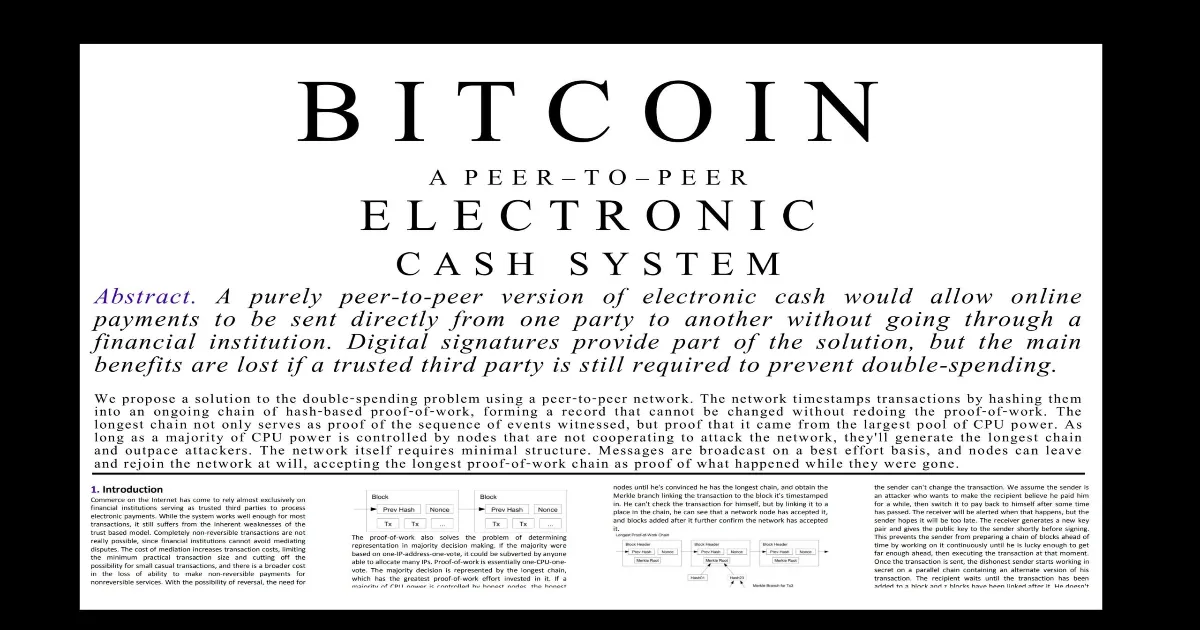
What Has Bitcoin Become 17 Years After Satoshi Nakamoto Published The Whitepaper? – Bitcoin Magazine

Getting close to two decades after the Bitcoin Whitepaper was published by Satoshi Nakamoto, how much bearing does the document have at this point?
Today marks seventeen years since Satoshi Nakamoto’s publication of the Bitcoin Whitepaper on the cryptography mailing list in 2008. Back then Bitcoin was nothing more than a proposal for a new niche technology, the latest in a long lineage of niche technologies created by the cypherpunks of the 1990s. 
Bitcoin has gone through many massive transformations since that day 17 years ago. It went from a niche internet collectible, to a decentralized network powering illegal dark net markets, to a mainstream speculative investment for retail, to Wall Street and governments all over the world’s favorite new asset class. We have all had front row seats to the first explosive global technological revolution to the internet, and it’s been a wild ride. 
On this anniversary I think it’s important to touch on a concept that is very relevant, POSIWID, or the Purpose Of A System Is What It Does. The basic idea is that when you have a complex system, it is pointless to try to define it based on what you want it to do, what really matters is what the pieces of that complex system are actually doing. That is all that matters at the end of the day. 
We have once again found ourselves in a time period where people are calling back to the whitepaper as a placeholder for some kind of founding document, or definition, or blueprint. The whitepaper is none of those things. It is simply a high level abstract explanation of a Proof-of-Work blockchain being used to implement a digital currency. It is the idea of a cart with wheels, versus the actual blueprint of the cart (the source code). 
Bitcoiners seem to periodically fixate on the whitepaper in this manner, and inevitably use that as a justification for acting antagonistic towards some use case or idea of improving Bitcoin that they disagree with. Maybe we will eventually get past this, maybe we won’t, but it is an unhealthy attitude to have towards such a potentially impactful technology such as Bitcoin. 
People didn’t recite the writings and speeches of Alexander Graham Bell when digital modems were invented to allow the first tendrils of the early internet to reach out between devices and facilitate digital signals flowing between them. They embraced it as a valuable technological innovation, and in the world today that dynamic has completely inverted itself. Most telephonic signals are now actually conveyed by communication mediums specifically constructed for digital communications. 
Telephone networks were used to bootstrap the digital medium of the modern internet in a way that Alexander Graham Bell might have had only the barest inklings of, reshaping the entire world in ways that would have been impossible to conceive for people of his generation. 
Satoshi did not give us a founding document to be shackled and constrained by when he released the whitepaper, he gave us a high level description of the software that followed. 
That is the actual gift he gave us, the software. And he gave it to us completely freely, open-source, to do with what we decide to do. 
“BitDNS users might be completely liberal about adding any large data features since relatively few domain registrars are needed, while Bitcoin users might get increasingly tyrannical about limiting the size of the chain so it’s easy for lots of users and small devices.” -Satoshi Nakamoto, 2010
This quote is always brought up in the context of the blocksize limit, or Bitcoin enabling multiple functionalities, but the thing that has always stood out the most to me is “users might get.” In the end before his disappearance, Satoshi is clearly being explicitly deferential to the wishes of users, and in the context of a critical and foundational decision like the blocksize limit. 
Bitcoin isn’t Satoshi’s anymore, it’s ours, and collectively with how we actually use our bitcoin, we decide what the purpose of the system is. It’s important to remember that. 
Established in 2012, Bitcoin Magazine is the oldest and most established source of trustworthy news, information and thought leadership on Bitcoin.
© BTC Media, LLC 2025

source