Posted on Leave a comment

XRP Price Forecast: Ripple’s XRP Jumps to $2.59 as ETF Assets Top $100M, Eyeing $3.45 Breakout – TradingNEWS

Ripple (XRP-USD) trades around $2.59, gaining 4.44% in the last 24 hours as both ETF inflows and institutional derivatives trading surge. The price has climbed 80% from its monthly low of $1.37, breaking above the 25-day Exponential Moving Average and forming a clear inverse head-and-shoulders pattern, signaling the potential start of a new bullish phase. The token’s rebound coincides with a surge in total trading volume, up 11% to $3.62 billion, showing aggressive long positioning in futures markets and heavy whale accumulation.
At the same time, data confirms that the XRPR ETF has crossed the $100.89 million AUM milestone, positioning it among the largest altcoin ETFs globally. This influx is particularly notable given XRP’s ongoing consolidation below its 2025 highs. The fund’s 0.75% expense ratio has not slowed inflows, highlighting sustained demand for regulated exposure to Ripple’s native token despite broader crypto volatility.
CME Group confirmed that XRP futures and micro contracts have processed over 567,000 lots, with a combined notional value exceeding $26 billion since launch. This makes XRP one of the most actively traded digital assets on the CME platform, ranking just behind Bitcoin and Ethereum. The presence of major institutional participants has given XRP a legitimacy layer that was once reserved for the top two cryptocurrencies.
This futures activity underscores deepening market liquidity and a shift in positioning among hedge funds and high-frequency traders seeking volatility exposure. Analysts now see XRP following the liquidity footprint of BTC-USD, with cyclical corrections replaced by sustained institutional positioning.
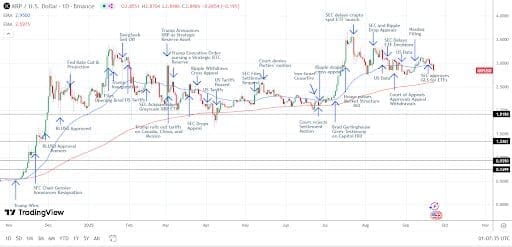
The XRP/USD chart reveals a breakout structure forming above the descending trendline, which had capped price action since early October. RSI momentum is climbing above 60, while the Supertrend indicator has flipped bullish, placing dynamic support near $2.48.
The immediate resistance lies at $2.67, where short-term profit-taking could occur. Clearing this level would pave the way for a 23–35% rally toward the $3.10–$3.45 range by December 2025. Conversely, if the pair slips below $2.33 (the 50-week EMA), XRP could retest $2.10–$2.00, which remains its key structural demand zone. This compression setup mirrors pre-breakout formations from 2017 and 2021, where XRP delivered multi-month surges once resistance zones were breached.
Ripple’s acquisition of Hidden Road and the creation of Ripple Prime represent one of the company’s most significant institutional plays to date. The new platform integrates multi-asset prime brokerage and digital asset custody under Ripple’s infrastructure, giving institutional clients streamlined access to XRP liquidity.
CEO Brad Garlinghouse emphasized that “XRP sits at the center of everything Ripple does,” linking the asset’s future growth directly to the company’s expanding global settlement ecosystem. Ripple Prime now positions Ripple as a cross-border liquidity provider, merging payments, stablecoin settlement, and asset management — a trifecta that directly strengthens XRP’s transactional relevance
The convergence of ETF growth, whale inflows, and derivatives participation paints a powerful accumulation narrative. Over 18 million XRP tokens have been withdrawn from exchange reserves in the last week, signaling cold storage accumulation and reducing circulating supply pressure. These on-chain movements parallel historical cycles that preceded multi-month rallies, as seen in early 2021 and 2023.
Moreover, the approval and scaling of XRP-linked ETFs, including REX Osprey’s XRPR, have introduced regulated investment channels that absorb liquidity without direct on-chain selling. Combined with growing futures participation, this structure reduces market float and aligns XRP’s trajectory with broader institutional accumulation patterns seen in Bitcoin’s post-ETF rally phase.
The Ripple vs. SEC legal case resolution earlier this year removed one of the largest overhangs in XRP’s valuation. With its classification as a non-security asset reaffirmed, Ripple has accelerated partnerships across Asia, Europe, and the Middle East, particularly in corridors tied to CBDC interoperability and remittance settlement. The rollout of the RLUSD stablecoin has further strengthened Ripple’s ecosystem by linking fiat liquidity directly to XRP transactions, improving settlement efficiency and reducing slippage for large institutional transfers.
As a result, Ripple’s total network volume through RippleNet and On-Demand Liquidity (ODL) channels has expanded, supporting sustained token velocity — a fundamental indicator of utility growth.
The macro backdrop continues to support crypto appreciation. U.S. CPI inflation slowed to 2.8%, below expectations, pushing the dollar lower and reviving appetite for high-beta assets like XRP. Simultaneously, weaker UK and Eurozone GDP prints have increased capital rotation toward dollar-based assets, with traders seeking volatility exposure through liquid instruments such as XRP futures.
Furthermore, the ongoing Trump–Xi trade dialogue and speculation around rare earth metal tariffs have reinforced crypto’s appeal as a non-sovereign hedge, particularly in the remittance sector, where cross-border transactions face heightened friction. XRP’s real-world settlement capability positions it as a beneficiary in this environment.
Despite bullish macro and institutional catalysts, near-term caution persists. Co-founder Chris Larsen’s $700 million XRP sale has stirred debate over insider conviction, although on-chain data suggests that whale wallets unrelated to Ripple have simultaneously increased accumulation. The XRP burn rate has slowed slightly, consistent with lower on-chain transaction volume, but analysts argue that this reflects market recalibration rather than waning adoption.
The Futures Taker CVD index continues to show strong green bars from October 17–24, confirming aggressive long positioning — an early signal that short-term weakness could be absorbed by institutional bids.
If XRP sustains its current accumulation range and clears $3.00, momentum models suggest an extension to $5.00–$5.50 by mid-2026. A larger structural move could unfold if multiple XRP ETFs under Franklin Templeton and 21Shares launch successfully under the Securities Act of 1933, providing lower-cost alternatives to the REX-Osprey product. Analysts project that such an event could trigger a “supply shock” effect — removing billions of tokens from open circulation as institutional custodians accumulate long-term holdings.
In a conservative downside case, if momentum stalls and ETF inflows plateau, XRP could retrace toward $2.00–$2.10, forming a long-term support base before the next macro cycle.
XRP’s behavior increasingly mirrors Bitcoin’s cyclical structure, though with amplified percentage swings due to lower liquidity depth. While BTC-USD hovers around $111,000, XRP’s outperformance in percentage terms underlines renewed speculative participation. Meanwhile, Ethereum (ETH-USD) consolidates near $3,930, anchoring the broader altcoin complex. The synchronized movement across these majors suggests that XRP’s breakout may coincide with the next phase of crypto market rotation — typically when altcoins decouple from Bitcoin dominance.
Ripple’s financial ecosystem is evolving into a multi-layered institutional network where XRP-USD functions as the liquidity bridge for settlement, collateral, and cross-border remittances. ETF expansion, legal clarity, whale accumulation, and macro tailwinds all point toward structural strength, not speculative excess.
Technical setups remain constructive as long as the token stays above $2.33, with the $2.67 breakout marking the next inflection level. Should momentum persist, targets at $3.45 appear attainable by year-end, with potential extensions to $5.00–$5.50 by 2026 under favorable ETF and regulatory developments.
Verdict:
Buy above $2.67, targeting $3.45–$5.00 over the medium term.
Hold within the $2.30–$2.60 consolidation range.
Cautious only below $2.00, where structural support weakens.
XRP’s trajectory in late 2025 is no longer speculative hype — it’s the result of a maturing ecosystem integrating institutional liquidity, regulated products, and macro validation. The stage is set for one of the most consequential altcoin rallies in years, with XRP-USD again positioned at the center of the digital value revolution.
Enter your email to receive our newsletter

source

Posted on Leave a comment

Best Crypto Presales 2025: Expert Picks – Digital Journal


Surprising fact: Bitcoin ETF inflows topped $355.76M recently, helping price hold above $100,000 and shaping demand for early-stage token rounds.
Super Pepe is front and center for readers who want a community-first meme play; find its presale access at superpepe.io. In a choppy market, selective projects with real utility and audits stand out.
We spotlight names like Digitap, which runs a live omni-bank and Visa-linked debit card, and Bitcoin Hyper, which raised nearly $25M and plans a BTC Layer 2. Infrastructure plays such as BlockDAG, Snorter, and Best Wallet add developer tools, trading bots, custody, and launchpad services that signal healthier adoption.
This guide aims to help investors cut through hype by weighing early momentum, community support, and practical features. Expect concise context, risk notes, and clear cues for timing and allocation.
Super Pepe sits front and center because a tight-knit community can turn meme energy into sustained attention during choppy market stretches. This presale gives readers a clear entry path at superpepe.io, paired with a community-first identity that many investors seek.
Super Pepe blends viral appeal with active supporter engagement. That mix helps a meme-led project stand out among other presale opportunities when narratives concentrate interest quickly.
“A focused community often keeps momentum alive after initial listings, especially when token teams show transparency and follow-through.”
Early entries benefit when attention and utility line up.
Projects that ship real features — like Digitap’s live omni-bank and Visa-linked spending — gain credibility. Investors reward teams that deliver utility, audits, and clear roadmaps.
Super Pepe tops the list — a community-driven meme play with strong social traction and direct early access at superpepe.io.
Community growth fuels visibility. Consider early access at superpepe.io if you want exposure to this narrative.
Live omni-bank app and Visa-linked debit card. Token sits at $0.0194 with a planned raise to $0.0268. Half of profits go to burns and staking rewards.
Audit passed and liquidity locked. Referral bonuses pay 15% to both inviter and invitee. Stage 5 price is $0.00006584 with 1,500+ holders and $450K+ raised.
Nearly $25M raised and whale interest in five-figure buys. BTC Layer 2 vision with SVM and presale staking APYs up to 48%.
BlockDAG blends DAG and PoW for faster confirmations. Snorter runs a Telegram trading bot with token-gated features. BullZilla and La Culex focus on viral campaigns, staking, burns, and community giveaways.
When traffic surges, matching engines and curated launchpads keep token launches usable and secure.
Hyperliquid focuses on deep liquidity and fast order matching. That matters when trading interest spikes during a token round.
Lower slippage and quick fills help traders and token teams avoid chaotic price moves. Projects benefit because on-chain activity looks orderly to new users and market makers.
Best Wallet bundles storage, cross-chain swaps, staking, and a vetted launchpad. Users can manage participation without juggling multiple apps.
This reduces onboarding friction and raises trust for early backers who seek a single, familiar interface.
Ethereum anchors many DeFi launches with mature tooling. Sui adds parallel processing for higher throughput.
Hedera brings enterprise-grade governance, Avalanche supports customizable subnets and has burned 4.8M+ AVAX, and WLFI links tokenized assets to familiar finance rails.
“Infrastructure choices shape fees, speed, and the first impression that converts early interest into long-term support.”
With institutional flows still active, selective positioning matters more than ever. Though headlines drive short-term swings, steady ETF inflows and solid community activity give clearer cues for timing new token rounds.
Bitcoin has largely held above $100,000 while weekly ETF net inflows sit near $355.76M. Analysts say spot ETFs since January helped establish higher support levels and added confidence for buyers.
Traders watching flows get a practical edge: steady inflows can cushion dips and make it easier to time entries. Bitcoin’s October peak at $125,761 shows upside bursts remain possible, but selective entries avoid short-lived bounces.
“Watch macro headlines and on-chain activity together; steady support plus active communities often signal more resilient participation.”
Solid token mechanics turn short-term interest into longer-term support for holders and apps. Good tokenomics make holding useful, not just speculative.
Burns cut supply gradually and can support gains if activity grows across the ecosystem. Digitap’s plan to funnel half of platform profit into burns and staking rewards creates that feedback loop.
High staking yields — like Bitcoin Hyper’s presale APYs — attract commitment. Staking signals value sharing with users who lock tokens and use network features.
Referral rewards turn every supporter into a growth partner. MoonBull’s 15% bonus to inviter and invitee is a simple, verifiable incentive that fuels organic expansion.
“Align incentives around use and rewards; tokens that do both tend to retain active holders.”
Focus on verifiable signals before you allocate capital. Start with documentation: third-party audits, locked liquidity, and clear token allocations reduce common risk. MoonBull’s audit and locked pool are good examples of basic checks that matter.
Ask for audit reports and read findings, not just the headline. Verify liquidity locks on-chain and watch vesting schedules.
Look for live features or shipped milestones. Digitap and BlockDAG show tangible progress; that often matters more than ambitious roadmaps.
Measure community quality: active discussion, prompt team replies, and regular updates signal healthier support than follower counts alone.
U.S. investors should size positions for capital preservation. Plan for swings and predefine exits.
Analysts and traders watch wallet distribution–concentrated holdings can pressure price after listing. Use curated places like Best Wallet’s launchpad and confirm official URLs before any sale opens to avoid phishing.
“Keep a checklist: thesis, timing, support signals, and a written exit plan.”
Choose projects that balance story with delivery, and keep position sizes small when markets swing.
Super Pepe stands out for community-driven momentum and straightforward early access for investors who want a quick entry. Utility names like Digitap, MoonBull, and Bitcoin Hyper show how apps, audits, and large raises can shape price and potential gains.
Infrastructure tools — Best Wallet and Hyperliquid — make trading and launches smoother. BlockDAG and Snorter add builder and trading utility that reduces friction for users and holders.
Let ETF-backed bitcoin flows inform timing, but plan exits and confirm audits and liquidity locks before you commit. strong,
Links: superpepe.io
Super Pepe combines a strong community focus with meme-driven marketing, active governance channels, and early access incentives like referral rewards and staking. The team emphasizes liquidity locks and regular audits to reduce rug risks. Community momentum and clear utility pathways help projects gain traction before public listings, which can amplify gains for early supporters.
Start with the token supply schedule, emission rate, and lockup periods. Check whether burns are scheduled or discretionary and whether staking yields are sustainable relative to protocol revenue. For referral systems, look for capped rewards and anti-abuse rules. Solid tokenomics balance incentives for holders while limiting dilution and reward inflation over time.
Prioritize networks with active developer ecosystems and low friction for user onboarding, such as Ethereum, Avalanche, Sui, and Hedera. Each chain offers trade-offs in fees, finality, and tooling. Projects bridging across chains or building on EVM-compatible layers can tap wider liquidity and dApp integrations, improving long-term adoption potential.
Verify smart contract audits, confirm liquidity locks, review the roadmap and team transparency, and examine token vesting schedules. Also assess regulatory exposure, KYC requirements, and whether the project aims for utility rather than speculative token models. Use position sizing and defined exit rules to manage market volatility and compliance risks.
Strong Bitcoin price action and institutional inflows often lift speculative markets and improve takeoff conditions for new token launches. Conversely, high volatility or outflows can compress risk appetite. Use broader market signals to time participation — enter selectively during accumulation phases and scale back when momentum stalls.
Positive signals include an audited contract, locked liquidity, transparent vesting, active developer updates, growing social engagement, and meaningful partnerships or integrations. Look for real product milestones, beta apps, or Visa-card utility, which show the project is building usable infrastructure rather than relying solely on hype.
Very important. Independent audits reduce smart-contract risk, while locked liquidity prevents immediate rug pulls after listing. Audits won’t eliminate all threats, but combined with on-chain verifications and reputable third-party attestations, they significantly lower technical and exit risks for early buyers.
They can when tied to real demand and protocol revenue. Burns reduce circulating supply, while staking aligns holder incentives and secures network functions. The key is design: rewards should come from protocol fees or utility, not endless token emissions. Sustainable loops preserve value for long-term holders.
Use a fixed percentage of your overall portfolio per presale and plan tiered exits — for example, take partial profits at short-term milestones and hold a core allocation for long-term upside. Define stop-loss levels and avoid emotional trading. Discipline in sizing and exits preserves capital and captures gains across volatile moves.
Choose multi-chain wallets with hardware support, reliable swap integrations, and curated launchpad access. Look for features like transaction simulation, gas fee estimation, and staking dashboards. Combining a hardware wallet with reputable software interfaces reduces custody risk while keeping participation efficient.
Disclaimer:
This article is for informational purposes only and does not constitute financial advice. Cryptocurrency investments carry risk, including total loss of capital. Readers should conduct independent research and consult licensed advisors before making any financial decisions.
Crypto Press Release Distribution by BTCPressWire.com
COMTEX_469812474/2909/2025-10-25T14:07:01

source

Posted on Leave a comment

The Blue Jays keep on hitting, and the World Series started with a bang – The Washington Post

  1. The Blue Jays keep on hitting, and the World Series started with a bang  The Washington Post
  2. Passan: Toronto waited 32 years for another World Series win — and Game 1 delivered  ESPN
  3. If it ain’t broke, don’t fix it: Barger sleeps on Davis Schneider’s couch again  Sportsnet.ca
  4. Commentary: After Dodgers’ disastrous World Series Game 1 loss, doubt has crept in  Los Angeles Times
  5. Like they’ve done all postseason, the Blue Jays keep piling up quality at-bats – The Athletic  The New York Times

source

Posted on Leave a comment

Pi Network Price Prediction: Experts Try To Make Bullish Case For Pi Coin As Price Continues To Fall – Live Bitcoin News

We participate in marketing programs, our editorial content is not influenced by any commissions. To find out more, please visit our Term and Conditions page.

Pi Network Price Prediction talk is rising again, even as the token slips. Recent updates show fresh movement on product and compliance, including a post that moved 3.36 million tentative KYC approvals into full status, which can increase eligible participants. 
Prices on major data boards for Pi still hover near $0.20 with soft momentum. That mix of falling price and stronger product signals makes Pi Network Price Prediction a live debate. Amidst this news, a payments project named Remittix enters the conversation as a separate utility play that does not depend on mining rewards.
A key driver for any Pi Network Price Prediction is supply on exchanges. Research shows that about 10 million PI moved off exchanges, which can reduce near-term sell pressure if sustained. At the same time, the core team reported that 3.36 million users just cleared full KYC after new system checks, expanding the verified base that can interact with apps and potential listings. 
Analysts note that the token remains below recent local highs and needs a fresh trigger to draw momentum buyers back. In this setup, bulls point to the user base growth and KYC clears, while bears point to unlocks and soft exchange depth.
Near-term Pi Network Price Prediction ranges cluster around $0.18–$0.23. A daily close above $0.22–$0.23 would put $0.25 back on the map, while a slip under $0.19 risks a slide toward $0.17 if flows thin out. Analysts’ views for a Pi Network Price Prediction depend on two things. First, whether app usage grows as newly verified users gain access. 
Second, whether exchange liquidity and spot listings broaden clearly. If both improve together, a climb is feasible; if not, the path likely stays choppy. That is why many desks keep repeating that data, not slogans, must lead the call.
While Pi appeals to users who mine on phones and hope the network matures into a wide economy, Remittix speaks to readers who want payment utility first. It is positioned at the intersection of crypto and global remittance, targeting a $19 trillion market with a wallet, web app, fiat rails, and API integrations. 
The team is verified by CertiK and ranked number one for Pre-Launch Tokens on Skynet. The project reports that more than 681 million tokens have been sold at $0.1166, and more than $27.7 million has been raised, with BitMart and LBank listings secured and one more top-tier exchange to be confirmed at launch. A live wallet beta and a large ambassador base add to the utility-led angle.
Pi Network Price Prediction remains a split call. Bulls point to KYC progress, potential app growth, and hints of broader connectivity. Bears point to falling prices and supply overhangs. If verified users translate into on-chain activity and if liquidity improves, the Pi Network Price Prediction could lift. 
For readers who like a payments project with clear verification and incentives, Remittix offers a separate path aimed at real settlement and merchant use, which is why some keep it on the watchlist during this Pi coin debate.
Discover the future of PayFi with Remittix by checking out their project here:
Website: https://remittix.io/   
Socials: https://linktr.ee/remittix   
$250,000 Giveaway: https://gleam.io/competitions/nz84L-250000-remittix-giveaway
Disclaimer: This is a paid post and should not be treated as news/advice. LiveBitcoinNews is not responsible for any loss or damage resulting from the content, products, or services referenced in this press release.
LiveBitcoinNews is a leading online platform dedicated to providing the latest news and insights about Bitcoin and the broader cryptocurrency market. It offers timely updates on market trends, regulatory developments, technological advancements, and expert analyses, catering to both seasoned investors and newcomers in the digital currency space. The site features a variety of content, including articles, guides, interviews, and opinion pieces, making it a comprehensive resource for anyone interested in staying informed about the rapidly evolving world of cryptocurrencies.
Contact us: support@livebitcoinnews.com
© Copyright – Livebitcoinnews.com

source

Posted on Leave a comment

5 tips for first-time cruise passengers, according to an expert – USA Today

Land and cruise vacations can seem an ocean apart – especially if it’s your first time setting sail.
From onboard drink packages to muster drills, there’s a lot for cruise newbies to take in. Even the rooms – called cabins or staterooms – have different names than at hotels.
Still, cruises can actually be more straightforward than land-based trips, according to Fora Advisor Randy Marsden. “A cruise is a rolling resort – your hotel, transport, and much of the entertainment are all bundled together, so logistics are simpler (pack once, unpack once),” he said. “You’ll have a structured daily schedule with port calls and onboard programming, so it’s more social and activity-driven than many land trips.”
Passengers can tailor them, too. With 31% of guests over the past two years cruising for the first time, according to Cruise Lines International Association’s 2025 State of the Cruise Industry Report – up from 27% in 2023 – Marsden helped USA TODAY round up five tips for newcomers.
Marsden recommended bringing:
He also suggested passengers carry any essentials with them, rather than placing them in checked luggage.
Be sure also to check the prohibited items for your specific cruise. For example, almost all ships don’t allow irons, and while liquor isn’t allowed in luggage, cruise lines often permit passengers to bring bottles of wine.
On a cruise that visits popular stops, consider booking one to two shore excursions in advance – while also leaving “space for spontaneous exploring.”
Keep in mind that when booking excursions, you should return to the ship by sail-away time. While excursions booked through the line are typically more expensive, they are in constant communication with the ship about arrival. Conversely, be sure to allow extra time when booking through a third party and communicate these needs to the local operator.
Make reservations for any specialty dining restaurants you want to try in advance, Marsden said. Those come with an added fee – which varies by cruise line and eatery – and reservations typically open a month or two before departure.
Passengers can make reservations for some entertainment offerings, as well. It’s worth booking both “early to avoid missing the best times.”
It’s easier to make reservations and keep track of your agenda through the cruise line’s app, so be sure to download it to your personal device well in advance of embarkation.
While cruise fares include many onboard amenities, such as most meals, entertainment and accommodations, they’re generally not all-inclusive. Marsden warned that “onboard gratuities, specialty dining, spa, and shore transfers add up – factor those into your total cost.”
Some cruise lines, such as Royal Caribbean International, offer wristbands that can serve as part stateroom key card and part payment method. You’re less likely to leave them behind or lose them in your bag, too (though some of those bands come at an extra cost themselves).
Cruise ships maintain a daily schedule of activities that give guests a comprehensive overview of their options for the day. Hard copies have historically been delivered to staterooms each night, but can also be found in cruise lines’ mobile apps.
Crew members can make recommendations, too, so don’t hesitate to ask them. 
Marsden suggested newer cruisers choose a cruise line that “matches your vibe” – whether you like family-friendly megaships or smaller, luxury vessels, USA TODAY has a quick guide here – and start with a short sailing ranging from three to five nights long.
“Cruising is one of the friendliest ways to travel – everything is taken care of so you can relax and try new things,” he said.
Nathan Diller is a consumer travel reporter for USA TODAY based in Nashville. You can reach him at ndiller@usatoday.com.

source

Posted on Leave a comment

New York Jets vs. Cincinnati Bengals 2025 odds, tips and betting trends | Week 8 – Jets Wire

New York (0-7) rides a seven-game losing streak into a matchup with (-) on Sunday, October 26, 2025 at Paycor Stadium. The Bengals are listed as favorites in this one, with the spread sitting at 6.5 points. The over/under is 44.5 in the contest.
The Jets lost versus the Carolina Panthers in their most recent game, 13-6.
In that game against the Panthers, Jets quarterback Tyrod Taylor completed 10 of 22 passes for 126 yards, with no touchdowns and two interceptions.
Facing the Pittsburgh Steelers in their last game, the Bengals won 33-31.
NFL odds courtesy of BetMGM Sportsbook. Odds updated Saturday at 1:59 p.m. ET. For a full list of sports betting odds, access USA TODAY Sports Betting Scores Odds Hub.
Our team of savvy editors independently handpicks all recommendations. If you purchase through our links, the USA Today Network may earn a commission. Prices were accurate at the time of publication but may change.
Gambling involves risk. Please only gamble with funds that you can comfortably afford to lose.  While we do our utmost to offer good advice and information we cannot be held responsible for any loss that may be incurred as a result of gambling.  We do our best to make sure all the information that we provide on this site is correct. However, from time to time mistakes will be made and we will not be held liable. Please check any stats or information if you are unsure how accurate they are. No guarantees are made with regards to results or financial gain. All forms of betting carry financial risk and it is up to the individual to make bets with or without the assistance of information provided on this site and we cannot be held responsible for any loss that may be incurred as a result of following the betting tips provided on this site.  Past performances do not guarantee success in the future and betting odds fluctuate from one minute to the next. The material contained on this site is intended to inform, entertain and educate the reader and in no way represents an inducement to gamble legally or illegally or any sort of professional advice.
Gannett may earn revenue from sports betting operators for audience referrals to betting services. Sports betting operators have no influence over nor are any such revenues in any way dependent on or linked to the newsrooms or news coverage. Terms apply, see operator site for Terms and Conditions. If you or someone you know has a gambling problem, help is available. Call the National Council on Problem Gambling 24/7 at 1-800-GAMBLER (NJ, OH), 1-800-522-4700 (CO), 1-800-BETS-OFF (IA), 1-800-9-WITH-IT (IN). Must be 21 or older to gamble. Sports betting and gambling are not legal in all locations. Be sure to comply with laws applicable where you reside. It is your sole responsibility to act in accordance with your local laws.

source