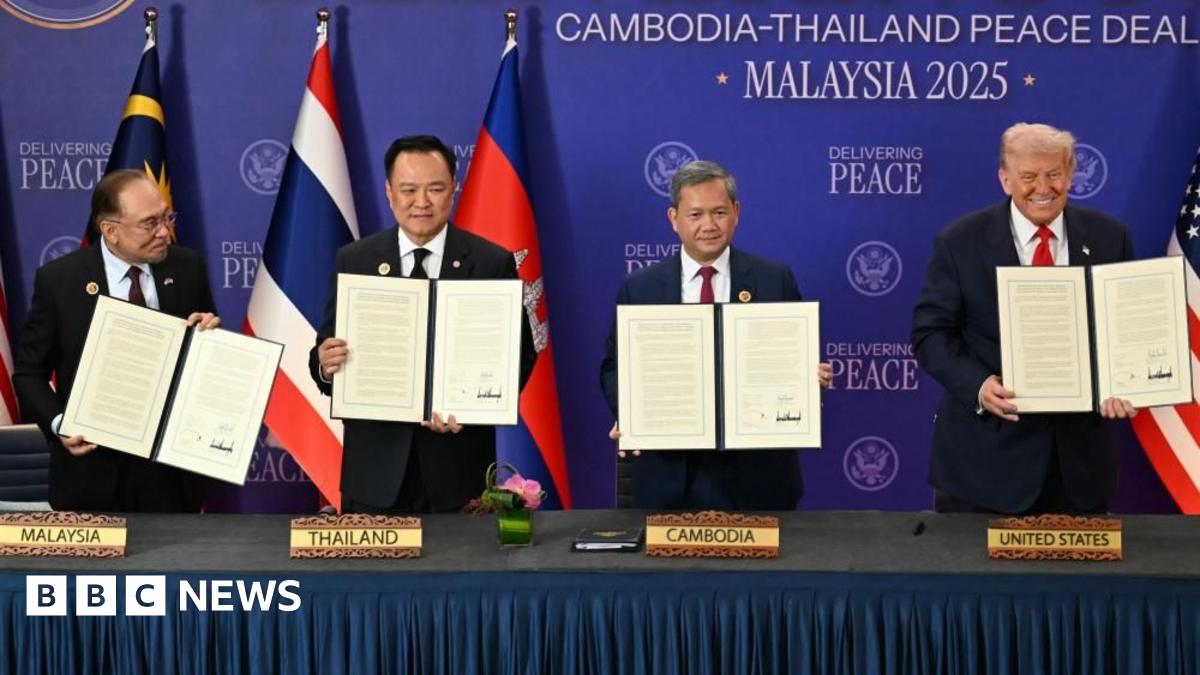
US President Donald Trump has presided over a "peace deal" between Thailand and Cambodia, who have a long-standing border dispute, that he calls "historic"
Trade pressure from Trump led to a ceasefire in late July, ending five days of clashes that killed over two dozen people
While in Malaysia, Trump will also attend a summit of the Association of South East Asian Nations or Asean
He is on a one-week high stakes trip to Asia that also includes stops in Japan for a meeting with the key US ally's new conservative leader, and South Korea to attend the Asia Pacific Economic Forum (Apec) leaders' summit
The highlight of the trip will be a meeting with his Chinese counterpart Xi Jinping on the sidelines of Apec in Gyeongju
This video can not be played
Watch: Trump lands in Malaysia for signing of Thailand-Cambodia 'peace deal'
Edited by Emily McGarvey, with Jonathan Head and Tessa Wong reporting from Kuala Lumpur
 Tessa Wong
at the Asean Summit in Kuala Lumpur
When Thailand and Cambodia ended hostilities back in July, that ceasefire came shortly after Trump warned that their war would endanger their respective trade deals and tariff negotiations with the US.
With today's signing coupled with Trump's announcement of a US trade deal with Cambodia and a minerals agreement with Thailand, he has made it very clear that his administration will be using US trade deals as a key way to diplomatically pressure countries to make peace.
"We do transactions, lots of them, with both nations as long as they live in peace," Trump said.
"And I really feel that when we make deals, we see two countries that we do a lot of business with… we have to use that business to make sure they don't get into wars."
Following the joint Thailand-Cambodia ceasefire agreement, trade agreements between the US and Thailand and Cambodia respectively have now been handed out to sign.
Trump could be heard saying that the agreements were "a great deal for both countries" as he signed them.
Just before the ceasefire deal was signed, the Cambodian PM Hun Manet thanked US President Donald Trump for his "decisive lead" and "tireless efforts" to make the peace accords a reality.
"No matter how difficult and complex a dispute may be, they must be resolved by peaceful means," he said.
Manet also thanked the Malaysian PM for his assistance in the agreement, and said he looked forward to continued support and contribution from the international community in the joint declaration.
The Thai PM also thanked Trump for his efforts in the ceasefire, and acknowledged his condolences in regards to the death of Thailand's Queen Mother.
He said that the removal of weaponry, and the freeing of prisoners of war would begin "promptly", adding that the declaration would provide "the building blocks for lasting peace" if fully implemented.
Tessa Wong
at the Asean Summit in Kuala Lumpur
Despite the Thais insisting in press briefings that they are signing a "joint declaration of Thailand and Cambodia relationship", and that they are not calling it a peace deal, it is clear that Trump and perhaps even Malaysia have other ideas.
In his opening remarks, Trump said they were signing the "Kuala Lumpur Peace Accords".
Meanwhile the backdrop onstage put up by the Malaysians states "Delivering Peace: Cambodia-Thailand Peace Deal".
Thai Prime Minister Anutin Charnvirakul and Cambodian Prime Minister Hun Manet have just signed a joint "peace deal", overseen by US President Donald Trump.
Everyone is waiting to hear further details on the agreement, but officials have already outlined a few of the details, which we told you about earlier today.
Trump says there have been "a lot of phone calls between the four of us" following the "bloodshed" between Thailand and Cambodia in July, but says his administration "got it stopped".
As a reminder, back in July, the Thailand-Cambodia border war ended with an “immediate and unconditional ceasefire” after days of fighting.
The US president says he is very good at getting peace deals done, arguing he is far better at it than the United Nations.
Trump begins by offering his condolences to Thailand following the death of Queen Sirikit, the mother of Thailand's King Vajiralongkorn.
He then thanks the Malaysian prime minister for his role in what Trump calls the "historic" agreement between the "courageous" leaders of Thailand and Cambodia.
He adds that the deal could save "millions of lives".
US President Donald Trump is speaking in Kuala Lumpur ahead of the signing of what he's called a "great peace deal" between Thailand and Cambodia.
Stay with us as we keep you across the latest updates from the signing ceremony.
 Suranjana Tewari
Asia Business Correspondent
South East Asia's major economies are export-reliant.
US trade policy, particularly around tariffs on semiconductors and electronics, leave many manufacturing hubs like Indonesia, Vietnam, Malaysia and Singapore vulnerable.
They trade heavily with both the US and China, and so are vulnerable to tensions between the world's two biggest economies too.
Indonesia's trade negotiator Airlangga Hartarto told the BBC earlier this month that he expects the country's deal with the US to be inked by the end of October.
Malaysia – which exported around $10bn worth of semiconductors to the US last year – could also be close to concluding its deal, with Prime Minister Anwar Ibrahim telling reporters last week that 99.9% of issues have been resolved.
 Tessa Wong
at the Asean Summit in Kuala Lumpur
We haven’t yet seen a copy of the actual agreement. But some information has already been outlined by officials who arrived here last week to hash out the details. Both countries have agreed to:
Cambodia has also said the agreement will pave the way for the release of 18 Cambodian soldiers detained by Thailand.
There may be more details revealed at the signing ceremony soon – we’ll keep you posted.
Anti-Trump demonstrations have been seen in Kuala Lumpur, with some protesters holding signs saying the president is not welcome in Malaysia.
Trump's five-day diplomatic tour of Asia will see him visit Malaysia, Japan and South Korea, with trade at the top of the agenda. As our reporter Tess Wong explains in an earlier post, many in Muslim-majority Malaysia have been critical about US support for Israel in the Israel-Gaza war.
Trade talks between the US and China have progressed to the point where Trump and Chinese President Xi Jinping can have a "very productive meeting" when they meet later this week, US Trade Representative Jamieson Greer says.
Speaking to reporters in Kuala Lumpur, Greer says: "I think we're moving forward to the final details of the type of agreement that the leaders can review and decide if they want to conclude together."
Greer says that extending the truce on trade measures has been discussed at the talks, which have been ongoing since Saturday.
Trump and Xi Jinping are expected to meet on Thursday in South Korea, at the end of the president's five-day Asia trip.
Suranjana Tewari
Asia business correspondent
Economies in Asia will be looking to stabilise relations with the US, after months of tariff disputes.
Trump's trade war has upended trade across the region's closely knit supply chains, with exporters unable to plan their operations amid the uncertainty.
South East Asia is a valuable market for the US, and ties with the Asean grouping are of strategic importance in the face of an increasingly assertive China.
Many American companies also now manufacture in the region after moving out of China.
The United States is also a top export destination for countries like Vietnam, the Philippines, Thailand and Cambodia.
So they will be looking at any trade deals inked in Malaysia for clues on what their agreements might look like.
Countries in South East Asia, especially manufacturing hubs like Cambodia and Vietnam, were hit with some of the highest tariff rates initially announced in April.
Many of those rates have since come down after trade negotiations. Here’s where they stand now:
Thailand's prime minister landed in Kuala Lumpur late on Saturday night, after delaying his departure to the summit following the death of Thailand's former Queen Sirikit.
Upon landing, Anutin Charnvirakul told Thai media that in his five-minute meeting with President Trump, he plans to sign a trade agreement, as well as discussing tariffs and security issues, including scammers.
He also intends to invite the president for a state visit to Thailand.
The prime minister also spoke to the signing of a "peace agreement" between Thailand and Cambodia; he said that conditions have been agreed on both sides, but Cambodia will need to fulfil a set of pre-conditions requested by Thailand first.
The set of four requests include: the removal of heavy weapons, the extraction of land mines along their shared border, a resolution to disputed land area and the suppression of scamming centres out of Cambodia.
He added that once both sides are confident conditions are being followed, Thailand will return 18 prisoners of war, and continue to work with Cambodia to lessen hostilities between the two nations.
After years of campaigning for a seat at the table, Timor Leste has today taken its place as the 11th member of Asean.
The young country, which won its independence from Indonesia in 2002, first applied for Asean membership in 2011. But analysts say there were concerns over whether the country could meet the level of commitment and contribution.
The decision to accept another country into the bloc is one that must be made unanimously across all member states.
The country's President Jose Ramos-Horta, who had been pushing to join the body for years, had in 2022 famously said: “It seems like the road to heaven… is easier than to reach the gates of Asean.”
But in 2023, Indonesia supported Timor Leste in its bid – setting out clear milestones and this year, Malaysia confirmed that Timor Leste would be accepted into the bloc.
This is not a recent dispute. The argument between the two South East Asian neighbours dates back more than a century, when their borders were drawn after the French occupation of Cambodia.
Things became hostile in 2008, when Cambodia tried to register an 11th Century temple located in the disputed area as a Unesco World Heritage Site – a move that was met with heated protest from Thailand.
Over the years there have been sporadic clashes that have seen soldiers and civilians killed on both sides.
Tessa Wong
at the Asean Summit in Kuala Lumpur
In just a few hours' time, we will see the leaders of Thailand and Cambodia sign an agreement. US President Donald Trump has called it a peace deal – but is it really one?
The title of the agreement is the much tamer "Joint Declaration of Relations between Thailand and Cambodia”. Thai officials have taken pains not to call it a peace agreement.
Looking at the terms that have so far been released to the media, the agreement only outlines initial steps to de-escalate the conflict. This includes withdrawing heavy weapons and coming up with mechanisms to jointly remove mines and clearly mark out the borders.
From what we know, there isn’t an actual formal declaration of peace in the agreement – though an immediate cessation of hostilities was already agreed upon in July when they first stopped fighting.
Tessa Wong
at the Asean Summit in Kuala Lumpur
As the US president walks down the tarmac, a sea of Malaysian and US flags are waved by greeters.
Trump then goes over to a group of Malaysians performing a traditional dance, and he joins in briefly by waving his arms and dancing on the spot.
He takes a pair of flags from the crowd and waves them, before grinning and posing for pictures. The US president appears to be in a jovial mood.
He enters his car along with Prime Minister Anwar Ibrahim and they are now making their way to the summit venue.
This video can not be played
Watch: Trump lands in Malaysia for signing of Thailand-Cambodia 'peace deal'
Trump has just stepped off Air Force One at Kuala Lumpur's international airport, greeted by Malaysian Prime Minister Anwar Ibrahim.
He is now shaking hands with various Malaysian ministers and senior government officials.
Trump's first port of call is to oversee a ceremony during which Thailand and Cambodia will sign a deal to normalise relations following clashes at their border in July.
Copyright © 2025 BBC. The BBC is not responsible for the content of external sites. Read about our approach to external linking.
source