
IN SHORT: A Facebook post circulating in Nigeria claims that a combination of ripe banana, raw egg and milk can be used to help women conceive. We have found no scientific evidence to support this.
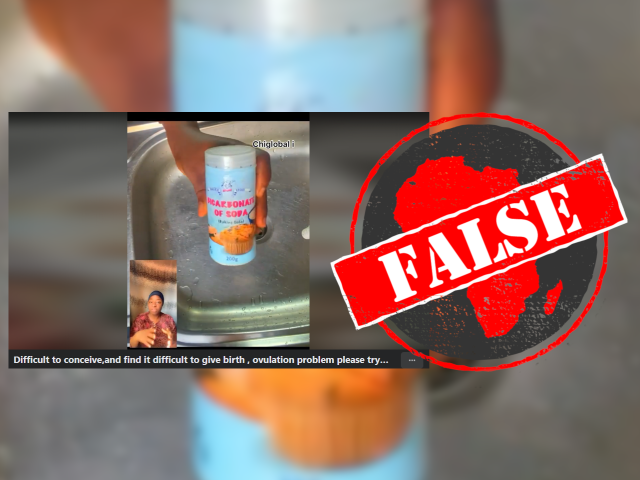
A video posted on Facebook in Nigeria claims that drinking a mixture of ripe bananas, raw eggs, milk and baking soda can help women conceive.
The accompanying text reads: “Difficult to conceive,and find it difficult to give birth , ovulation problem please try this is very good it works.”
The person speaking in the video says the bananas must be ripe and explains their benefits. She advises people to drink this mixture again after three months.
The video has been viewed over 84,000 times with most comments thanking the account while others pose questions.
The same claim has been made here, here and here.
In 2019, Africa Check debunked a very similar claim. A fertility expert told us then that a mixture of milk, egg, banana and soda would have no effect on fertility.
But can this mixture help women conceive? We looked into it.
Africa Check asked Ishaq Abdul, a professor of obstetrics and gynaecology in clinical sciences at the University of Ilorin, about the mixture and whether it could help women get pregnant.
He said there were a number of different causes of infertility known scientifically and he had not come across any studies into the use of this mixture.
“As gynaecologists, we ask relevant questions, examine our patients, carry out necessary investigations, and use the cumulative findings to decide on what causes the problem as well as provide the appropriate solutions,” he said.
He then advised people who wanted to get pregnant to see qualified gynaecologists instead.
We believe that everyone needs the facts.
You can republish the text of this article free of charge, both online and in print. However, we ask that you pay attention to these simple guidelines. In a nutshell:
1. Do not include images, as in most cases we do not own the copyright.
2. Please do not edit the article.
3. Make sure you credit “Africa Check” in the byline and don’t forget to mention that the article was originally published on africacheck.org.
A fact-checker has rated your Facebook or Instagram post as “false”, “altered”, “partly false” or “missing context”. This could have serious consequences. What do you do?
Click on our guide for the steps you should follow.
Africa Check is a partner in Meta’s third-party fact-checking programme to help stop the spread of false information on social media.
The content we rate as “false” will be downgraded on Facebook and Instagram. This means fewer people will see it.
You can also help identify false information on Facebook. This guide explains how.
Africa Check values your trust and is committed to the responsible management, use and protection of personal information. See our privacy policy.
For democracy to function, public figures need to be held to account for what they say. The claims they make need to be checked, openly and impartially. Africa Check is an independent, non-partisan organisation which assesses claims made in the public arena using journalistic skills and evidence drawn from the latest online tools, readers, public sources and experts, sorting fact from fiction and publishing the results.
Africa Check values your trust and is committed to the responsible management, use and protection of personal information. See our privacy policy.
We will never charge you for verified, reliable information. Help us keep it that way by supporting our work.
Africa Check values your trust and is committed to the responsible management, use and protection of personal information. See our privacy policy.
Support independent fact-checking in Africa.