Posted on Leave a comment

US supreme court to hear case that could upend Voting Rights Act – The Guardian

Dispute over Louisiana district returns to justices after long legal saga – and could have far-reaching implications
A 160-year-old campaign against civil rights heads to the supreme court
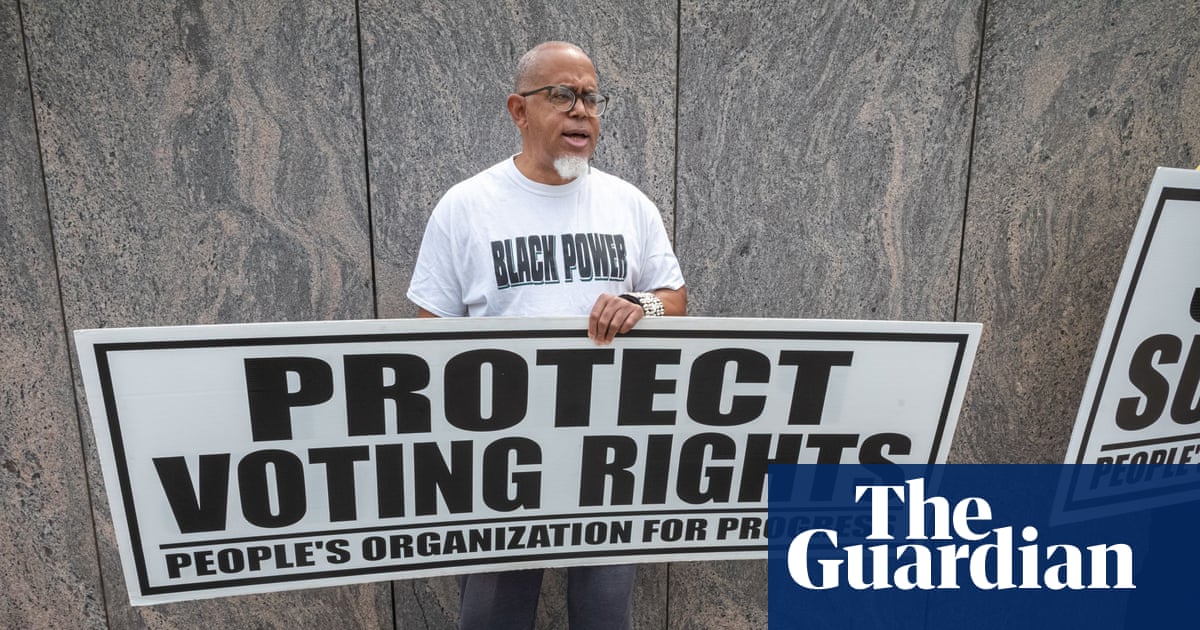
The US supreme court will hear a hugely consequential case on Wednesday that will determine the future of the Voting Rights Act, the landmark civil rights law designed to prevent discrimination in voting.
The case, Louisiana v Callais, involves a dispute over Louisiana’s sixth congressional district, which snakes from Shreveport in the state’s north-west to Baton Rouge in the center. Louisiana Republicans drew the district after a successful lawsuit filed by Black voters under section two of the Voting Rights Act, which outlaws election procedures and practices that discriminate on the basis of race.
But the question at the heart of the case could have far-reaching implications. After hearing argument in the case in March, the supreme court took the unusual step of not issuing a ruling at the end of last term. Instead, it instructed the parties to address an explosive question: whether Louisiana’s decision to create an additional majority-minority district violated the 14th and 15th amendments to the constitution, which guarantee equal protection under the law and prohibit denying the right to vote based on someone’s race. In asking the question, the supreme court set up a blockbuster case on whether section two itself was constitutional when it comes to redistricting.
A ruling holding section two unconstitutional would dramatically upend American election law and strip minority voters of a tool to challenge discrimination. For decades, voting rights lawyers have turned to section two to challenge district lines – from congressional districts to school boards – that dilute the influence of minority voters. Supreme court precedent requires plaintiffs to clear a series of challenging hurdles in order to strike down an existing district.
The supreme court could affirm the constitutionality of section two, strike it down altogether, or leave the provision intact but make it much harder to bring section two lawsuits.
The state of Louisiana, along with a group of white voters, are urging the justices to say section two is unconstitutional.
“Race-based redistricting harms voters – and by extension, our political system – by sorting them based on their skin color and then divvying them up between minority and non-minority districts,” lawyers for Louisiana wrote in a brief to the supreme court.
The Trump administration has also filed a brief with the court urging the justices to raise the bar plaintiffs need to meet to win a section two case.
On the other side of the case are Black voters who filed the original Voting Rights Act suit that produced Louisiana’s current congressional map. They urge the justices to uphold section two of the Voting Rights Act.
“Without section 2, minority voters would continue to face extreme instances of discrimination,” their lawyers write. Without section 2, jurisdictions could simply eliminate minority opportunity districts even where they remain necessary for voters of color to have any opportunity to elect candidates of choice, wiping out minority representation and re-segregating legislatures, city councils, and school boards – as some have recently attempted to do.”
The case is returning to the justices after a long and twisted legal saga.
After the 2020 census, Louisiana Republicans passed a congressional map in which Black voters only comprised a majority in one of the state’s six congressional districts. A group of Black voters sued under section two of the Voting Rights Act in March of 2022, arguing that it was possible to draw a reasonably configured district in the Baton Rouge area that would give Black voters a majority in a second-congressional district. A district court judge and US court of appeals for the fifth circuit agreed with them, ordering a new map. The supreme court let the map go into effect for the 2024 elections.
With the midterm elections fast approaching, Louisiana Republicans decided to draw a new map. Rejecting proposals from the plaintiffs, they adopted the strangely shaped Shreveport-to-Baton Rouge district for political reasons, saying they wanted to preserve the seats of powerful Republicans, including Mike Johnson, the House speaker, and Julia Letlow, a member of the appropriations committee.
The US supreme court has said there is nothing federal courts can do to stop redistricting for partisan advantage. A Black Democrat, Cleo Fields, won the new majority-Black congressional district last fall.
But when the new map went into effect, a group of white voters sued in a different court, saying that the new map violated the 14th and 15th amendments because it sorted voters based on their race. A three-judge panel agreed and struck down the new map and the supreme court heard the case on appeal.

source

Posted on Leave a comment

Government to introduce new powers to fight money laundering, terrorism financing, crypto crime – The Conversation

   Professorial Fellow, University of Canberra     <br><span>Michelle Grattan does not work for, consult, own shares in or receive funding from any company or organization that would benefit from this article, and has disclosed no relevant affiliations beyond their academic appointment.</span><br><a class="logo" href="/institutions/university-of-canberra-865"><picture><source srcset="https://images.theconversation.com/partners/286/logos/logo-1601008442.png?ixlib=rb-4.1.0&q=45&auto=format&w=170&h=170" media="(min-width:600px)"></source><img alt="University of Canberra" src="data:image/gif;base64,R0lGODlhAQABAAD/ACwAAAAAAQABAAACADs%3D" /></picture></a><br><a href="https://theconversation.com/institutions/university-of-canberra-865">University of Canberra</a> provides funding as a member of The Conversation AU.<br><a href="/us/partners">View all partners</a><br><a href="https://doi.org/10.64628/AA.rkncp6f9u">https://doi.org/10.64628/AA.rkncp6f9u</a><br>Share article<br>Print article<br>Home Affairs Minister Tony Burke on Thursday will outline new powers to combat money laundering,  terrorism financing and crime risks associated with cryptocurrency and Crypto ATMs.<br>AUSTRAC, Australia’s anti-money laundering and counter-terrorism financing regulator, estimates 85% of the transactions sent by  the top users of  Crypto ATMs comes from the proceeds of scams or money-mule activity.<br>It has found that where victims are stopped from  transactions by  other financial institutions,  the criminals then move to Crypto ATMs (CATMs).<br>Almost all (99%) of CATM transactions are estimated to be cash deposits, which are high risk for money laundering, the government says.<br>Under amendments Burke will introduce, the AUSTRAC CEO will be given the power to restrict or prohibit high-risk products, services or delivery channels, including  Crypto ATMs.<br>There will also be new powers to disrupt the use of  mule accounts by money launderers. This is where criminals take over legitimate bank accounts, which they often buy or rent from from international students or other visa holders.<br>The Home Affairs Department’s Visa Entitlement  Verification Online Terms and Conditions will be changed to give financial institutions ongoing access  to visa information, so they can determine people’s residential status, thus helping close mule accounts.<br>Burke said: “There are significant money laundering, terrorism financing and serious crime risks associated with Crypto ATMs.<br>"Australia has the highest number of CATMs in the region, and the third highest in the world. Three years ago there were only 200 in operation, six years ago there were 23.” <br>In June AUSTRAC put the number of Crypto ATMs at more than 1800. <br>Burke said that under the changes, “if a bank suspects mule activity, they will be able to check visa-holder status and use this to inform decisions about whether the account is being used by criminals”. This was  “about equipping banks with the right information to help them manage risk, and prevent their accounts falling into the hands of criminals.”<br>AUSTRAC says on its website that its cryptocurrency taskforce had found “a hidden world of scams and dodgy dealings”.<br>It says the taskforce has refused to renew the registration of one crypto ATM provider; another has withdrawn registration, and a third has paused operation.<br>“In July, a joint law enforcement operation identified 90 victims of crimes including money mule activity and scams targeting older Australians. That same month, we introduced minimum standards for crypto ATM providers,” AUSTRAC says. <br>In June the AUSTRAC CEO Brendan Thomas said that people in the 60 to 70 age group were the most prolific users of Crypto ATMs in Australia. <br>“It is a huge concern that people in this demographic are over represented as customers using cash to purchase cryptocurrency and, as evidence suggests, that a large number of 60-70 year old users are victims of scam activity,” he said.<br>“Crypto can be a high risk investment, but people who consider and are willing to accept those risks may find them a convenient vehicle for investment. <br>"However, I would warn anybody who is asked to use one of these machines to send funds to someone to stop and think twice, as once your money is gone it is almost impossible for authorities to retrieve it.”<br>     Write an article and join a growing community of more than 212,700 academics and researchers from 5,331 institutions.   <br>     <a class="button" href="/become-an-author">Register now</a>   <br>       Copyright © 2010–2025, <a href="https://theconversation.com/us/who-we-are">The Conversation US, Inc.</a>     <br><br><a href="https://news.google.com/rss/articles/CBMixwFBVV95cUxNa2VjalRXOEdRaG5scnZwLVBuVUxrSU9nek5Tc0liUkhSWnZpbXY1SEFGaVljRFhyUEt2MllkSXA0bzFrLWVmWnpJN0RoaXR6eXFrclI4aVl6blNROGVVZjRCNjU4SzQ0YW1UVlNfb2VNbkRTRFp4bV9FMzRoay1yNGFMNFl6UHZSX1NPRXd3Ykxsb24yeEVrb2thV3lQa3NET19WY1JTNVJxVE92MGdKM1VLUUdPMUNldlo2TFpOVVlPR3NOYzg4?oc=5">source</a>