
XRP targets $10 as institutional money returns, while AlphaPepe’s viral presale emerges as the best crypto to buy now.
Permanent link to this press release:
XRP targets $10 as institutional money returns, while AlphaPepe’s viral presale emerges as the best crypto to buy now.
Permanent link to this press release:
PayPay, the leading cashless payment platform backed by SoftBank, has acquired a 40% stake in Binance Japan. This marks a strategic partnership that combines PayPay’s vast user base with Binance’s advanced crypto exchange technology. The collaboration will allow Japanese users to buy and sell cryptocurrencies seamlessly, bridging the gap between traditional finance and the growing digital asset market in Japan.
In a move to advance Japan’s digital finance landscape, PayPay and Binance Japan have formed a strategic partnership. PayPay, which has over 70 million users, is Japan’s top cashless payment platform.
This partnership enables Binance Japan users to purchase cryptocurrencies directly through PayPay Money, simplifying the process of converting fiat to digital assets. Additionally, users will be able to withdraw their proceeds from crypto transactions into their PayPay accounts.
The alliance merges Binance’s expertise in blockchain technology with PayPay’s trusted infrastructure. This combination is expected to make it easier for Japanese consumers to transition between fiat currency and cryptocurrencies, creating a more accessible digital economy. “Japan is one of the world’s most dynamic digital economies,” Binance said, noting the growing demand for solutions that integrate traditional finance with digital assets.
The partnership also promises to introduce new financial products and services. Both companies plan to co-develop features like crypto-linked rewards, instant settlement services, and blockchain-backed tools for merchants. These innovations aim to enhance the overall payment experience, bridging the divide between cashless payments and digital currencies.
This collaboration is not only a business partnership but also a step toward furthering Japan’s transition to a Web3-based financial ecosystem. PayPay’s extensive user base and established credibility will provide a strong foundation for Binance Japan to expand its offerings. By working together, the two companies aim to improve accessibility and compliance with Japan’s evolving regulations on digital assets.
PayPay’s corporate officer, Masayoshi Yanase, emphasized the partnership’s role in enhancing smartphone-based financial services. “By investing in Binance Japan, we aim to combine the convenience and security of PayPay with Binance’s innovation,” said Yanase. “We’ll continue supporting the growth of Japan’s financial infrastructure through services tailored to user needs.”
Takeshi Chino, General Manager of Binance Japan, highlighted how the collaboration will help make Web3 more accessible. “This alliance represents a significant step toward the future of digital finance in Japan,” Chino stated. He added that by merging PayPay’s scale with Binance’s technology, users across Japan would be able to enjoy a seamless digital asset experience.
The 40% stake acquisition by PayPay is a milestone for both companies in Japan’s competitive financial market. PayPay extends its reach beyond cashless payments into the digital asset space, showing strong confidence in the role of cryptocurrencies within Japan’s regulated financial landscape. For Binance, this partnership marks a successful re-entry into the Japanese market, which is known for its strict oversight and progressive approach to digital assets.
Together, the two companies aim to create a system where crypto and traditional payments can work side by side, offering a seamless user experience. The collaboration not only strengthens PayPay’s position in the digital finance space but also reinforces Binance’s commitment to fostering compliance and user protection within the Japanese market.
Kelvin Munene is a crypto and finance journalist with over 5 years of experience in market analysis and expert commentary. He holds a Bachelor’s degree in Journalism and Actuarial Science from Mount Kenya University and is known for meticulous research in cryptocurrency, blockchain, and financial markets. His work has been featured in top publications including Coingape, Cryptobasic, MetaNews, Coinedition, and Analytics Insight. Kelvin specializes in uncovering emerging crypto trends and delivering data-driven analyses to help readers make informed decisions. Outside of work, he enjoys chess, traveling, and exploring new adventures.
Bitcoin (BTC) is attracting investor attention as it continues to perform strongly in 2025. Traders…

🎉 It’s here!
The full TribFest program is now LIVE.
TribFest 2025 is presented by JPMorganChase
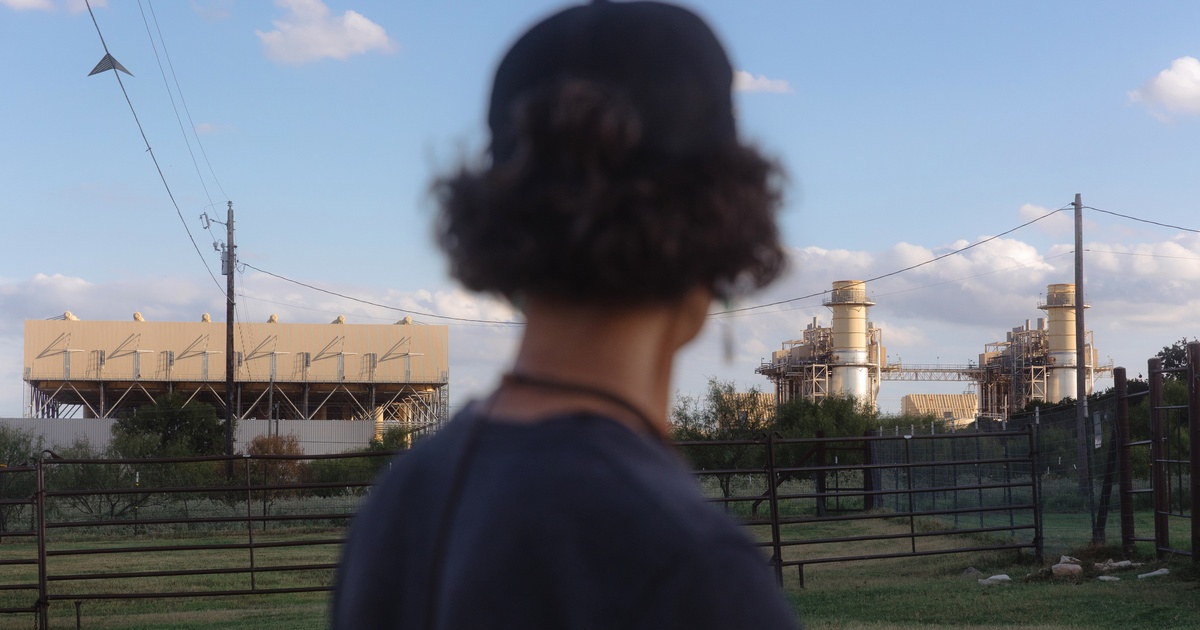
Leaders of the effort say they moved to rural Hood County for its quiet country charm, which was shattered by what locals call “that roar” from the facility.
Sign up for The Brief, The Texas Tribune’s daily newsletter that keeps readers up to speed on the most essential Texas news.
HOOD COUNTY — Danny Lakey and his wife have spent countless evenings sitting on rocking chairs on their front porch, watching the sun slowly dip behind the cows grazing on their neighbor’s ranch.
It was the calm country life they dreamed of in 2021 when they bought their log home, tucked into the woodlands of rural Hood County, southwest of Fort Worth. Danny Lakey proudly calls their home their “personal Cracker Barrel,” where they have more cows and horses as neighbors than people.
But ever since a noisy cryptocurrency facility moved in about half a mile away in 2023, he said their rocking chairs have mostly sat empty. Other nearby residents also say they don’t spend much time outside anymore because of what many call “that roar.”
Some compare it to a plane that never lands, or a lawnmower that never turns off. A county commissioner said it’s like “sleeping with a leafblower under your pillow.” No matter the comparison, there’s one common thread — it’s relentless.
It’s the sound of thousands of fans blowing in unison, cooling down nearly 60,000 computers working at lightning speed day and night, racing to earn bitcoins, the most common type of cryptocurrency. The facility, built in 2022, is a sprawling compound of computers stored in containers roughly the size of the mobile homes less than 100 yards away, where dozens of families live.
Residents say they repeatedly asked the facility, owned by MARA Holdings, also known as Marathon, to do something about the noise. The Florida-based company responded by extending a 2,000-foot long, 24-foot tall soundproofing wall last year and replacing some cooling fans with an immersion cooling system.
But residents say it’s done little to muffle the noise, which nearby residents have measured with decibel readers at just below the statewide ordinance of 85 decibels — the volume of a food blender or garbage disposal.
This site is protected by reCAPTCHA and the Google Privacy Policy and Terms of Service apply.
Now, community members have turned to an ambitious strategy to lower the volume: create a city. Lakey and others led a drive to collect enough signatures supporting incorporation, and in November, residents will vote on whether to create the city of Mitchell Bend, named after Mitchell Bend Highway, the two-lane road that binds the neighborhood.
If the roughly 250 registered voters approve the measure, Mitchell Bend would cover two square miles and have around 600 residents and one stop sign.
Incorporating into a city would give the community the power to create a noise ordinance they hope will force the $5 billion Bitcoin company to quiet down. Residents initially asked their county commissioners to set a noise limit, but in Texas, counties don’t have that power — only the state and municipalities do.
It’s a clash that’s playing out across Texas as more crypto facilities and data centers move to rural parts of the state, recruited by state leaders and drawn by abundant land, fewer regulations and attractive tax deals. Unlike some states, Texas doesn’t tax crypto companies’ profits. Texas also has cheaper electricity.
Marathon, which has at least three other crypto facilities in Texas, has been firmly defending its place in Hood County. The company sent a letter to the county judge in August asking him to invalidate the ballot measure, alleging that it had found that some people who signed the petition live outside the proposed city’s boundaries.
Marathon told The Texas Tribune in a written statement that the company is “aware that a few residents are trying to create a new town in what appears to be an attempt to negatively impact its Granbury facility” referring to the nearby county seat.
The company pointed to economic benefits it brings to the community: “MARA has a track record of adding jobs and tax revenues to the communities in which we operate and has invested more than $1.2 billion in our Texas sites, contributing millions in local tax revenues and supporting local schools and nonprofits. We are committed to maintaining our health and safety standards at the Granbury data center and being good neighbors.”
The fight with Marathon has also created an internal conflict among residents weighing whether to form a city: Many moved to the countryside to escape not only noisy cities, but city regulations.
“We are still conservative, we love our freedom,” Lakey said of his GOP-leaning community. “The biggest pushback that we’re getting on incorporation is from people who fear that a new city is going to try to set a lot of regulations. They’re very Texan, which means: don’t tell me what to do with my property.”
He and others say they’ve come to this point not only because the noise is a nuisance, but because residents say it’s robbing them of sleep and causing various health problems: hearing loss, vertigo, migraines and high blood pressure.
“We’re tired of billion dollar companies coming in and ruining our lives,” Lakey told County Judge Ron Massingil during an August commissioners court meeting. “And we’re getting really good at fighting Goliath.”
Texas’ rural sprawls have become a magnet for crypto companies.
In 2021, after China banned cryptomining, many flocked to the U.S. and Gov. Greg Abbott laid out a welcome mat for companies seeking a new home. On X he posted: “Texas is open for Crypto business.”
Texas is now home to at least 27 bitcoin facilities, according to the Texas Blockchain Council, making it the top crypto mining spot on the planet. Facilities in Rockdale and in Corsicana are the two largest in the world.
In 2023, according to the state’s comptroller’s office, crypto mines across Texas used around 2,717 megawatts of power, enough to power roughly 680,000 homes and far surpassing anywhere else in North America; Georgia is a distant second, at 525 megawatts.
State leaders have warmly welcomed crypto companies because they represent tax dollars and jobs: The industry pumped $4 billion into the state economy and employed 12,000 Texans last year, Carol Haines, senior vice president at digital infrastructure company Core Scientific, said during a Texas Tribune panel. Texas now has around 40% of the nation’s crypto investment, she said.
Many Hood County residents say they support businesses coming to Texas — but they want regulations in place to protect communities’ peace.
“You can be here, I don’t mind,” Lakey said. “Just be quiet, be a good neighbor. Act like a good neighbor, and you’re welcome to stay.”
Lakey and others who pushed for incorporation say they have butted heads with Massingill, the county judge, who rejected the petition for the ballot measure three months after the county had approved it — and a week after Marathon challenged some of the petition signatures.
In a heated moment during an August commissioners meeting, Massingill addressed a number of residents who expressed frustration about his decision to invalidate the petition. Massingill said he initially thought the petition had been reviewed by the county attorney, but it wasn’t. He said the county’s elections coordinator later informed him that the petition didn’t have enough valid signatures.
“I just don’t want anybody to say I’m not doing my job,” he told the audience.
When residents started over and got more than enough signatures to put incorporating Mitchell Bend on the ballot, Massingill approved it.
Using incorporation as a tool to regulate companies has become a common strategy for rural residents, said Alan Bojorquez, an Austin lawyer who says he’s helped a dozen communities try to become cities.
He’s worked with residents in Webberville in Travis County, which incorporated in 2003 to regulate gravel-making companies in the area that created large amounts of dust. He also worked with a community west of San Antonio called Quihi, where residents hoped to set regulations for multiple mines causing noise and dust, but their ballot measure failed in 2004.
“Normally you see people creating a city because they’re trying to protect something that’s being threatened,” Bojorquez said. “It’s this big balance of wanting the countryside life but also needing the regulations to protect it while you’re there.”
County Commissioner Nannette Samuelson, whose district includes the facility, said there are days when she can hear the crypto facility’s fans at her home, six miles away. She said she and the other commissioners urged the Texas Legislature last year to set stricter noise regulations for the state, but their plea fell on deaf ears.
State lawmakers have debated proposals in past legislative sessions to give counties the power to set noise ordinances like cities can, but have failed to agree on a bill. Cheryl Shadden, Lakey’s neighbor who’s lived in Hood County for around 40 years, said it’s a gap in the state’s policies that rural Texans are falling through.
“So if it’s in a big city, then ‘Hey, we’ll put some more protection in because there’s more of you people, but since you’re just a small, two square-mile town, you don’t deserve any protection?’” she asked. “How does that equate?”
As the November vote approaches, some residents said they feel trapped because they worry their property values have plummeted due to the constant noise.
Donna Adair, 65, has a brick home with a cozy backyard shed that she’s converted into her rockhounding lab. Bright red crepe myrtles line her driveway, and she’s adorned her yard with colorful birdhouses. She says she misses reading on her porch bench in peace.
Selling her home isn’t an option. “I couldn’t morally do it,” Adair said. “It’s wrong if you have a problem and you don’t tell people what it is. It may not be a sin of commission, but it’s a sin of omission.”
A mile away, Geraldine Lathers, 74, lives in a mobile home down the road from the crypto facility and says she began taking Vitamin D pills instead of going outside since the constant hums of the fans began two years ago. She added the supplements to medications she takes for vertigo spells, intense headaches and hypertension, ailments she says began last year.
“It’s just that awful,” Lathers said from her living room. “That noise is so loud, oh my God it makes you sick … it goes through your body.”
But what makes her heart ache is that her family visits less often because of the noise.
She said her grandkids grew up spending Sunday afternoons in her backyard when her big family — she now has 23 grandchildren and 20 great-grandchildren — often got together for barbecues. Now, she said, they don’t visit as much as before. The parents don’t want their kids near the noise, she said.
The two bounce houses they used to blow up for the kids are in the shed, Lathers said. “They don’t go out no more.”
That’s why Lathers said she’s planning on voting in favor of creating Mitchell Bend in November, even though she’s not enthusiastic about the idea.
“I’m for it, if it’ll make the noise go away,” she said while petting her dog, Gizzmo. “I don’t want to really be a city, but what choices have you got?”
Disclosure: Texas Blockchain Council has been a financial supporter of The Texas Tribune, a nonprofit, nonpartisan news organization that is funded in part by donations from members, foundations and corporate sponsors. Financial supporters play no role in the Tribune’s journalism. Find a complete list of them here.
The wait is over! The full TribFest program is here. Join us Nov. 13–15 in downtown Austin and hear from 300+ thinkers, leaders and change-makers shaping Texas’ future. TribFest gives you a front-row seat to what’s next, with 100+ sessions covering education, the economy, policy, culture and more. Explore the program.
TribFest 2025 is presented by JPMorganChase.
Independent Texas reporting needs your support. The Texas Tribune delivers fact-based journalism for Texans, by Texans — and our community of members, the readers who donate, make our work possible. Help us bring you and millions of others in-depth news and information. Will you support our nonprofit newsroom with a donation of any amount?
colleen.deguzman@texastribune.org
@acolleendg
Learn about The Texas Tribune’s policies, including our partnership with The Trust Project to increase transparency in news.
Energy Environment
Loading content …
Loading content …
For premium support please call:
For premium support please call:
XRP is up nearly 460% in a year after regulators backed off the crypto's issuing company, Ripple.
While adoption of Ripple's products continues to grow, large banks prefer a product that doesn't require the bank to touch XRP itself.
10 stocks we like better than XRP ›
With the Securities and Exchange Commission's (SEC) lawsuit against Ripple, the company behind XRP (CRYPTO: XRP), in the rearview mirror and a national bank charter application pending, XRP bulls feel there is a lot of momentum behind the token. Given its nearly 440% run during the past year, they have a point. So, with XRP hovering at less than $3, is now the time to buy?
Where to invest $1,000 right now? Our analyst team just revealed what they believe are the 10 best stocks to buy right now. Continue »
The bull case for XRP seems compelling. After years of regulatory uncertainty, Ripple finally settled litigation with the SEC in August, paving the way for increased adoption within the traditional financial system — the key to driving XRP's price higher. This has always been the core of XRP's investing thesis: As more banks adopt the technology, it will increase the demand for XRP, and its price will follow.
It's not so simple. Here's what I think a lot of investors miss: Banks can use Ripple's payment technology without ever touching XRP.
RippleNet, Ripple's most widely adopted product, doesn't require banks to hold or even briefly touch XRP. They get much of the speed advantages, the cost savings, and the efficiency gains while continuing to use their preferred currencies.
Ripple's on-demand liquidity (ODL) product, on the other hand, does often make direct use of XRP as a bridge asset for cross-border transactions. An ODL customer can send funds to a bank in another country without having to deal with the hassle and cost of currency exchange and maintaining pre-funded accounts in other countries. Instead, XRP can be used as an intermediary.
The issue is that ODL is not widely used by the larger banks that really matter. It's designed for institutions that have problems with liquidity, and in terms of value transacted, it remains niche compared to RippleNet.
This limits ODL's effect on XRP demand. While it's not non-existent, I don't think the effect is as strong as many investors believe. A dramatic increase in adoption across banking of Ripple's technology is much more likely to be seen with RippleNet, not ODL.
Image source: Getty Images.
Even if ODL adoption were to accelerate, there's an even bigger problem on the horizon: Ripple's own stablecoin ambitions may derail XRP's path, or at least seriously hinder it. The company's pursuit of a national trust bank charter signals that it wants to be at the forefront of what could be a huge wave of adoption of stablecoins in banking. It's a smart move for Ripple, as stablecoins can provide some of the same benefits that Ripple offers, and could be a several-trillion-dollar market by 2030, according to a Citigroup analysis.
Why does this matter for XRP? Ripple's stablecoin, RLUSD, could replace XRP as the preferred bridge asset in ODL transactions, significantly reducing demand. It's a scenario that could soon be a reality. Ripple's stablecoin push is clear between the charter application and its $200 million acquisition of a stablecoin payment technology company.
So, should you buy XRP while it's less than $3? I don't think you should. Although short-term catalysts could drive speculative gains, the fundamental disconnect between Ripple's success and XRP's value isn't going away. When Ripple itself is building alternatives to XRP's primary use case, that's not a great sign in my view.
It's easy to get caught up in hype, but it doesn't often lead to good outcomes. Bitcoin and Ethereum are both better options for investors who want exposure to crypto. They have proven track records of value and are more likely to succeed in the long run.
Before you buy stock in XRP, consider this:
The Motley Fool Stock Advisor analyst team just identified what they believe are the 10 best stocks for investors to buy now… and XRP wasn’t one of them. The 10 stocks that made the cut could produce monster returns in the coming years.
Consider when Netflix made this list on December 17, 2004… if you invested $1,000 at the time of our recommendation, you’d have $642,328!* Or when Nvidia made this list on April 15, 2005… if you invested $1,000 at the time of our recommendation, you’d have $1,134,270!*
Now, it’s worth noting Stock Advisor’s total average return is 1,064% — a market-crushing outperformance compared to 191% for the S&P 500. Don’t miss out on the latest top 10 list, available when you join Stock Advisor.
See the 10 stocks »
*Stock Advisor returns as of October 7, 2025
Citigroup is an advertising partner of Motley Fool Money. Johnny Rice has no position in any of the stocks mentioned. The Motley Fool has positions in and recommends Bitcoin, Ethereum, and XRP. The Motley Fool has a disclosure policy.
AOL
AOL
AOL
AOL
AOL
AOL
Advertisement
Advertisement
Advertisement
Advertisement
Advertisement
Advertisement
Advertisement
Advertisement
Advertisement
Advertisement
We participate in marketing programs, our editorial content is not influenced by any commissions. To find out more, please visit our Term and Conditions page.
We participate in marketing programs, our editorial content is not influenced by any commissions. To find out more, please visit our Term and Conditions page.
–
Best token to invest in is the question firing up crypto feeds this October 2025. Bitcoin (BTC) is stable at $122,000, Ethereum (ETH) holds $4,800, and XRP shocks the market by trading at $2.86 with a $171 billion market cap. Those who doubted XRP under $1 now feel the sting of regret, watching whales stack while retail sits on the sidelines.
But the coin stealing attention is BlockchainFX ($BFX). Unlike most projects, this isn’t just a presale fantasy. BlockchainFX is already live as a trading super app combining crypto, stocks, forex, and commodities. Early adopters are calling it one of the strategic early crypto picks of the year, with explosive presale numbers fueling predictions of 1000x potential gains.
The XRP market outlook is filled with bullish energy. Trading volume in the past 24 hours exceeded $6.6 billion, with whales aggressively buying the dip. XRP has already climbed nearly 50,000% since launch, and analysts expect 2025 to be a year where it could finally reclaim its $3.50–$5 levels.
XRP is not just a speculative play anymore. It’s building momentum through partnerships in banking and global remittances, making it a real-world utility coin. With regulation headwinds clearing, the 2025 token price prediction for XRP points toward continued growth, but timing remains critical. Those waiting for dips may miss the breakout entirely.
BlockchainFX ($BFX) stands out for one reason: it delivers utility today. The app already processes millions in daily trading volume with more than 10,000 active users. Audited by CertiK and fully KYC compliant, BlockchainFX has credibility most presales lack.
This is why participants label $BFX the best token to invest in. Holders don’t just wait for charts—they earn daily. Up to 70% of trading fees are redistributed as USDT rewards, generating 4–7% daily returns with APYs reaching 90%. Add in the BFX Visa cards (Gold, Green, Metal), which let holders spend crypto globally, and this token becomes more than just an asset—it’s a lifestyle upgrade.
The BlockchainFX presale is already rewriting the script for Q4 2025. The price started at $0.01 and has surged to $0.027, with scheduled increases every Monday until the confirmed $0.05 launch. Over $9.1 million has already been raised from 13,700 buyers, proving demand is sky-high.
The ROI math is irresistible. A $5,000 entry today at $0.027 grows to $9,259 at launch. If the token climbs to $1 as analysts forecast, that’s $185,000. A $50,000 position could hit $1.85 million. This is why urgency dominates discussions—every delay costs future gains.
The presale offers extra perks:
These mechanics fuel scarcity while locking in community loyalty. That’s why analysts call this an explosive presale with 1000x potential upside.
Many community members see BlockchainFX ($BFX) as your second chance at life-changing ROI. Those who missed Bitcoin under $1,000 or Ethereum under $1000 know the pain of waiting too long. $BFX removes that regret by combining real-world revenue streams with aggressive growth projections.
Forecasts place post-launch valuations between $0.10 and $0.25 in the near term, with long-term projections above $1 as adoption scales. Five centralized exchange listings are already confirmed, ensuring liquidity from day one. For participants, this is a play that combines immediate staking rewards with exponential upside—a rare balance in today’s crypto market.
So, is BlockchainFX truly the best token to invest in this October 2025? XRP may be targeting $5, Ethereum continues to dominate, but BlockchainFX has set itself apart with explosive presale growth, real utility, and ROI scenarios that trigger both urgency and greed. The BlockchainFX presale is live at $0.027, with the clock ticking toward $0.05. Every week missed means fewer tokens and smaller upside.
Participants who act now can secure 30% more tokens with BLOCK30, stack referral rewards, and even compete for the $500,000 prize pool. With APYs up to 90% and 1000x potential, BlockchainFX is not just a presale—it’s a once-in-a-cycle opportunity. For community members searching for strategic early crypto picks, $BFX is proving why it deserves the crown as the best token to invest in before 2026 begins. Bags or regrets—the choice is now.
Find Out More Information Here
Website: https://blockchainfx.com/
X: https://x.com/BlockchainFXcom
Telegram Chat: https://t.me/blockchainfx_chat
Disclaimer: This is a paid post and should not be treated as news/advice. LiveBitcoinNews is not responsible for any loss or damage resulting from the content, products, or services referenced in this press release.
LiveBitcoinNews is a leading online platform dedicated to providing the latest news and insights about Bitcoin and the broader cryptocurrency market. It offers timely updates on market trends, regulatory developments, technological advancements, and expert analyses, catering to both seasoned investors and newcomers in the digital currency space. The site features a variety of content, including articles, guides, interviews, and opinion pieces, making it a comprehensive resource for anyone interested in staying informed about the rapidly evolving world of cryptocurrencies.
Contact us: support@livebitcoinnews.com
© Copyright – Livebitcoinnews.com
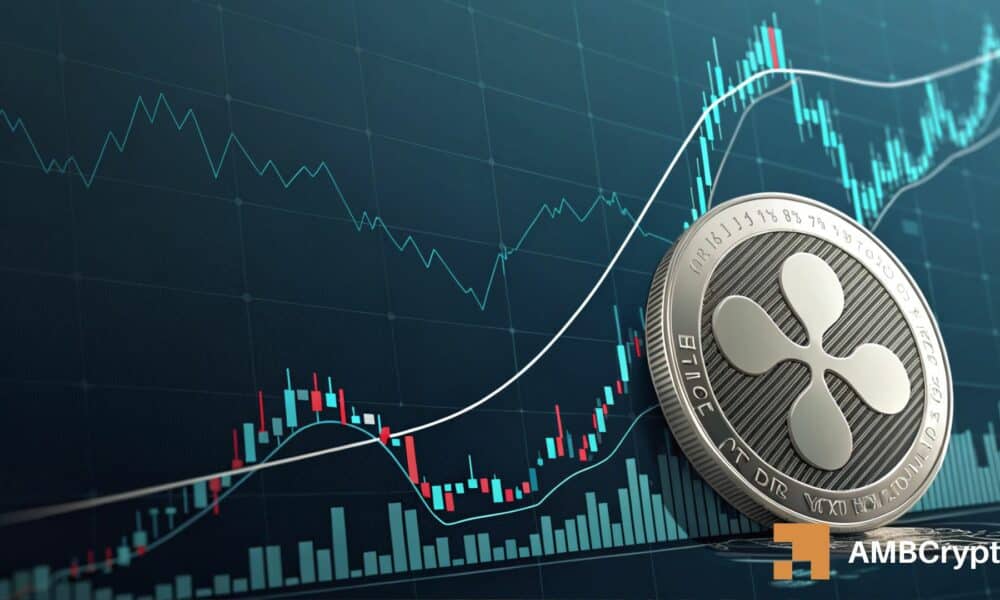
XRP shows growing bearish pressure as network activity cools and sell-side dominance strengthens.
The descending triangle pattern, reinforced by dominant sell-side CVD, indicates sustained downward pressure that could drive a retest of $2.72.
Falling Open Interest and lower network participation show fading confidence, which could increase the likelihood of another downward move.
Ripple [XRP] has been showing visible weakness within a descending triangle, with lower highs compressing against a flat support near $2.72.
Bearish pressure is building across the market, with sell-side momentum on the rise. On-chain and derivatives data show traders are losing confidence, and overall sentiment remains cautious.
For XRP, several key indicators now signal a shift toward downward momentum. The spotlight is on the $2.72 support level.
Can it hold, or will fresh selling pressure drive prices into a deeper decline?
Source: TradingView
The Spot Taker CVD remains in “Taker Sell Dominant” territory, implying continuous net selling in the spot market. This trend indicates that aggressive market participants are still offloading XRP, limiting any meaningful bullish recovery.
Additionally, short-term bounces have failed to reverse this pattern, showing that sellers maintain control of momentum. However, if this selling intensity eases, XRP could stabilize briefly before its next major move.
Market conditions remain fragile, and any further downside push could easily drive a retest of the triangle’s lower boundary near $2.72.
Source: CryptoQuant
On-chain data shows a significant cooldown in network participation, reflecting waning investor enthusiasm.
Transaction count recently dropped to around 109K, while network growth fell to just 859 — both signaling a steep decline in on-chain activity.
This slowdown suggests that fewer addresses are engaging with the XRP Ledger, reducing transaction volume and overall network momentum.
However, a rebound in network engagement could indicate renewed accumulation.
Until then, the fading activity reinforces the bearish narrative already reflected in XRP’s technical setup and trading volumes.
Source: Santiment
Open Interest (OI) declined by 6.51% to 2.78 billion, at press time, underscoring lower participation among derivatives traders. This drop shows that both long and short traders are closing positions as volatility subsides.
Such contraction often precedes a continuation of the prevailing trend, especially when accompanied by dominant sell-side pressure.
However, low leverage exposure might limit the extent of forced liquidations in the short term.
For XRP to regain momentum, new positions must emerge with renewed confidence. Until that happens, the prevailing caution could support another retest toward $2.72.
Source: CryptoQuant
XRP faces a decisive moment as multiple indicators align toward downside pressure. Technical weakness, shrinking network activity, and declining OI all suggest limited bullish support.
While $2.72 remains a key psychological and structural level, sustained sell dominance could drive a deeper retracement.
Unless demand strengthens soon, XRP’s short-term outlook leans bearish, increasing the probability of a retest at $2.72 before any potential rebound.
Disclaimer:
AMBCrypto’s content is meant to be informational in nature and should not be interpreted as investment advice. Trading, buying or selling cryptocurrencies should be considered a high-risk investment and every reader is advised to do their own research before making any decisions.
© 2025 AMBCrypto


