

samreen Adeel(@Square-Creator-25a8092f267df)’s insights Binance
source
Despite losing most of its value and practically fading into obscurity, on October 2, Melania Trump restarted the promotion of the MELANIA token.
An AI-generated video posted on X implied the token is “the path into the future”, confusing traders, as there was no mention of a controversial, unexplained selloff of $30M community funds on April 7.
In the meantime, the market is in full recovery mode, as even the latest XRP price prediction sparks hype. And right now, crypto presales such as DeepSnitch AI offer the opportunity for the biggest gains.
DeepSnitch AI generated heavy interest due to raising nearly $300K rapidly in the first stage of the presale. The fast action, the price of $0.01735, and the underlying AI utility have many traders aping into DeepSnitch AI due to its astronomic upside potential.
After months of dormancy, the First Lady posted an AI-generated video promoting the meme coin, tagging the coin’s official account on October 2.
Although the post referred to MELANIA as the “path into the future”, sparking if the new promotional activity will put the coin back into the limelight, investors are cautious due to its volatile history.
MELANIA drama started on April 7 when the team moved $30 million of funds to private wallets and sold them off without explaining to investors the reasoning behind the move. Moreover, insiders may have also sold $1.5M worth of MELANIA to profit from the weekly 21% increase on April 28.
The token lost most of its value since its January launch and traded at around $0.1800 at press time. According to CoinMarketCap, MELANIA recorded a small 13% weekly increase as a result of the video.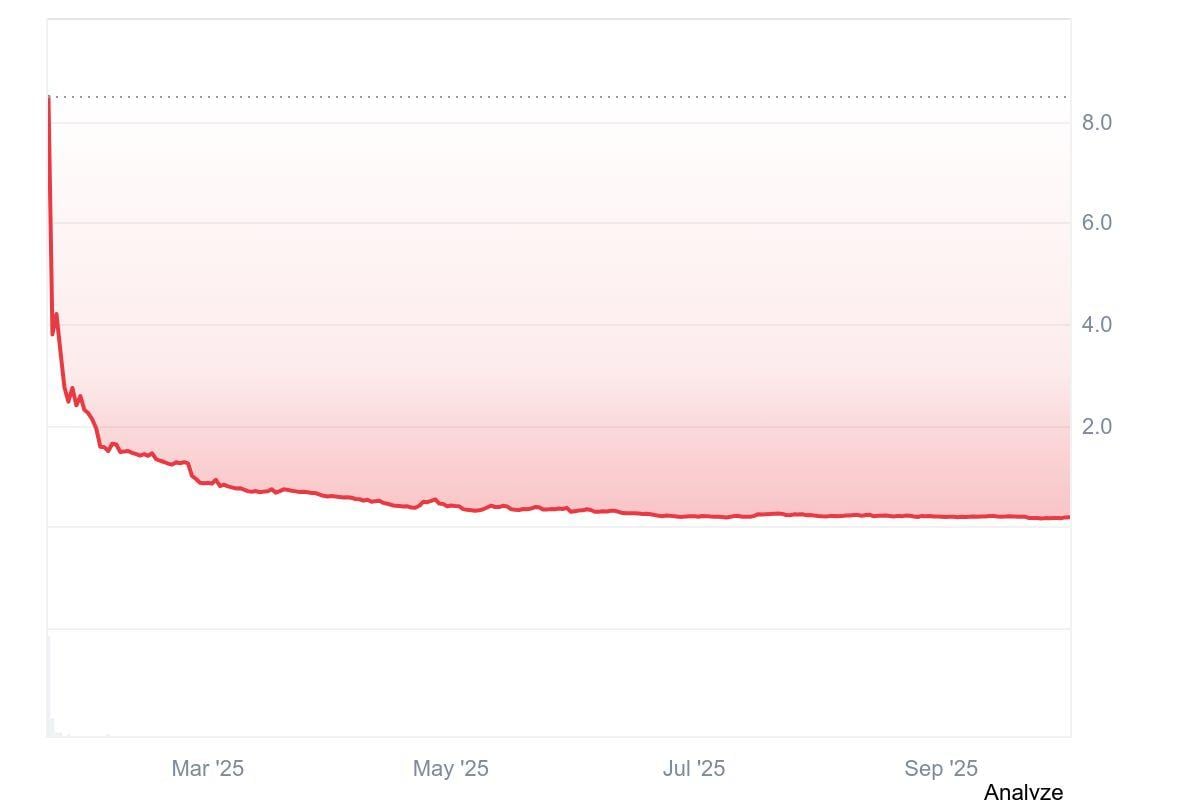
This isn’t surprising, as one of the founders associated with the controversial LIBRA token also co-created MELANIA. Hayden Davies is also allegedly behind the Wolf of Wall Street-inspired meme coin, which crashed by 99% within 48 hours.
As a result, it’s unlikely that investors will re-rotate into MELANIA.
Most coins are set to pump in October, which is why investors are likely to choose safer established coins or high-potential crypto presales in order to grow their bags during Q4.
As a bona fide trader analytics suite, DeepSnitch AI raised almost $300K within the first stage at the price of only $0.01735.
DeepSnitchAI is building an AI-powered platform consisting of a smart central dashboard and five AI agents that scope out crucial crypto analytics. For instance, traders will be able to track whale wallets, spot contract risks (thus avoiding rug pulls), find new high-potential coins, and gain access to the latest alpha news.
If the market forces stay positive, DeepSnitch AI has the potential to become an integral tool for a wide array of retail traders. If this happens, the project will likely explode upon listing and reach mainstream adoption.
The price is set at $0.01735. This is an affordable entry point into the AI market, while the combo of the core utility and the hype that helped the project raise $293K could provide a sizable upside.
Some investors already believe that 100x is within sight. This means that investing $500 or $300 could potentially yield traders profits $50K and $30K, respectively.
Generally speaking, such an ROI is very hard to achieve with established coins. For instance, to get the same returns on a $500 investment with XRP would require it to reach $300, which is unlikely considering the coin’s ATH was $3.80.
Judging by the results and the sheer quality of the utility, DeepSnitch AI might be the best crypto to buy now for astronomic returns. Check out the DeepSnitch AI presale and reserve your tokens.
According to CoinMarketCap, XRP tested $3 multiple times on October 2, finally breaking through the critical level.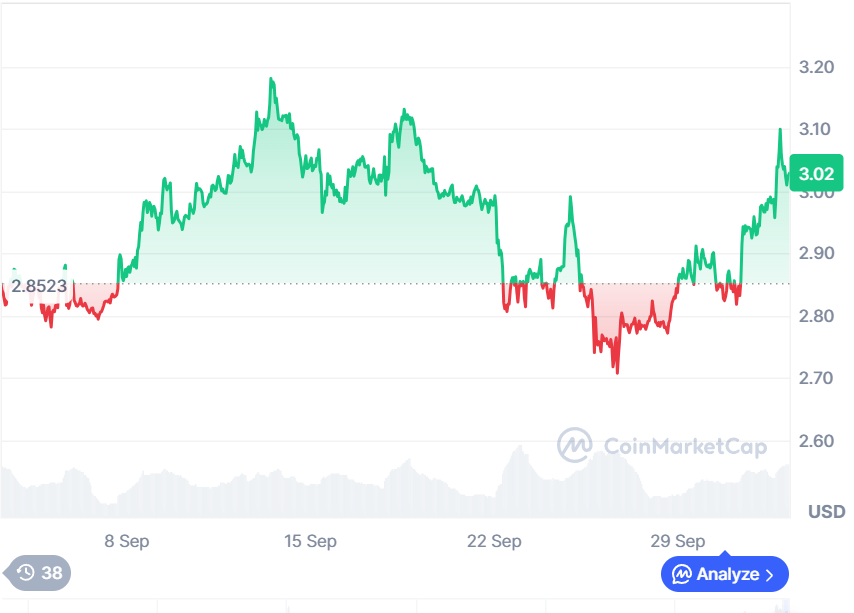
According to experts, the best times for XRP are yet to come, citing the expected launch of various XRP ETFs in Q4, which might push the demand to new heights. If the momentum continues and bulls continue pushing, there’s a possibility that XRP might reach $3.50 in October, with an end-of-the-year target of $5.
In the short term, XRP is expected to rally toward $3.40 if the price stays solid above $3.
However, despite the strong fundamentals and the bullish XRP price prediction, this crypto may not be a good investment for traders who are looking for explosive crypto coins. That is, unless you’re ready to put in thousands into a token that is often clowned on for its volatility and slow price action.
Cardano continued a definitive uptrend on October 3 and settled in the $0.8600 area, according to CoinMarketCap.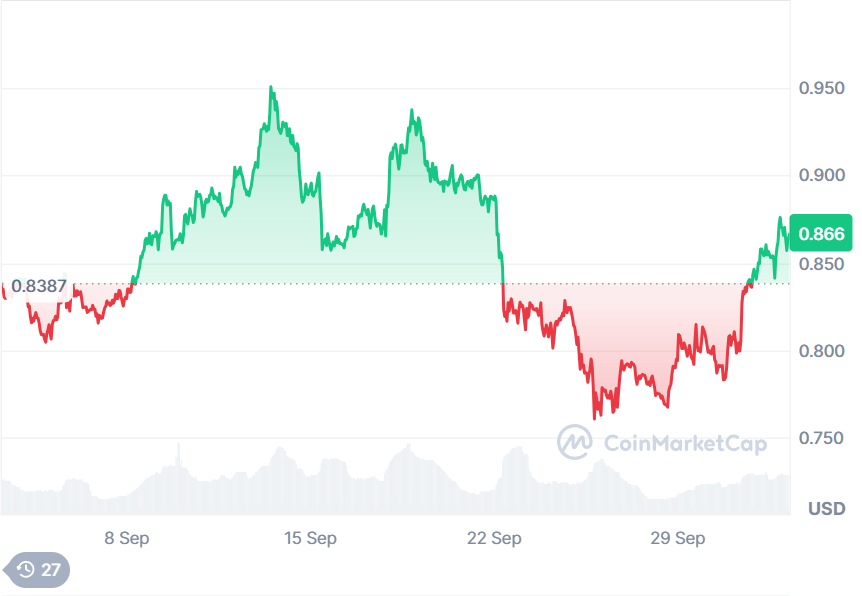
For the time being, bulls will have to strengthen their position, which may help Cardano trade at $1.02 in the short term.
Yet, since it’s in full recovery mode, analysts believe that ADA will heavily benefit from anticipated ETF approvals in the coming weeks. If ADA maintains its trajectory, there’s a strong possibility for a pump above $1 with an eventual Q4 goal of $4.
For the time being, bulls will have to strengthen their position, which may help Cardano trade at $1.02 in the short term.
However, a breakdown below $0.75 could tank ADA to as low as $0.68.
Even if Cardano reaches $4, it might not provide as strong an ROI that is possible to receive with early-stage presales.
As MELANIA returns from the dead and the market breaks out in a series of rallies, even the XRP price prediction is buzzing.
At the same time, presales are slowly entering their zenith as traders expect to grow their bags as the altcoin season inches closer. DeepSnitch AI, for instance, raised over $293K at $0.01735 in the first stage of the presale.
Since many believe that a 100x pump is in the books for DSNT after listing, October is the best time to participate in the DeepSnitch AI presale.
Analysts expect XRP to test $3.50 in October and potentially reach $5 by the end of 2025, driven by ETF launches and bullish momentum.
While XRP has solid fundamentals, presales like DeepSnitch AI may offer higher upside potential due to lower entry prices and trader-centric utility.
Key catalysts include ETF approvals, institutional adoption, favorable regulatory outcomes, and sustained bullish momentum in the crypto market.
Disclaimer: This media platform provides the content of this article on an “as-is” basis, without any warranties or representations of any kind, express or implied. We assume no responsibility for any inaccuracies, errors, or omissions. We do not assume any responsibility or liability for the accuracy, content, images, videos, licenses, completeness, legality, or reliability of the information presented herein. Any concerns, complaints, or copyright issues related to this article should be directed to the content provider mentioned above.
Solana Price Surge: 20% Up to $232 and Counting Solana has surged about 20% in…


Winning numbers drawn in Friday’s Indiana Cash Pop San Antonio Express-News
source


Highlights
Banks and payment networks are embedding stablecoins into cross-border settlement to cut inefficiencies.
Interoperability and prefunding models are critical to making stablecoins viable at scale.
Institutional adoption depends on trusted rails, governance and regulatory compliance.
Stablecoins were once the province of private issuers, characterized by opaque backing, fragmented liquidity and minimal oversight.
Complete the form to unlock this article and enjoy unlimited free access to all PYMNTS content — no additional logins required.
yesSubscribe to our daily newsletter, PYMNTS Today.
By completing this form, you agree to receive marketing communications from PYMNTS and to the sharing of your information with our sponsor, if applicable, in accordance with our Privacy Policy and Terms and Conditions.
At times, they behaved more like speculative assets than steady payment mechanisms.
However, established banks and global payment networks are increasingly embedding stablecoins into settlement rails that corporates and treasurers may trust.
Traditional cross-border payments are cumbersome. A payment may travel through multiple correspondent banks, each charging fees, performing compliance holds and holding prefunded balances in various jurisdictions. This leads to multiday settlement, foreign exchange slippage, float costs, limited transparency and reconciliation burden.
Stablecoins on blockchain rails seek to address these frictions directly. Because stablecoins are typically pegged to fiat currencies like the U.S. dollar, volatility is minimized. Settlement can become atomic and near instant. Token transfer and transaction metadata move together. Liquidity can be supplied just in time, so capital isn’t locked across multiple nostro accounts. Programmable rules can embed reconciliation, enforce compliance or trigger conditional transfers.
Stablecoins are emerging as connective settlement layers in B2B cross-border flows, helping chief financial officers manage liquidity more efficiently. When Coinbase reported second-quarter earnings results in July, CEO and co-founder Brian Armstrong said cross-border stablecoin payments are likely a $40 trillion opportunity, and the B2B market is 75% of that.
Advertisement: Scroll to Continue
Payment networks are among the first incumbents to fold stablecoin rails into their strategies. Visa announced Tuesday (Sept. 30) a pilot to enable institutions to prefund stablecoin balances into Visa Direct for global disbursements, while recipients still receive fiat. This cuts prefunding friction and turns what were days of float into minutes.
Visa framed stablecoin prefunding not as a cryptocurrency experiment, but as a treasury liquidity tool, treating tokenized balances as “money in the bank” for outgoing payouts.
Mastercard has also launched initiatives to settle cross-border card flows using tokenized settlement, emphasizing integration into existing payment infrastructure, interoperability across rails and regulatory compliance.
These network-led pilots signal that stablecoins are being embedded as extensions of, not replacements for, established processing rails.
Banks are not idle. Many of the world’s largest institutions are exploring issuance and settlement capabilities. Those banks see stablecoins as a mechanism to streamline cross-border flows.
In Europe, a consortium of nine banks announced Sept. 25 that they launched a project to issue a euro-denominated stablecoin under the European Union’s Markets in Crypto-Assets regulation (MiCA) supervision, aiming for it to become “a trusted European payment standard” with near-instant, low-cost, cross-border settlement.
At the same time, banks are embedding existing stablecoins rather than reinventing everything. An August collaboration between Circle and Finastra connects bank payment hubs to Circle’s USDC settlement infrastructure, enabling fiat-originated payments to settle in USDC behind the scenes. This hybrid approach reduces friction for banks wanting stablecoin efficiency without rebuilding front-end systems.
Stablecoin rails are not uniformly cohesive. Many stablecoins exist across multiple blockchains (Ethereum, Solana, Avalanche, etc.). To move value across chains, institutions must use bridges, which lock tokens on one chain and issue equivalents on another. But bridging carries liquidity fragmentation, hidden spreads and security vulnerabilities.
Bridging may soon be central to liquidity management, cross-border settlements and risk exposure, and CFOs must manage predictability, liquidity and risk across multiple chains. Further, stablecoin bridging and token swaps introduce operational risk. Bridge hacks historically have accounted for roughly 40% of crypto value lost across the sector.
Networks and banks have an opportunity to reduce these risks by offering standardized cross-chain settlement services, curated liquidity pools and governance to rationalize fragmentation.
Stablecoins Reshape Cross-Border Payments as Banks and Networks Step In
Stablecoins Surge This Week as Market Value Tops $300 Billion
OnePay to Add Crypto Services Amid Drive to Build Financial Super App
Decentralization Emerges as a Test of Big Tech’s AI Power
We’re always on the lookout for opportunities to partner with innovators and disruptors.