
Banker 66 BOOM,💓
Second banker 81 ended in machine,
37 Equivalent to 62,
89 Played 90.
Winning Numbers: 43-62-02-90-(66 Bnk)
Machine Numbers: 27-82-(81)-17-80
Banker 66 BOOM,💓
Second banker 81 ended in machine,
37 Equivalent to 62,
89 Played 90.
Winning Numbers: 43-62-02-90-(66 Bnk)
Machine Numbers: 27-82-(81)-17-80

“How I Discovered My Uterine Fibroids” Health Central
source


MARA Holdings has solidified its position as the world’s second-largest public Bitcoin holder, announcing its treasury now contains 52,850 BTC valued at more than $6 billion.
The Miami-based Bitcoin mining company revealed these numbers in its September 2025 production update, marking a significant milestone in corporate Bitcoin adoption.
The company trails only Strategy (formerly MicroStrategy), which holds 640,031 bitcoins. With Bitcoin trading above $114,000 in early October 2025, MARA’s holdings represent a major bet on cryptocurrency as a treasury asset.
MARA mined 736 Bitcoin in September, a 4% increase from August. The company won 218 blocks on the Bitcoin network, showing a 5% monthly improvement. These gains came even as global mining competition intensified, with the worldwide hashrate jumping 9% to an average of 1,031 exahashes per second.
“This growth in production underscores our ability to execute consistently, even as mining becomes more difficult,” said Fred Thiel, MARA’s chairman and CEO, in the company’s official statement.
MARA’s energized hashrate reached 60.4 EH/s by month’s end, reflecting ongoing expansion of its mining infrastructure. The company maintained 99% fleet uptime during September, demonstrating operational reliability.
MARA has accelerated its Bitcoin accumulation throughout 2025. The company held just 47,531 BTC in March, meaning it added over 5,300 bitcoins to its treasury in six months. This growth came through both mining operations and strategic purchases.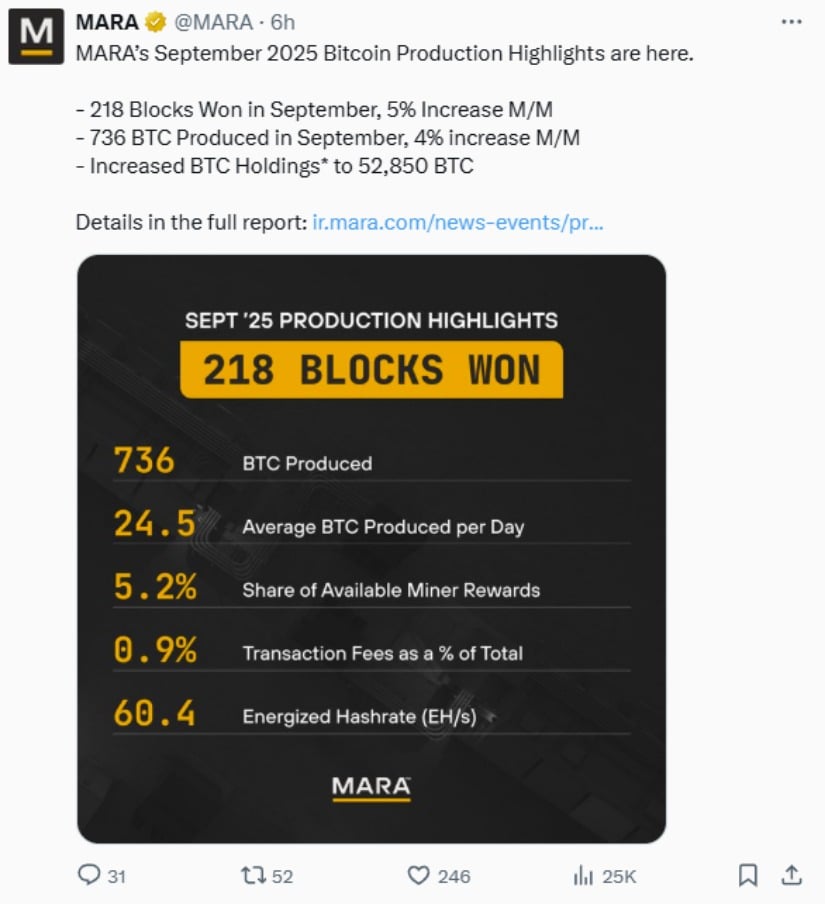
Source: @MARA
Here’s how MARA’s holdings grew:
The company did engage in some Bitcoin sales during September as part of its “digital asset management activities,” according to its disclosure. However, mining production more than offset these sales, resulting in net growth.
CEO Fred Thiel has emphasized that MARA treats Bitcoin as a productive asset rather than letting it sit idle. “Unlike passive treasury companies, we treat our bitcoin as a productive, risk-managed asset,” Thiel explained in an August press release. The company uses its holdings to strengthen its balance sheet and fund operations.
MARA’s production gains stem from major infrastructure improvements. At the company’s Texas wind farm, all mining containers and equipment are now fully deployed and connected. This facility is on track to reach full operational status in the fourth quarter of 2025.
The company’s Hannibal, Ohio site now operates at 100% capacity with 86 megawatts online. MARA plans to add another 14 megawatts by year-end. Since taking full control of this location, the company increased uptime to 99%.
These renewable energy projects serve dual purposes. They reduce MARA’s operating costs while supporting the company’s goal of sustainable Bitcoin mining. The Texas wind farm specifically helps MARA mine Bitcoin using clean energy sources.
MARA’s 52,850 Bitcoin holdings place it far ahead of other public mining companies but well behind Strategy’s massive position. Strategy has pursued an aggressive Bitcoin acquisition strategy for years, using convertible debt and stock sales to fund purchases.
Michael Saylor predicted in December 2024 that MARA could become the next Bitcoin company to join the Nasdaq 100 index. This would follow Strategy’s historic inclusion in the prestigious index.
MARA’s market capitalization stood at approximately $6.74 billion as of early October 2025. The company’s stock has gained ground alongside Bitcoin’s price appreciation, with shares climbing 20% over the past month.
Other companies are starting to follow the Bitcoin treasury model. Adam Back’s Bitcoin Standard Treasury Co. is preparing to go public with plans to accumulate more than 50,000 BTC, which could challenge MARA’s second-place position.
MARA represents part of a broader movement of public companies adding Bitcoin to their balance sheets. This strategy gained traction after Strategy pioneered the approach in 2020. Companies view Bitcoin as a hedge against inflation and a superior store of value compared to traditional cash reserves.
Recent U.S. Treasury guidance has made this strategy more attractive by clarifying that certain unrealized gains on digital assets don’t count toward corporate minimum taxes. This provides tax benefits for companies like MARA that hold large Bitcoin positions.
The company emphasizes its role in national digital infrastructure. By mining Bitcoin and holding it as a treasury asset, MARA positions itself at the intersection of digital finance and energy management.
MARA differs from pure treasury companies by actively mining new Bitcoin rather than only buying it on the open market. This dual approach of mining production and strategic accumulation allows the company to grow holdings while controlling costs through operational efficiency.
MARA continues expanding its mining operations across multiple locations. The company targets sustained production growth through infrastructure investments and energy optimization. With facilities in Texas, Ohio, and international locations, MARA maintains geographic diversification.
The company’s Bitcoin holdings now exceed the $6 billion mark, a milestone that reinforces its commitment to the cryptocurrency. As Bitcoin prices fluctuate, the value of these holdings will change, but MARA’s strategy focuses on accumulating more Bitcoin rather than maximizing short-term dollar value.
Whether other public companies follow MARA’s lead remains to be seen. For now, the company stands as the second-largest institutional Bitcoin holder, trailing only Strategy’s dominant position.
MARA Holdings has built a $6 billion Bitcoin treasury through consistent mining operations and strategic asset management. The company’s 52,850 BTC position demonstrates how public companies can use cryptocurrency as a core treasury asset. With operational efficiency improvements, renewable energy investments, and continued production growth, MARA has established itself as a leader in corporate Bitcoin adoption beyond just buying coins on the market. Brave New Coin reaches 500,000+ engaged crypto enthusiasts a month through our website, podcast, newsletters, and YouTube. Get your brand in front of key decision-makers and early adopters. Don’t wait – Secure your spot and drive real impact in Q3 & Q4. Find out more today!
4 Oct 2025
4 Oct 2025
4 Oct 2025
Sven Luiv|4 Oct 2025|News|
Usman Ali|4 Oct 2025|News|
Naveed Iqbal|4 Oct 2025|News|
Naveed Iqbal|4 Oct 2025|News|
Usman Ali|4 Oct 2025|News|
Auckland / Melbourne / London / New York / Tokyo
A Techemy company
PO Box 90497, Victoria St West, Auckland Central, 1010, New Zealand.
© 2025 Brave New Coin. All Rights Reserved.
Sponsored

Nollywood actress Destiny Etiko has shared a cryptic message on social media following her recent awkward encounter with colleague Angela Okorie.
Over the weekend, a viral video surfaced showing Destiny deliberately walking away on the dance floor to avoid Angela during an event. The clip sparked buzz online, with many speculating about tension between the two stars.
In what seemed like a veiled jab, Angela later described herself as “a light that makes darkness disappear” and emphasized that “darkness and light have nothing in common.”
Responding subtly, Destiny posted a series of striking new photos on Instagram and captioned them with affirmations of self-worth.
“I am authentic, unapologetic, and unstoppable,” she declared.
Later, in an Instagram Live session, Angela called out Destiny, accusing her of hiding behind social media to throw jabs but staying silent when face-to-face.
Without mentioning names, Destiny seemed to respond once again, sharing another post that read:
“Learning, laughing, and loving every moment. Dream big, study hard.”
The ongoing back-and-forth hints at unresolved tension between the Nollywood stars, as fans watch to see if either party will address the matter more directly.
Copyright © 2025 Gistlover Media. All Rights Reserved

Can You Get Pregnant With PCOS and Endometriosis? Health Central
source

Spokane
Coeur dAlene
Live updates all day, breaking news as it happens and weather every 10 minutes
Resize:
Lottery
Director of Digital and Streaming
Lottery
NEWMAN LAKE, Wash. — A Newman Lake retiree discovered she won $472,500 in the Washington State Lottery’s Hit 5 game while checking her ticket over morning coffee Wednesday.
D.M., who asked to remain partially anonymous, matched all five numbers in the September 23 drawing when the jackpot reached $945,000. She split the prize with another winner.
“I went flying upstairs and told my better half, ‘I think I just won some money,'” she said.
The winner buys a Hit 5 ticket weekly at Yoke’s Fresh Market in Liberty Lake and checks her numbers the next morning against the newspaper.
“I’ve matched four numbers before and won $150, but nothing like this,” D.M. said. “Some of the really big games just seem to take forever and so I looked at the big prize amounts with Hit 5 and I said to myself, ‘I’d be happy with that’…and now I am!”
She plans to use her winnings for a bathroom remodel and travel to visit out-of-state family. The remainder will go into savings.
COPYRIGHT 2025 BY KXLY. ALL RIGHTS RESERVED. THIS MATERIAL MAY NOT BE PUBLISHED, BROADCAST, REWRITTEN OR REDISTRIBUTED.
Director of Digital and Streaming
{{description}}
Email notifications are only sent once a day, and only if there are new matching items.
Your browser is out of date and potentially vulnerable to security risks.
We recommend switching to one of the following browsers:

Six XRP ETF filings are due Oct. 18–25; we trace the paperwork and model flows, liquidity, and price impact.
Cover art/illustration via CryptoSlate. Image includes combined content which may include AI-generated content.
Six spot XRP exchange-traded funds (ETFs) await SEC approval in the US, with final deadlines for October, and they can reshape market conditions following their debut.
The regulatory backdrop underwent a significant change on Sept. 17, when the SEC approved generic listing standards for crypto-related ETFs across major exchanges.
As a result, Bloomberg senior ETF analyst Eric Balchunas noted on Sept. 29 that approvals on altcoin ETFs are not a matter of “if,” but “when.”
However, timing still depends on Washington. During the federal shutdown, the SEC is operating with a skeleton crew and does not process registration statements, pausing the launches of ETFs until funding resumes.
Once staff return, effectiveness orders can be reassessed, meaning an October approval is still plausible.
The regulatory backdrop suggests that Bitwise, 21Shares, WisdomTree, Canary Capital, CoinShares, and Grayscale will launch their XRP products on Cboe this month. Consequently, the move will restructure the XRP market.
How much money could flow is a live debate, but several guideposts exist. Market researchers suggested as much as $8 billion in first-year inflows, with CryptoQuant’s Julio Moreno estimating ETFs could absorb 1% to 4% of circulating supply.
Meanwhile, Bitget’s Jamie Elkaleh estimated the $4 billion to $8 billion range as a realistic base case.
JPMorgan’s January framework, extrapolated from Bitcoin and Ethereum penetration, projected 3% to 6% of market cap converted into inflows.
XRP traded at $3.05 as of press time, which implies roughly $5.5 billion to $11 billion in year-one net creations.
In the battle to capture capital flows in this billion-dollar market, fee competition and distribution strategies are crucial. Lower expense ratios and broad brokerage access historically correlate with stronger early flows.
Regarding investor positioning, retail investors are likely to dominate the first-year inflows if XRP is to replicate the movements of spot Bitcoin ETFs. A K33 February research highlighted that 25.4% of spot Bitcoin ETF assets under management are held by institutions.
Launch day price action demands nuance. Bitcoin’s US spot ETFs triggered a “sell the news” stretch, as BTC tumbled 7.5% on the day following the products’ launch and risked losing the $40,000 threshold.
Ethereum’s spot ETF debut saw a similar movement, with a 4.25% decline the day after its launch. In a larger timeframe, Bitcoin quickly climbed to a local top of nearly $74,000 two months later, while Ethereum continued to nosedive until early October.
However, Bitcoin’s movement occurred in a bullish environment for the entire market, while the Ethereum ETF aftermath took place during a significant correction period. As a result, it is challenging to predict XRP’s price action, although a sell-the-news event is likely to happen, considering past events.
What is almost certain to change is XRP’s market plumbing. Glassnode documented how US spot ETFs have become a structural “supply absorber” for Bitcoin and Ethereum on their weekly reports.
The exchange-traded products capture net creations that remove coins from the liquid float. When ETF demand cools, fragility rises. Conversely, when flows resume, drawdowns stabilize as supply tightens.
An XRP complex would likely replicate that cadence, with steady creations capturing inventory inside funds, shifting price discovery toward the pace of advisor and retail allocations, and reducing sensitivity to purely crypto-native liquidity cycles.
With the crypto ETF rule change in place and the paperwork live, the core question for XRP ETFs is not about a potential approval, but how the first wave of flows reshapes XRP’s market dynamics.
Gino Matos is a law school graduate and a seasoned journalist with six years of experience in the crypto industry. His expertise primarily focuses on the Brazilian blockchain ecosystem and developments in decentralized finance (DeFi).
AJ, a passionate journalist since Yemen’s 2011 Arab Spring, has honed his skills worldwide for over a decade. Specializing in financial journalism, he now focuses on crypto reporting.
Your daily dose of must-have crypto news and deep dives. Direct to your inbox.
Disclaimer: Our writers’ opinions are solely their own and do not reflect the opinion of CryptoSlate. None of the information you read on CryptoSlate should be taken as investment advice, nor does CryptoSlate endorse any project that may be mentioned or linked to in this article. Buying and trading cryptocurrencies should be considered a high-risk activity. Please do your own due diligence before taking any action related to content within this article. Finally, CryptoSlate takes no responsibility should you lose money trading cryptocurrencies.
The XRP Ledger is a decentralized cryptographic ledger powered by a network of peer-to-peer servers.
Bitcoin, a decentralized currency that defies the sway of central banks or administrators, transacts electronically, circumventing intermediaries via a peer-to-peer network.
Ethereum is a decentralized, open-source blockchain platform that enables the creation of smart contracts and decentralized applications (DApps).
Bitwise Asset Management pioneered the first cryptocurrency index fund and is the leading provider of rules-based exposure to the cryptoasset space..
Established in 2013 by Digital Currency Group, Grayscale Investments is a trusted authority on digital currency investing and cryptocurrency asset management.
21Shares is a Swiss provider of crypto- currency exchange-traded products (ETPs).
WisdomTree is a global financial innovator, offering a well-diversified suite of exchange-traded products (ETPs), models, and solutions.
Canary Capital is a prominent investment management firm specializing in institutional cryptocurrency trading and asset management.
The CoinShares Group is a pioneer in digital asset investing.
CryptoQuant is a South Korean firm specializing in providing cryptocurrency market analytics and on-chain data to investors and industry participants.
Cboe Global Markets is a leading global exchange operator and provider of financial market solutions.
Bitget is a Seychelles-based cryptocurrency exchange platform established in 2018 that provides services for trading various digital assets.
JPMorgan Chase & Co is a global leader in financial services, offering solutions to the world’s most important corporations, governments, and institutions in more than 100 countries.
K33, formerly Arcane Crypto, is a research-led digital assets brokerage with investment services that was founded in 2018 by CEO Torbjørn Bull Jenssen.
Glassnode brings data intelligence to the blockchain and cryptocurrency space.
Eric Balchunas is an American author, ETF analyst, and Senior ETF Analyst at Bloomberg Intelligence.
Get the latest crypto news, insights and market analysis straight to your inbox.
We respect your privacy and will never share your email address.
Please add [email protected] to your email whitelist. You may unsubscribe at any time.
Disclaimer: By using this website, you agree to our Terms and Conditions and Privacy Policy. CryptoSlate has no affiliation or relationship with any coin, business, project unless explicitly stated otherwise. CryptoSlate is only an informational website that provides news about coins, blockchain companies, blockchain products and blockchain events. None of the information you read on CryptoSlate should be taken as investment advice. Buying and trading cryptocurrencies should be considered a high-risk activity. Please do your own diligence before making any investment decisions. CryptoSlate is not accountable, directly or indirectly, for any damage or loss incurred, alleged or otherwise, in connection to the use or reliance of any content you read on the site.
© 2025 CryptoSlate. All rights reserved. Terms & Conditions | Privacy Policy
Learn how pros avoid bagholding, spot insider front-runs, and capture alpha — before it’s too late.
Please add [email protected] to your email whitelist.
Stay connected 👇

Written by
Kamina Bashir
Edited by
Harsh Notariya
Since the launch of Pi’s Open Network, the community has eagerly awaited the listing of Pi Coin (PI) on Binance, the world’s largest crypto exchange. However, these expectations have yet to materialize.
Amid this, an analyst has outlined three primary reasons behind PI’s absence from major exchanges like Binance and Coinbase.
BeInCrypto previously reported that Binance launched a community vote for PI listing. Despite receiving 86% of the votes in favor, the exchange did not list the token.
Then, on Pi2Day, many expected an announcement regarding the listing, but once again, there was nothing. However, this may not be without reason.
In a detailed post on X, analyst Kim H. Wong highlighted why Binance or Coinbase have yet to list Pi Coin. According to him, the first obstacle is the non-open-source nature of Pi Network’s blockchain code.
Wong emphasized that open-source code facilitates trust and technical scrutiny, a standard the Pi Network has yet to meet. The second issue is the absence of a third-party security audit.
Major exchanges require rigorous security evaluations to protect users and comply with regulatory standards. The analyst revealed that unverified audit claims have been contradicted by ‘official disclaimers.’ Furthermore, there is no reliable documentation or source to verify that Pi Network has ever been audited.
“Third-party security audits are critical but not explicitly tied to open-source requirements. Coinbase emphasizes rigorous security reviews and often prefers audited code, while Binance focuses on technical stability and market demand. Open-source code, while not mandatory, would facilitate audits and enhance trust, but Pi Network’s closed mainnet status and lack of public audit reports suggest it may not yet meet these standards,” Wong stated.
The third reason is that Pi Network may not have formally applied for listing on these exchanges. At present, Pi Coin is available to trade on several centralized exchanges, including OKX, MEXC, Bitget, etc. However, whether the team has submitted an official application to Binance or Coinbase is uncertain.
This step is essential, as exchanges often require proactive engagement from project teams, including detailed documentation and compliance with their listing criteria. Without this, Pi Network’s path to these high-profile platforms remains blocked.
Previously, in an exclusive interview with BeInCrypto, Ray Youssef, CEO of NoOnes, also stressed that Pi Network’s mainnet’s permissioned nature and lack of transparency regarding how its tokenomics will work in an open environment are key factors that have hindered its listing on Binance.
Meanwhile, Wong added that a Binance or Coinbase listing could prove favorable for the price, which is currently just 10.7% away from returning to its all-time low.
BeInCrypto data showed that Pi Coin’s price has continuously declined for two months.
At the time of writing, it was trading at $0.45, down 3.8% over the past day. The trading activity has also slowed a bit as evidenced by the 5.8% dip in trading volume over the last 24 hours.
Daily Crypto Insights
Insights, news and analysis of the crypto market straight to your inbox
Disclaimer
In adherence to the Trust Project guidelines, BeInCrypto is committed to unbiased, transparent reporting. This news article aims to provide accurate, timely information. However, readers are advised to verify facts independently and consult with a professional before making any decisions based on this content. Please note that our Terms and Conditions, Privacy Policy, and Disclaimers have been updated.

