Posted on Leave a comment

AVAX One Leads the Charge in Crypto's Bold New Era – OneSafe

In a stunning metamorphosis within the cryptocurrency sector, AgriFORCE emerges anew as AVAX One, signaling a decisive foray into the dynamic world of blockchain finance. This rebranding is more than a cosmetic change; it marks a critical juncture for institutional investors eager to tap into the expansive horizons of decentralized finance (DeFi). With an impressive $550 million fundraising initiative currently underway and an ambitious target of raising over $700 million in AVAX tokens, AVAX One is set to solidify its role as a powerhouse in the Avalanche ecosystem.
As AVAX One takes this audacious leap forward, the global marketplace is experiencing a seismic shift toward blockchain investment strategies. Companies everywhere are adjusting their sails, recognizing the growing relevance of digital assets. This transformation encapsulated in the AVAX One rebranding, embodies a thorough reevaluation of institutional investment practices. The company’s treasury-backed model is not merely about amassing crypto assets; it aims to inject substantial capital into its ventures while enhancing governance functions and championing groundbreaking DeFi projects.
Central to this eye-catching rebranding is Hivemind Capital, a significant player in the crypto investment arena. Tasked with spearheading the funding campaign, Hivemind has rallied contributions from more than 50 institutional investors, notable names like the Digital Currency Group (DCG) and Kraken among them. This robust support underscores a resounding faith in AVAX One’s strategic direction and the Avalanche blockchain’s potential to redefine financial systems. This confidence becomes increasingly vital as AVAX One navigates the labyrinth of regulatory challenges while striving to establish itself as a leading force in digital asset accumulation.
While AVAX One garners attention, the Avalanche Foundation is concurrently pursuing its own ambitious vision, reportedly aiming to secure $1 billion to create two U.S. treasury firms focused on acquiring and managing AVAX tokens. This endeavor not only fortifies the network but also cements AVAX’s status as a cornerstone of institutional investment. The foundation’s tactical decision to launch dedicated treasury firms signals a purpose-driven approach aimed at ensuring the stability and growth of the Avalanche network, striving to carve out a competitive edge in the crowded crypto market.
However, as institutional players deepen their engagement in the crypto space, they must tread carefully through a landscape riddled with potential pitfalls. Experts raise alarms about the volatility inherent in large, centralized token holdings, warning that such a concentration may clash with the decentralized ethos that underpins DeFi. Although the institutional influx of AVAX tokens acts as a cushion against market fluctuations, it also brings to light pressing concerns around liquidity risks that could jeopardize smaller entities in the ever-evolving Web3 domain.
Looking ahead, AVAX One’s interaction with staking and governance will shape its trajectory. By amassing a significant portfolio of AVAX tokens, the company stands to wield considerable influence within the decentralized finance ecosystem, shaping operational norms for burgeoning crypto ventures. By developing a treasury management framework that deftly balances compliance and efficiency, AVAX One has the opportunity to pioneer innovative practices that smaller firms might emulate, establishing a comprehensive and sustainable strategy for navigating the complex world of crypto asset management.
The potential that AVAX holds is vast. Recent price developments hint at a remarkable 400% rally, piquing the interest of investors far and wide. With the Avalanche network undergoing technical advancements that have catapulted its market cap to over $12 billion, both current and prospective investors find themselves with a favorable outlook. As AVAX One and the Avalanche Foundation forge ahead, significant innovations loom on the horizon, illuminating the interconnected destinies of traditional finance and emergent digital currencies.
AVAX One’s rebranding and the Avalanche Foundation’s bold initiatives illustrate the rapid and dynamic evolution of the cryptocurrency landscape. This strategic pivot by institutional investors signals a transformative shift that compels established players and newcomers alike to reassess their roles in the blockchain domain. By navigating the inherent risks while embracing cutting-edge treasury strategies, entities like AVAX One are positioned to redefine how institutions engage with decentralized finance. This transformation stands as a testament to the potential reshaping of the financial landscape, showcasing the bright futures that dedicated crypto engagement can unlock.

Get started with Web3 Busineses effortlessly. OneSafe brings together your crypto and banking needs in one simple, powerful platform.
AVAX One ushers in a new chapter for crypto investment, with innovative strategies and $550 million fundraising targeting institutional investors in the DeFi landscape.
$ASTER token launch revolutionizes DeFi with explosive volume, innovative tokenomics, and cross-chain trading. Explore Aster's impact on future decentralized trading.
The CSRC advises Chinese brokerages to pause RWA tokenization in Hong Kong, highlighting regulatory challenges and growth potential in the digital asset market.
Begin your journey with OneSafe today. Quick, effortless, and secure, our streamlined process ensures your account is set up and ready to go, hassle-free
source

Posted on Leave a comment

$180 Billion XRP Faces Its Biggest Upgrade Yet With New Ripple DeFi Roadmap – TradingView

Ripple’s new roadmap makes it clear that XRP, already valued at $180 billion, is being promoted as an institutional DeFi asset at a time when the sector is demonstrating its true size: $161.8 billion is locked in protocols, $292.8 billion in stablecoins, $15.6 billion is traded daily on DEXes and there is $23 billion in perpetuals volume, according to DefiLlama. 
The message is clear: XRPL is evolving beyond payments to encompass the compliance, credit and tokenized markets, where billions are already changing hands daily.
1/ Institutional DeFi is here and the XRP Ledger has solidified its position as the trusted open source settlement layer for global institutions.
The next phase of the roadmap starts now. Explore it below and read the full blog for details 🧵⬇️ https://t.co/YLQ9Po8xMQ
Upgrades are now live, with on-chain proof of regulatory status, freeze controls for issuers and simulation tools for reducing errors. These features address regulators' concerns, contributing to the growth of XRPL's stablecoin, which recently surpassed $1 billion in a single month, and its position in the top 10 real-world asset chains, valued at $15.6 billion in DeFi. XRP's role as a settlement asset within this system continues to expand.DefiLlama">
The bigger shift will come with version 3.0. A protocol-level lending system will pool liquidity and issue loans natively under KYC/AML standards, creating cheaper institutional credit and direct yield opportunities. The Multi-Purpose Token standard, due in October, will allow bonds and structured products to be issued and traded directly on XRPL. 
Bottom line
These are not side experiments but are ways of pulling regulated money into markets where XRP is both the collateral and the liquidity rail.
Privacy is next. Zero-knowledge proofs are being developed to enable institutions to transact and collateralize positions without revealing details while still passing audits.
In a market where ETFs are pulling in inflows of $270 million in a single day and stablecoins are approaching $300 billion, Ripple’s plan signals that XRP is not just surviving but is being positioned to sit at the heart of the largest flows in digital finance.
Select market data provided by ICE Data Services. Select reference data provided by FactSet. Copyright © 2025 FactSet Research Systems Inc.Copyright © 2025, American Bankers Association. CUSIP Database provided by FactSet Research Systems Inc. All rights reserved. SEC fillings and other documents provided by Quartr.© 2025 TradingView, Inc.

source

Posted on Leave a comment

Ask the Pediatrician: School cell phone policies: Tips for families – The Union Democrat

Sunny. High 86F. Winds WSW at 5 to 10 mph..
A clear sky. Low 58F. Winds light and variable.
Updated: September 22, 2025 @ 9:37 am
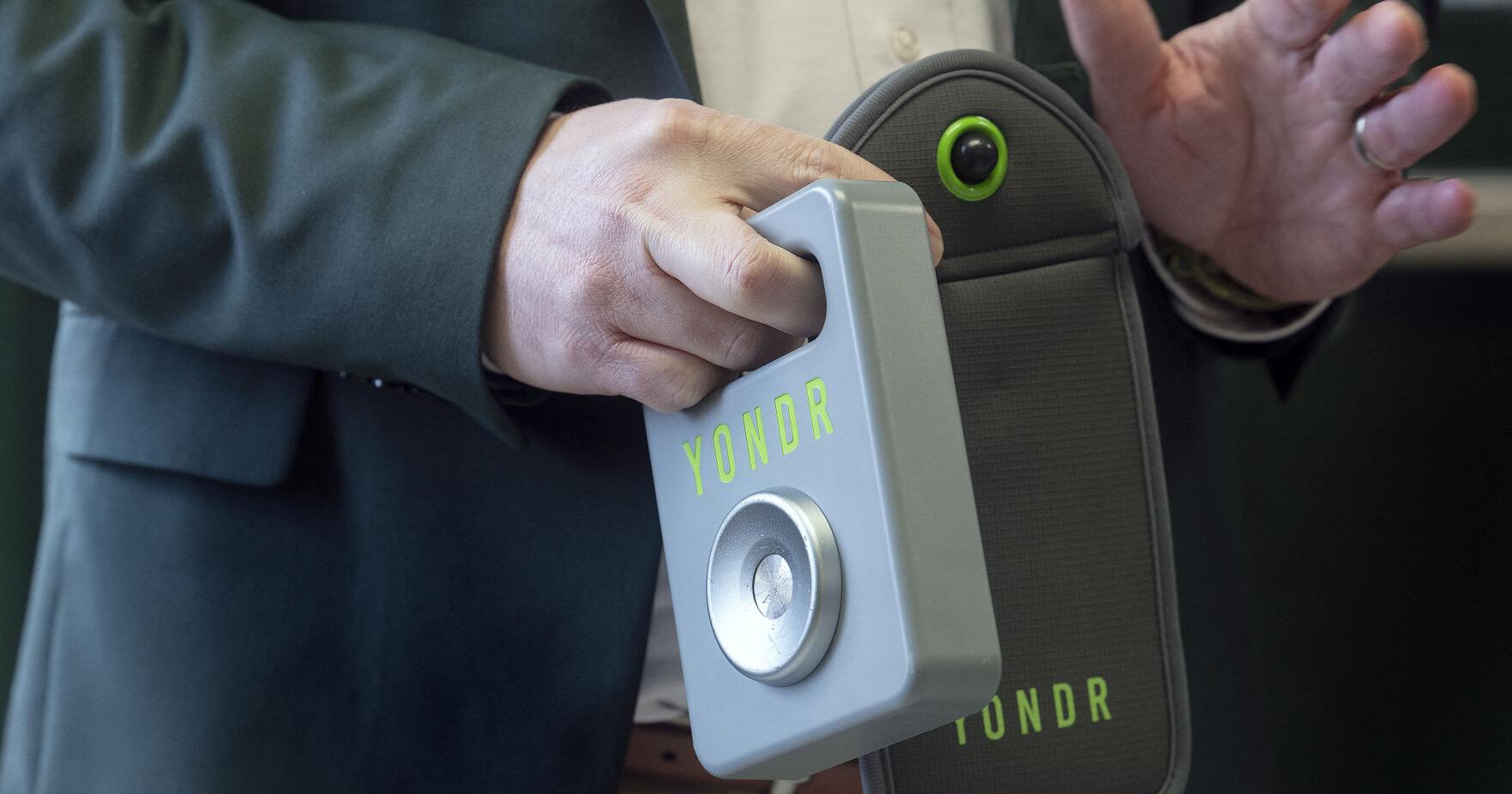
Mark Twain Middle School Principal Matthew Mough speaks during an interview about the school’s smartphone ban in Alexandria, Virginia, on March 6, 2025, while holding the locking YONDR pouch for cell phones and magnetic unlocking base kept by the school’s administrators. The phone ban at the School is among a wave of measures implemented around the US, and is part of a global movement replicated in Brazil, France and beyond. Mough admitted that enforcing the ban, and winning over students, has proved challenging. “The majority of kids who have phones don’t love it,” he said. “However, if you dig deeper with them in the conversation, they will acknowledge that it’s helped them remain focused.” (Jim Watson/AFP/Getty Images/TNS)

Mark Twain Middle School Principal Matthew Mough speaks during an interview about the school’s smartphone ban in Alexandria, Virginia, on March 6, 2025, while holding the locking YONDR pouch for cell phones and magnetic unlocking base kept by the school’s administrators. The phone ban at the School is among a wave of measures implemented around the US, and is part of a global movement replicated in Brazil, France and beyond. Mough admitted that enforcing the ban, and winning over students, has proved challenging. “The majority of kids who have phones don’t love it,” he said. “However, if you dig deeper with them in the conversation, they will acknowledge that it’s helped them remain focused.” (Jim Watson/AFP/Getty Images/TNS)
Does your child’s school have a new phone policy starting this year? Some schools now ask students to keep phones away “bell-to-bell,” from the start of classes through dismissal. Others use locking bags like the Yondr pouch to store phones during the day. Some only allow phones at lunch.
New school phone policies like these and more can mean some adjustments for both students and parents. Parents, especially, have said they feel worried about not being able to easily access their child at school if there’s an emergency. These changes will take some getting used to for everyone. Here are some first steps to help your children prepare for these changes.
Without thinking about it, many of us have our phones in our hands or pockets most of the day. Try setting times at home when everyone puts their phones out of reach and does other activities. These breaks from screens help kids of all ages adjust to being without their devices and focus more on what’s happening around them.
Easy times to start going phone-free are during car rides, meals or time outside. At bedtime, swap the phone for a book, journaling or another bedtime routine. As a parent, you can model this behavior by putting away your devices, too!
One way to help your teen or tween step away from their phones more is by showing them the benefits of phone-free time. Talk about time away from phones as an experiment that everyone will learn from. How does it feel to not have their phone within reach? Do they like the uninterrupted time being alone with their thoughts, or is it uncomfortable at first? How much have they gotten in the habit of following a feed rather than their own creativity? Pay attention to see if at-home conversations or homework become easier.
You can also utilize built-in phone settings that most phones and devices have to help manage screen time. Through digital well-being, screen time or family pairing settings, you can set downtime or do-not-disturb options. Instead of seeing it as a restriction on your family’s screen time, treat it as protecting activities that matter to you, where you want to be fully present. Remind your kids that tech companies don’t need (or deserve) to have access to us every waking minute of the day!
Check your phone settings together as a family and view your screen time amount or number of pickups. Are you surprised at how many times you also pick up your phone?
Middle and high school students often say they use their phones to relax or “reset” when school feels overwhelming. As a caregiver, validate the fact that it’s normal to feel that way at school sometimes. But also emphasize the importance of problem-solving with other coping strategies like taking deep breaths, using grounding exercises, asking to take a brief walk to get a drink of water and speaking with a school counselor. Parents and educators can work together to support students who are feeling stressed or overwhelmed by brainstorming plans for when students need to reset.
A major source of phone notifications during kids’ school days is—guess what? Parents! Although it’s convenient, and you may want to provide emotional support to a stressed child, kids learn how to be independent more easily when they have some space away from their parents each day. Batch your notifications until after school is over or write ideas down on a sticky note to talk about with your child later.
Did you know you can schedule texts to be delivered at specific times in the future? Type a text when convenient for you and select “Send Later” to deliver when convenient for them!
For unexpected issues like needing a pickup, illness or forgetting homework, use the school office phone line during the school day. Set an expectation that using the phone is fine before and after school. If you’re worried about communicating during emergencies, talk to the school and review the emergency communication plan. All schools should have a plan in place.
If your child or teen is getting a new phone, you can do them a favor by making it boring to begin with. This means starting out without social media, YouTube or games. These are the biggest distractions during school hours. You can set up the phone to require your permission for new downloads. This way, the phone is mostly a communication device, not a source of fun, and they won’t be as tempted to check it during the school day.
Some parents have expressed concern about phone rebounding, or increased use for extended time periods, after their kids get their phones back at the end of the day. Talk with your children about how it feels to be away from their phone during school hours and how they can still use their phone mindfully while also ensuring tasks that need completed like homework are prioritized.
Change is hard, so treat mistakes as a growth opportunity. Take the time to review and discuss your school’s phone policy with your child. Go over what the consequences will be if kids violate their school policy, and how you will work together to help your child succeed.
____
Jenny Radesky, MD, FAAP, is Co-Medical Director of the American Academy of Pediatrics (AAP) Center of Excellence on Social Media and Youth Mental Health and the David G. Dickinson Collegiate Professor of Pediatrics at the University of Michigan Medical School, where she directs the Division of Developmental Behavioral Pediatrics. Dr. Radesky authored the AAP policy statements Media and Young Minds and Digital Advertising to Children. She is editor of the developmental behavioral pediatrics textbook Encounters With Children, 5th Edition, and sits on the Board of Children Youth and Families at the National Academy of Science. You can follow her on Instagram@jennyradeskymd.
Megan Moreno, MD, MPH, MSEd, FAAP, is Co-Medical Director of the AAP Center of Excellence on Social Media and Youth Mental Health and a Professor of Pediatrics and Affiliate Professor of Educational Psychology at the University of Wisconsin-Madison. She is the academic chief for the Division of General Pediatrics and Adolescent Medicine and serves as Vice Chair of Academic Affairs for the Department of Pediatrics. Dr. Moreno is passionate about helping teens through the challenges around balancing relationships, influences, and experiences, and to consider ways in which technology may provide new venues for education and support. You can follow her team on social media at@SMAHRTeam.
©2025 Tribune Content Agency, LLC. 
Sorry, there are no recent results for popular videos.
Sorry, there are no recent results for popular commented articles.
Your browser is out of date and potentially vulnerable to security risks.
We recommend switching to one of the following browsers:

source

Posted on Leave a comment

Pi Network Price Prediction: PI Coin Could Collapse Within 6 Months As Traders Look For Alternatives – CoinCentral

The Pi Network Price Prediction debate has strengthened with investors weighing the risks of holding the token. The project has established a strong community, yet concerns about sustainability are always on the horizon. 
That is why most investors are now starting to consider alternative crypto projects, which have more obvious avenues for adoption in the real world. Among them is Remittix (RTX), currently priced at $0.1030, which is working on cross-border payments with a beta wallet to be implemented in Q3 2025.

Pi Coin is worth $0.3474, a 1.12% appreciation in value over the past day. Its market capitalization is at $2.77 billion, backed by a $26.45 million trading volume, but with a drop of 36.36%. This blend of relative value appreciation but slowing liquidity has sent alarm bells ringing among analysts after the most recent Pi Network Price Prediction metrics.
A project with little real-world application can struggle to maintain momentum once the hype has passed. It is for this reason that Pi Network is being increasingly compared to new tokens building infrastructure from scratch. Investors are looking to know if new presales with working products might offer safer, longer-term opportunities.
Remittix is among the most hotly talked-about crypto presales that are live now, with more than $23.4 million raised and more than 642 million tokens sold. It is selling at $0.1030 per token, one of the top cryptos under $1 with actual utility. 
The company has acquired two major centralized exchange listings as part of its rollout strategy. BitMart indicated support when presale reached $20 million (BitMart announcement), and LBank indicated support subsequently after the $22 million threshold (LBank official statement). Such listings instill confidence through early liquidity and exposure among global markets.
At the heart of Remittix’s roadmap is the Q3 2025 beta wallet, designed to bring crypto and fiat systems seamlessly together. The wallet will support more than 40 cryptocurrencies and more than 30 fiat currencies, with real-time FX conversion at launch. Users can deposit money directly into bank accounts in more than 30 countries, something not typically found in other DeFi projects.

By focusing on ease of use and mobile first, Remittix is fixing one of crypto’s biggest problems: making digital currencies accessible to freelancers, companies, and everyday remitters. Its innovations put it in the running among the best new altcoin launches this year.
With its presale buzz, upcoming beta wallet, and utility-focused vision, Remittix tells a far different narrative than Pi Network. It may not have the same hype, but with its practical adoption focus and low gas fee solutions, it’s got the makings of a crypto with real utility
Discover the future of PayFi with Remittix by checking out their project here:
Website: https://remittix.io/
Socials: https://linktr.ee/remittix
$250,000 Giveaway: https://gleam.io/competitions/nz84L-250000-remittix-giveaway
Disclaimer: This media platform provides the content of this article on an “as-is” basis, without any warranties or representations of any kind, express or implied. We assume no responsibility for any inaccuracies, errors, or omissions. We do not assume any responsibility or liability for the accuracy, content, images, videos, licenses, completeness, legality, or reliability of the information presented herein. Any concerns, complaints, or copyright issues related to this article should be directed to the content provider mentioned above.
Maisie is an experienced Crypto & Financial news journalist, having written for Moneycheck.com, Blockonomi.com, Computing.net and is Editor in Chief at Blockfresh.com
TLDRs; UAE launches first Middle East Nvidia AI Technology Center with Abu Dhabi’s Technology Innovation…


Never Miss Another Opportunity.
Get hand selected news & info from our Crypto Experts so you can make educated, informed decisions that directly affect your crypto profits!
Type above and press Enter to search. Press Esc to cancel.
BC Game Crypto: 100% Bonus & 400 Free Casino Spins, Claim Here!

source

Posted on Leave a comment

Is XRP Price Going to Crash After Falling Below $3 Again? – TipRanks

XRP dropped under $3, sparking fears of a deeper slide toward $2. But while the short-term chart looks bearish, some analysts insist the bigger trend still points to double-digit gains.
XRP (XRP-USD) slipped about 5% in the past 24 hours, trading around $2.80 on Monday. The failure to hold above $3 matters because it is not just another number on a chart It’s important to know that round numbers often serve as emotional checkpoints. Falling below them suggests the market’s momentum has shifted.

In XRP’s case, $3 had become a symbolic milestone after months of climbing, so losing that level is seen as a warning that the rally may be losing fuel.
Technical analysts are watching XRP’s chart, and what they see is a classic descending triangle. This is a pattern where each rebound stalls at a lower high, showing that sellers are stepping in earlier each time.
At the same time, buyers are defending the same floor, creating a flat line of support. When that floor finally breaks, the result is often a sharp move downward.
For XRP, the key support is around $2.75. If price closes below that, chart watchers say a sell-off could carry it as low as $2.07. This price level would mark a drop of more than a quarter from where it stands now.
Beyond the chart, there is another factor weighing on XRP: profit-taking. One way analysts measure this is through a metric called Net Unrealized Profit/Loss, or NUPL.
In simple terms, it shows how many holders are in profit compared with those in loss.
Today, more than 94% of XRP’s supply is in profit. This sounds like a win, but in practice it creates pressure. When nearly everyone is sitting on gains, many decide it is time to cash out. XRP’s NUPL reading is now in the 0.5–0.6 zone, a level that has coincided with local tops in the past. This happened in 2017, again in 2021, and once more in January 2025, each time followed by sharp corrections. Traders fear history could be repeating.
Despite the warning signs, not everyone is convinced XRP is heading for disaster.
Some analysts argue the current pullback is just noise in a larger uptrend. They point to the weekly and monthly charts, which still show bullish structures forming. CryptoBull, for instance, predicts XRP will climb to $5 as soon as October, brushing aside the latest dip as a technical correction.
Another popular commentator, Egrag Crypto, told his followers that while short-term charts look shaky, the higher time frames are “crystal clear.” He sees an ascending triangle forming on the monthly chart with a target as high as $27. Others, like XForceGlobal, believe Elliott Wave analysis points to an eventual cycle top above $20.
The immediate question is whether XRP can reclaim the $3 level or whether resistance will keep it capped. If buyers cannot push price back above that mark, the focus will shift to whether $2.75 can hold as durable support.
A breakdown there could bring XRP closer to $2, wiping out much of the recent rally. At the same time, some traders are betting that the launch of new ETFs and looser monetary policy from the Federal Reserve will revive demand for risk assets, including XRP.
At the moment, the token is caught in a battle between short-term weakness and long-term optimism, and whichever side wins will define its next chapter.
At the time of writing, XRP is sitting at $ 2.86.
Disclaimer & DisclosureReport an Issue

source

Posted on Leave a comment

Pi Coin Price Bounce Might Be a Bull Trap To New Lows – BeInCrypto

Written by
Ananda Banerjee
Edited by
Harsh Notariya
Pi Coin (PI) is showing some life after a tough stretch. At the time of writing, the Pi Coin price sits near $0.36, up almost 3% in the past 24 hours and about 4% over the past week. The move might look encouraging for traders hoping the token has turned a corner.
But caution is warranted. A closer look at the charts suggests the price surge may not be what it seems. If current signals play out, this bounce could become a trapdoor to a new all-time low at $0.31.
The first clue comes from the Money Flow Index (MFI), which tracks both price and trading volumes to show buying or selling pressure. MFI has risen sharply alongside this bounce, pointing to active dip-buying. On the surface, this looks healthy — it suggests traders are stepping in.
But the Chaikin Money Flow (CMF) tells another story by curling down and staying in the deep negative territory. CMF measures whether money is flowing into or out of the asset. Right now, CMF sits at -0.11, showing there are no meaningful inflows from bigger players but outflows.
Want more token insights like this? Sign up for Editor Harsh Notariya’s Daily Crypto Newsletter here.
That means the recent Pi Coin price uptick is retail-driven, without the backing of larger money. This mismatch between MFI and CMF often signals weakness.
Zooming out, the daily RSI (Relative Strength Index) makes things even clearer.
RSI compares the size of recent gains to recent losses. In this case, the Pi Coin price has made lower highs, but RSI has made higher highs. That’s a hidden bearish divergence, which typically points to continuing downtrends. Put together, the MFI-CMF split and RSI divergence confirm that the bounce may be nothing more than a trap.
The 4-hour chart provides the final piece of the puzzle. The Pi Coin price appears to have formed a head-and-shoulders pattern, a classic bearish setup. The right shoulder peak seems complete now with the bounce, with the neckline sitting around $0.33. If price breaks below that neckline, the measured target points to a drop toward $0.31 — a new all-time low.
That’s why this bounce looks risky. While retail traders are fueling the short-term rise, broader indicators and chart structures are pointing down.
There is one way to invalidate this bearish setup: Pi Coin must reclaim $0.37 with a strong 4-hour close. That would break above the head area of the bearish pattern, restoring momentum for the bulls. Until that happens, the bounce is better seen as a trapdoor that could send the PI price lower.
Daily Crypto Insights
Insights, news and analysis of the crypto market straight to your inbox
Disclaimer
In line with the Trust Project guidelines, this price analysis article is for informational purposes only and should not be considered financial or investment advice. BeInCrypto is committed to accurate, unbiased reporting, but market conditions are subject to change without notice. Always conduct your own research and consult with a professional before making any financial decisions. Please note that our Terms and Conditions, Privacy Policy, and Disclaimers have been updated.

source

Posted on Leave a comment

Next Crypto to Explode as DSNT Presale Demand Goes Bonkers – CoinCentral

On September 17, meme coin livestreamers pulled off a stunt by unveiling a 12-foot golden statue of President Donald Trump holding a Bitcoin outside the US Capitol. The prank, streamed on Pump.fun, came with claims it was a tribute to Trump’s pro-crypto stance.
Theatrics like this may create attention, but traders hunting for the next crypto gem are attracted somewhere else. The noise does not sway them. Instead, they are digging for the next crypto to explode. One that can boost their portfolios by 100x or above.
At the moment, DeepSnitch AI is topping the lists, with many considering it the perfect fit. It has a strong, unbeatable branding with a solid utility that will keep it relevant in any market cycle. More than $218k has been raised already, and demand is hitting peak levels.
The Trump statue stunt landed just hours after the Federal Reserve cut interest rates by 25 basis points, the first reduction of the year. Rate cuts are typically bullish for crypto, as cheaper borrowing costs fuel risk-on assets. Coupled with Trump’s growing acceptance of Bitcoin, the moment was designed to capture global attention.
The statue, placed on the National Mall near Union Square, stood as both satire and a reminder of how political narratives now intertwine with crypto culture. A website promoting the event called it a tribute to Trump’s “unwavering commitment to advancing the future of finance through Bitcoin.”
But beneath the memes, markets are indicating something else. Bitcoin remains steady above $117,000, while altcoin chatter is heating up. Investors are no longer content with double-digit gains. They are searching for the kind of early-stage entries that can multiply a portfolio. That’s why presales like DeepSnitch AI are getting massive attention from all angles.
DeepSnitch AI is now on most people’s watchlist, and action takers are already swarming into its ongoing presale. It is getting massive attention, with more than $218,000 raised despite being in stage 1 and priced at $0.01667. Each new stage pushes the entry higher. That’s why buyers are moving now, while the cheapest seats are still open.
What makes it stand out is the mix of hype and function. The “snitch” theme is cheeky, meme-ready, and built for virality. It clicks with the same culture that pushed DOGE and SHIB into the mainstream. But DeepSnitch AI has both the branding and is building tools that help people in the market.
Five AI agents are in the works. They scan wallets, flag scams, and push alerts faster than the noise. Whales win because they act first, and retail usually chases. DeepSnitch AI is designed to cut that lag and put better insights in everyone’s hands.
Nearly half of crypto holders believe AI coins will lead the pack in 2025. Analysts expect the AI sector to triple by the end of the decade.
Telegram is still the beating heart of crypto with bots, groups, and a billion users. DeepSnitch AI is embedding itself right into that ecosystem, with 30% of its supply committed to marketing. That kind of budget fuels virality long after the presale ends.
Meme-driven branding, functional AI tools, trader psychology, and a built-in distribution channel are a rare mix, and not something you’ll easily find elsewhere. That’s why many already call it the next crypto to explode. At Stage 1 pricing, the entry is still cheap enough to capture outsized growth.

 
APX is one of the best-performing cryptos at the moment, rising more than 370% in the past week. The project recently confirmed that its token upgrade page for $ASTER went live on September 17, 2025.

Despite the massive increase, analysts expect a decline, with forecasts predicting a drop of over 20% to $0.15 by December. Technicals show RSI above 88, indicating overbought conditions. For now, APX remains volatile, a strong mover in the short term, but unlikely to sustain it long-term.
PENGU gained just over 9% this week, outperforming the general crypto market. On-chain data shows steady trading, with the token holding above both its 50-day and 200-day averages.
Even so, analysts expect a drop of more than 20% to $0.028 by December, with concerns about volatility. Sentiment remains bullish in the short term, but with limited growth.
DeepSnitch AI is catching attention for all the right reasons. The branding is built for virality. The tools are being built for traders. And it integrates into a billion-user network through Telegram. Altogether, it feels like the next crypto moonshot that could 100x this bull run.
This is why so many are calling it the next crypto to explode. For anyone chasing a shot at serious returns, DeepSnitch AI might just be that gem. It’s the kind of early entry that makes a cycle profitable. Stage 1 is still open, but not for long.
 

Because it combines meme energy, trader-first AI tools, and early presale pricing with strong momentum.
Each stage lifts the price higher, so the earliest buyers get the most attractive entries.
It had an average week after making about 9% in gains. However, analysts expect a price decline.
Disclaimer: This media platform provides the content of this article on an “as-is” basis, without any warranties or representations of any kind, express or implied. We assume no responsibility for any inaccuracies, errors, or omissions. We do not assume any responsibility or liability for the accuracy, content, images, videos, licenses, completeness, legality, or reliability of the information presented herein. Any concerns, complaints, or copyright issues related to this article should be directed to the content provider mentioned above.
This is a Press Release provided by a third party who is responsible for the content. Please conduct your own research before taking any action based on the content.
TLDR Plasma is launching Plasma One, a stablecoin-focused neobank, after its blockchain reaches mainnet later…


Never Miss Another Opportunity.
Get hand selected news & info from our Crypto Experts so you can make educated, informed decisions that directly affect your crypto profits!
Type above and press Enter to search. Press Esc to cancel.
BC Game Crypto: 100% Bonus & 400 Free Casino Spins, Claim Here!

source

Posted on Leave a comment

Magnitude 4.3 earthquake wakes San Francisco Bay Area; centered in Berkeley – Los Angeles Times

This is read by an automated voice. Please report any issues or inconsistencies here.
An earthquake strong enough to awaken people across the region rattled the San Francisco Bay Area early Monday morning.
The earthquake, estimated at a magnitude 4.3, occurred at 2:56 a.m. and was centered in Berkeley. A preliminary estimate suggested the earthquake was centered around the corner of Dwight Way and Piedmont Avenue, just a few blocks from the UC Berkeley campus.
Monday’s earthquake was the most powerful to hit the Bay Area in three years. A magnitude 5.1 earthquake ruptured underneath the sparsely populated hills east of San José, near Mount Hamilton, on Oct. 25, 2022.
“Light” shaking, as defined by the Modified Mercalli Intensity Scale, was felt Monday across Berkeley, Oakland and San Francisco, according to the U.S. Geological Survey. Other areas that saw “light” shaking include Albany, Alameda, San Leandro, Piedmont, Orinda, Lafayette, Walnut Creek and Richmond.
“Light” shaking can disturb dishes and windows, visibly rock standing motor cars and feel like a heavy truck has struck a building.
There were no immediate reports of major damage. A display window at a butcher shop shattered in Berkeley, KTVU-TV reported, and a listener in the Oakland Hills told KCBS radio that his dishes spilled across the floor. KGO-TV broadcast images of plastic bottles fallen from store shelves in Oakland’s Montclair neighborhood.
A magnitude 2.6 aftershock struck at 8:01 a.m. near Claremont and Ashby avenues, close to the Claremont Resort and Club.
There is a 4% chance that there will be another magnitude 4 or greater earthquake in the next week, according to the U.S. Geological Survey. There is also a less than 1% chance of an aftershock of an earthquake of magnitude 5 or greater over the next week.
The epicenter of the earthquake was located near the Hayward fault — one of the most feared in the San Francisco Bay Area. The fault runs for 74 miles through the East Bay and into San José.
The Hayward fault’s biggest earthquake in modern history occurred in 1868, when a magnitude 7 earthquake ruptured probably between Fremont’s Warm Springs neighborhood all the way to Berkeley, according to the California Geological Survey.
California
A report by the U.S. Geological Survey estimates that at least 800 people could be killed and 18,000 more injured in a hypothetical magnitude 7 earthquake that ruptures 52 miles of the Hayward fault between Fremont and San Pablo Bay. As many as 2,500 people could need to be rescued from collapsed buildings, and 22,000 people could be trapped in elevators.
Monday’s earthquake was felt as far away as Santa Rosa to Santa Cruz.
The earthquake activated the MyShake earthquake early warning app, powered by the U.S. Geological Survey’s ShakeAlert system.
Some people said they felt the earthquake at around the same time as the early warning app sounded on their phone.
California
California has suffered some destructive earthquakes in the last few decades but much bigger quakes are possible. These maps show some scenarios.
In Alameda, Laura Sonido woke up to the earthquake, feeling shaking initially for about five seconds, followed by another strong jolt and a few more seconds of shaking.
“It was strong enough to where I could hear my windows rattling,” Sonido said. “Nothing broke in the house, but the mirrored bathroom cabinets swung open. Thankfully, nothing spilled out.”
Did you feel this earthquake? Consider reporting what you felt to the USGS.
Find out what to do before, and during, an earthquake near you by signing up for our Unshaken newsletter, which breaks down emergency preparedness into bite-sized steps over six weeks. Learn more about earthquake kits, which apps you need, Lucy Jones’ most important advice and more at latimes.com/Unshaken.

Sign up for Essential California
The most important California stories and recommendations in your inbox every morning.
You may occasionally receive promotional content from the Los Angeles Times.
Follow Us
Rong-Gong Lin II is a reporter for the Los Angeles Times based in San Francisco who specializes in covering statewide earthquake safety issues and other natural disasters, public health and extreme weather. The Bay Area native is a graduate of UC Berkeley and started at The Times in 2004.
California
California
California
California
Altadena fire survivors face uncertainty rebuilding. We talk with Greenline Housing, a group helping Black and Latino families buy lots to preserve the community’s character.
After a jail fight, an inmate defies norms and becomes an expert in the jail’s computer system. A smuggled phone leads to a shocking cover-up.
Police hunted a serial killer preying on women in 1970s Los Angeles. Richard Winton and Madison McGhee discuss the case’s grim history and recent developments.
California
California
California
California
Subscribe for unlimited access
Site Map
Follow Us
MORE FROM THE L.A. TIMES

source