Idaho Lottery results: See winning numbers for Powerball, Pick 3 on Oct. 15, 2025 Yahoo News Australia
source



Pedestrians walk past a digital broadcast in Mumbai announcing the start of a military offensive named “Operation Sindoor” on Wednesday. Photo: INDRANIL MUKHERJEE / AFP
India launched missile strikes on nine sites in Pakistan and Pakistan-administered Kashmir early Wednesday morning in a campaign titled “Operation Sindoor”.
Two days of subsequent fighting between the nuclear-armed neighbours have killed nearly four dozen people.
India’s offensive followed a terrorist attack in Indian-administered Kashmir that killed 26 people last month.
India said Pakistan-based Islamist militants were responsible for the attack, but Pakistan has denied involvement.
But what lies behind the name given to the military operation?
Sindoor is the Hindi word for vermilion, a red powder that is a traditional marker of the marital status of Hindu women. It is usually worn in the parting of a woman’s hair.
According to custom, the powder is wiped off and never applied again if a Hindu woman is widowed.
In Hinduism, the red colour of vermilion is a symbol of fertility, love and prosperity. It’s also believed to protect the family.
According to legend, Hindu Goddess Parvati, wife of Lord Shiva, wore vermilion as a symbol of piety and affection towards her husband.
It is believed that Hindu women in the Indian subcontinent have been wearing sindoor for thousands of years, with excavated female figurines from prehistoric times depicting the ritual.
Some ancient Indian texts also reference the application of sindoor.
For a country as large and diverse as India, it is difficult to generalise anything.
The ritual remains widespread in some Hindu communities, while not so much in others.
Some women apply it every day, some only when attending family functions and religious rituals, and some never apply it.
But regardless of how often sindoor is applied, many married Hindu women hold onto an emotional attachment to the application of the powder.
Some are critical of the expectation for married Hindu women to wear Sindoor, claiming it pushes them lower in the social gender hierarchy.
They view sindoor as a symbol of patriarchal control and gender inequality.
While women are expected to wear symbols that indicate marital status, there is no such expectation of married Hindu men.
The name is an apparent reference to the widows left by the Pahalgam terrorist attacks in April that killed 26 men, most of them Hindu.
Some have interpreted the name to be vengeance for the women who were widowed because of the attack.
Taking the symbolism further, the Indian Army announced the military offensive with a grim social media image that depicts spilled vermilion resembling spattered blood.
“Justice is served,” read a message in the social media post that accompanied the image.
Copyright © 2025, Radio New Zealand
IndoNZ is a dedicated initiative producing content for and about the diverse Indian community in New Zealand.
Radio New Zealand is an independent public service multimedia organisation that provides audiences with trusted news and current affairs in accordance with the RNZ Charter. Contact the team by email at indonz@rnz.co.nz
New Zealand’s Indian and Pakistani residents call on the two neighbouring nuclear powers to halt rapidly rising hostilities.
The worst fighting in more than two decades has erupted between the two nuclear-armed enemies.
India, Pakistan and China all claim partial or complete ownership of the region, but how did that become the case?
Analysis – India and Pakistan are getting perilously close to a dangerous military confrontation.
The worst fighting in more than two decades has erupted between the two nuclear-armed enemies.

Bitcoin entered November under intense pressure, its price collapsing beneath the psychological $100,000 line for the first time since June before clawing back toward $103,000 by mid-week trading. The drop marked a 20 % correction from the record $126,186 high in early October, officially pushing BTC-USD into a technical bear market. Nearly $1.3 billion in leveraged long positions were liquidated within 24 hours, the heaviest wash-out since April’s post-halving volatility. On-chain metrics from CoinGlass showed open interest down 23 % week-over-week and close to 30 % of circulating supply—around 5.8 million BTC—now held at an unrealized loss, a proportion that has historically defined exhaustion phases rather than cycle tops.
Rising U.S. yields intensified the decline. The 10-year Treasury climbed to 4.15 % and the 2-year to 3.63 %, tightening global liquidity just as digital-asset inflows cooled. Data platform SoSoValue reported $1.3 billion in outflows from spot Bitcoin ETFs since October 29, led by BlackRock’s IBIT, Fidelity’s FBTC, and Grayscale’s GBTC; spot Ether ETFs lost another $500 million. With the Fed reluctant to expand liquidity operations, traders blamed the absence of the “stealth QE” that had supported prior rallies. Correlation between Bitcoin and the NASDAQ-100 surged to 0.86, proving that crypto remains tethered to risk-asset sentiment rather than trading as digital gold.
After the liquidation wave, derivatives funding flipped negative across major exchanges—−0.015 % on average—signaling that shorts now pay to hold positions. CoinGlass heat maps show liquidity bands at $102.5 K, $111.5 K, $116 K, and $117.5 K where large bids have re-appeared. Order-book depth finally turned net-positive, hinting that whales are re-accumulating into panic. Stan Low of Grvt Research called this “the fourth corrective leg of 2025’s bull structure,” projecting that drawdowns exceeding 20 % historically precede rebounds of 40 % plus within 60 days once leverage clears.
The downturn exposed how corporate treasuries handle Bitcoin exposure. Sequans Communications (SEQU.PA) liquidated 1,000 BTC for ≈ $100 million, trimming its debt from $189 million to $94 million and cutting its debt-to-NAV ratio to 39 %. The Paris-based firm still holds 2,200 BTC (≈ $240 million) but its share price has collapsed 80 % YTD, highlighting leverage risk. In contrast, MicroStrategy (NASDAQ:MSTR) added 397 BTC at $114,771 average between Oct 27 – Nov 2, while Marathon Digital Holdings (NASDAQ:MARA) posted a 92 % revenue jump YoY and its first quarterly profit, aided by diversification into AI-data-center services. Marathon’s shares rebounded 3 % after hours though still down 6.7 % intraday, demonstrating that investors reward operational pivoting more than speculative accumulation.
Glassnode data confirmed long-term holders sold ≈ $45 billion BTC since mid-October, reducing LTH supply to 14.1 million coins, the steepest fall in 17 months. Short-term holders absorbed part of that flow, suggesting redistribution rather than abandonment. The 200-week EMA around $97,400 continues to act as structural support; Bitcoin has never closed two consecutive weeks below this line during an ongoing bull phase. The RSI near 41 and the BVOL volatility index up 28 % month-to-date imply the market is oversold yet turbulent, primed for consolidation once selling fatigue completes.
Regulatory noise intensified uncertainty. New EU disclosure standards and Asian capital-flow controls weighed on sentiment, while U.S. policymakers debated fresh crypto-tax measures. The Supreme Court review of Trump-era tariffs added macro tension, feeding into broader risk aversion. Still, adoption data stayed firm: active Bitcoin addresses rose 18 % YTD, and wallet creation in South Asia and Latin America hit record highs. Capital rotation into stablecoins totaled $7.4 billion in two weeks, suggesting sidelined liquidity waiting for clarity rather than mass exit.
The Crypto Fear & Greed Index collapsed from 54 to 38 in 48 hours, marking the sharpest sentiment contraction since the FTX aftershock of 2023. Retail traders retreated: Binance and OKX stablecoin deposits reached $2.8 billion, showing defensive positioning. Former Paxful CEO Ray Youssef described the mood as “classic exhaustion—good news ignored, bad news amplified.” Such sentiment phases historically precede stabilization when liquidity pools rebuild around large-holder bids.
BTC now oscillates between $99,000 support and $106,500 resistance. A decisive close above $111,500 could expose the liquidity cluster at $117,500, while any break below $97,000 risks a slide toward $92,000, the 38.2 % Fibonacci retracement of 2024’s $64 K base. CME futures basis narrowed to +0.9 % annualized, confirming leverage compression. Options implied volatility sits near 63 %, giving long-vol traders attractive skew. Spot-volume turnover increased 41 % week-on-week, indicating capitulation energy shifting to accumulation.
The correction spilled into the entire crypto market. Ethereum (ETH-USD) plunged 13 % to $3,143, Solana (SOL-USD) lost 2.6 %, Cardano (ADA-USD) slipped 0.7 %, and XRP (XRP-USD) eased 1 % to $2.26. Aggregate digital-asset capitalization fell below $2.2 trillion, erasing $400 billion since October. Yet institutional building continued: Ripple secured a new $500 million funding round led by Fortress Investment Group and Citadel Securities, reaffirming confidence in blockchain infrastructure even amid market stress.
Bitcoin’s multi-week slide reflects the intersection of macro tightening, ETF outflows, and cyclical profit-taking rather than structural failure. With nearly one-third of supply underwater and leverage largely flushed, conditions resemble prior mid-cycle resets that paved the way for rebounds once liquidity normalized. The crucial threshold remains the 200-week EMA near $97,400; holding above it keeps the long-term bull intact. Near term, expect a volatile range between $97 K – $111 K, with upside momentum contingent on ETF inflows returning and U.S. yields easing below 4 %.
Based on current data: rating — Buy on weakness / accumulate between $97 K and $101 K; short-term bias neutral to bearish, long-term bullish.
Enter your email to receive our newsletter

Track key indicators & trends
Get your questions answered
Stay informed, get engaged
Grow your business
Driving change & making a difference
Press releases and contact information
Everything you need to grow
News, resources to build your team
The following article was first posted in the Insights section of Harris Beach Murtha’s website. It is reposted here with permission.
In its ongoing efforts to revamp the H-1B visa status framework, the U.S. Department of Homeland Security issued a Notice of Proposed Rulemaking on Sept. 24, 2025, proposing a regulatory rule to change the process by which cap-subject H-1B status applicants are selected by U.S. Citizenship and Immigration Services (USCIS) for eligibility to file H-1B petitions in its annual lottery.
This substantive change proposes a weighted lottery selection system whereby H-1B beneficiaries offered the highest wages are given the highest likelihood of being chosen in the lottery and afforded the opportunity to subsequently petition for H-1B work status.
This system is a marked departure from the current system, in which there is generally no special preference given to H-1B lottery entrants.
The H-1B visa status classification is the most common visa type used for U.S. employers to hire and employ foreign nationals for temporary employment. This status is available to those hired to be employed and perform services in a “specialty occupation.”
This term is defined in the relevant immigration regulations as an occupation that:
“… requires theoretical and practical application of a body of highly specialized knowledge in fields of human endeavor including, but not limited to, architecture, engineering, mathematics, physical sciences, social sciences, medicine and health, education, business specialties, accounting, law, theology, and the arts, and which requires the attainment of a bachelor’s degree or higher in a specific specialty, or its equivalent, as a minimum for entry into the occupation in the United States.” [8 U.S.C. § 214.2(h)(4)(ii)]
To implement and set limits upon the H-1B program, Congress set an annual quota restricting its use.
The current framework caps the annual quota for new H-1B petitions for those who have not been granted H-1B status during the previous six years at 65,000.
The H-1B cap numbers have not been updated for many years and have not accounted for population growth or the current needs of the U.S. economy.
An additional 20,000 slots are also allocated for those foreign national beneficiaries who have earned the minimum of a master’s degree from a qualifying U.S. educational institution.
Due to political constraints, the H-1B cap numbers have not been updated for many years and have therefore not accounted for population growth or the current needs of the U.S. economy.
Accordingly, for many years, the annual H-1B quota has been filled nearly instantaneously upon the commencement of the filing eligibility period.
This situation has led to the creation of the H-1B cap lottery system, wherein a random lottery system is used annually at the outset/opening of each H-1B cap season to determine which applicants will fill the available cap slots and be afforded the opportunity to petition for, and gain, H-1B status each year.
Until now, no special consideration in the annual cap lottery was given regarding the compensation level for each offered H-1B position.
Indeed, the plain language of the controlling Immigration and Nationality Act statute states that the H-1B cap slots conferring H-1B eligibility should be “issued … in the order in which petitions are filed for such visas or status” (thereby permitting the cap lottery system to be used at the commencement of each year’s quota system implementation in a random nature, and not by limiting/favoring the availability of the H-1B program to those employers who pay the highest compensation).
In contrast, the proposed new DHS rule drastically changes the way in which those who registered for the H-1B cap lottery are selected to have the opportunity to petition for H-1B status.
It instead institutes a new wage-based selection process system where the selection of H-1B registrations are prioritized/weighted based upon the salary compensation level the employer plans to pay the H-1B worker.
For instance, there are four wage levels currently used by the U.S. Department of Labor to categorize H-1B specialty occupations.
The selection of H-1B registrations are prioritized/weighted based upon salary compensation level.
This new rule utilizes that mechanism to prioritize each submitted lottery registration in terms of its likelihood to be chosen as a lottery winner.
In effect, those H-1B beneficiaries to be paid at the highest Level 4 wage will possess four times the chance of being selected in the lottery than those being paid at the Level 1 “entry-level,” those with Level 3 qualifying wage compensation will have three times the chance of success as Level 1 applicants, etc.
As a result, USCIS has acknowledged the probability of Level 1 workers being selected to be eligible to file an H-1B cap-subject petition will decrease by 48%!
Immigration advocates argue this proposed rule/regulation violates Congressional intent regarding the promulgation and implementation of the H-1B program, as Congress did not intend to limit the program’s use to employers with the ability to pay the highest wages.
Indeed, it can be rationally said the U.S immigration system as a whole was not created for, nor intended to be, a plutocratic type of system favoring the wealthy.
Immigration advocates claim this change will have a substantial negative impact on a wide range of U.S. employers and industries, including the healthcare and technology fields.
Additionally, they argue the new system will limit the ability of smaller businesses and startups to use the program to foster innovation and growth, thereby unnecessarily hindering the potential success of their business efforts.
Therefore, they say this consequence could ultimately hurt, not help, the U.S. economy.
Conversely, large corporations that can afford to pay the higher wages are enthused by this change, as it will undoubtedly lead to higher percentages of their H-1B cap lottery entrants being selected as winners, affording them the opportunity to employ more of these workers each year than prior lottery results have yielded.
The new system will limit the ability of smaller businesses and startups to use the program to foster innovation and growth.
In terms of what comes next, the 30-day comment period required by the Administrative Procedure Act ended in late October.
During this period, comments were submitted by immigration advocates, including the American Immigration Lawyers Association, in opposition to the proposed rule.
AILA requested that, at a minimum, this rule be delayed in its implementation and not used for the upcoming fiscal year 2027 cap filing season (the lottery for which will be administered in March of 2026).
Judicial action is also being contemplated by an array of immigration advocacy groups, but no lawsuit contesting the measure has been filed as of this writing.
Therefore, barring these types of developments to pause or prevent its implementation, the rule is likely to complete its required regulatory process in time to be implemented for the next H-1B cap lottery process in March.
Harris Beach Murtha’s Immigration Practice Group will continue monitoring this and related H-1B issues and update the public regarding future developments.
About the author: David Jacobson is a Harris Beach Murtha member who focuses his practice on employment-based immigration matters for corporate clients in various industries, including financial services, pharmaceuticals, media, information technology, real estate, construction, chemical and environmental engineering, market research, and advertising.
Your email address will not be published.
The latest news and information delivered directly to your inbox.
CBIA IS FIGHTING TO MAKE CONNECTICUT A TOP STATE FOR BUSINESS, JOBS, AND ECONOMIC GROWTH. A BETTER BUSINESS CLIMATE MEANS A BRIGHTER FUTURE FOR EVERYONE.
© 2025 CBIA
350 Church Street
Hartford, CT 06103
860.244.1900
Search
AWS Blogs
January 2025: This post was reviewed and updated to use Git repository instead of AWS CodeCommit, which is no longer available to new customers.
Several factors can make remediating security findings challenging. First, the sheer volume and complexity of findings can overwhelm security teams, leading to delays in addressing critical issues. Findings often require a deep understanding of AWS services and configurations and require many cycles for validation, making it more difficult for less experienced teams to remediate issues effectively. Some findings might require coordination across multiple teams or departments, leading to communication challenges and delays in implementing fixes. Finally, the dynamic nature of cloud environments means that new security findings can appear rapidly and constantly, requiring a more effective and scalable solution to remediate findings.
In this post, we will harness the power of generative artificial intelligence (AI) and Amazon Bedrock to help organizations simplify and effectively manage remediation of security control findings. By using Agents for Amazon Bedrock with action groups and Amazon Bedrock Knowledge Bases, you can now create automations with AWS Systems Manager Automation (for services that support automations with AWS Systems Manager) and deploy them into AWS accounts. Thus, by following a programmatic continuous integration and development (CI/CD) approach, you can scale better and remediate security findings promptly.
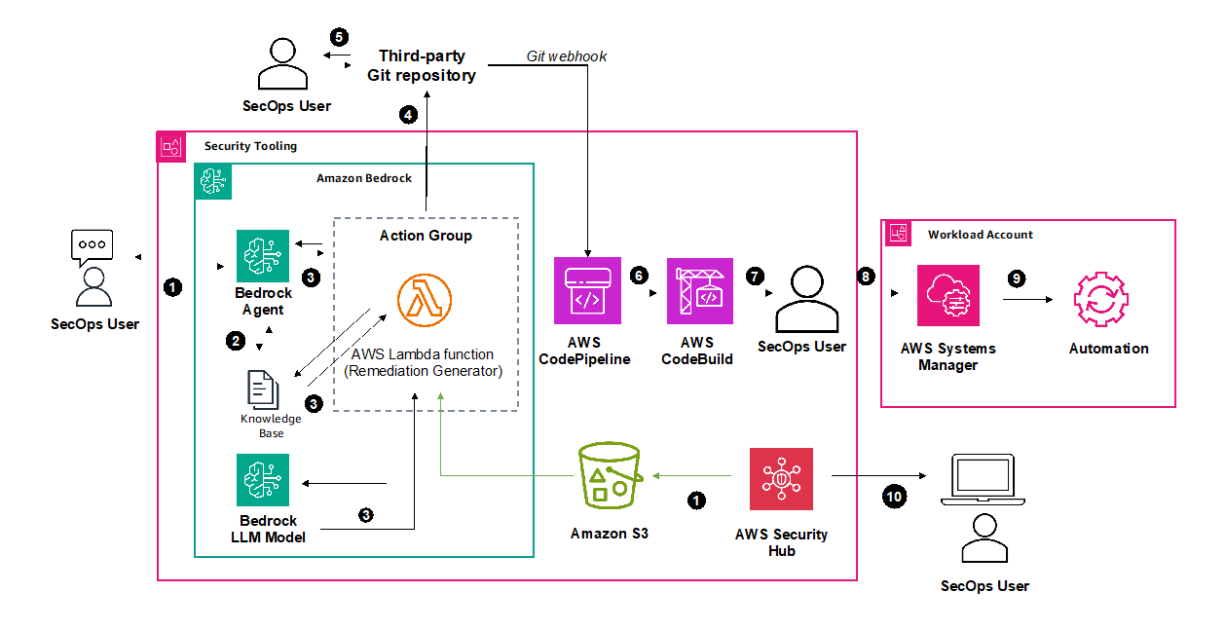
This solution follows prescriptive guidance for automating remediation for AWS Security Hub standard findings. Before delving into the deployment, let’s review the key steps of the solution architecture, as shown in the following figure.
Figure 1 : AWS Security Hub control remediation using Amazon Bedrock and AWS Systems Manager
Note: The folder structure of the Git repository is based on AWS services, and there is a parameters file under each parent AWS service folder.
In this post, we focus on remediating the following two example security findings:
The example findings demonstrate the two potential paths the actions group can take for remediation. It also showcases the capabilities of action groups with Retrieval Augmented Generation (RAG) and how you can use Amazon Bedrock Knowledge Bases to automate security remediation.
For the first finding, AWS has an existing Systems Manager runbook to remediate the S3.5 finding. The solution uses the existing runbook (through a knowledge base) and renders an AWS CloudFormation template as automation.
The second finding has no AWS provided runbook or playbook. The solution will generate a CloudFormation template that creates an AWS Systems Manager document to remediate the DMS.1 finding.
Below are the prerequisites that are needed before you can deploy the solution.
There are four main steps in order to deploy the solution.
Configuring a knowledge base enables your Amazon Bedrock agents to access a repository of information for AWS account provisioning. Follow these steps to set up your knowledge base.
Prepare the data sources:
Create the knowledge base:
Note: After successful creation, copy the knowledge base ID because you will need to reference it in the next step.
Sync the data source:
IMPORTANT: The following steps are required for GitHub integration. If you choose to use a different source control provider, you may do so, but you will need to edit the committer class accordingly. This is crucial for the proper functioning of the solution with your chosen source control system.
GitHub Setup
This command will deploy all the necessary resources, including the Lambda function, the CodePipeline, and the Amazon SNS notification.
Create an action group linked to the Lambda function that was created in the CDK app. This action group is launched by the agent after the user inputs the Security Hub finding ID or finding title, and outputs a CloudFormation template in the Code Commit repository.
Note: For this solution, openapischema.json is provided to you in the Git repository. Upload the JSON into the S3 bucket created in Step 1 and reference the S3 URI when selecting the API schema in this step.
In order to validate the solution, follow the below steps :
Figure 2 : AWS Security Hub finding title
If a finding already has an AWS remediation runbook available, the agent will output its details. That is, it will not create a new runbook. When automation through a Systems Manager runbook isn’t possible, the agent will output a message similar to “Unable to automate remediation for this finding.”
Figure 3 : An example Bedrock Agent Interaction
Note: Bedrock_Generated_Template_Name refers to the name of the YAML file that has been output by Amazon Bedrock.
Figure 4 : An example Bedrock generated YAML file
To avoid unnecessary charges, delete the resources created during testing. To delete the resources, perform the following steps:
The integration of generative AI for remediating security findings is an effective approach, allowing SecOps teams to scale better and remediate findings in a timely manner. Using the generative AI capabilities of Amazon Bedrock alongside AWS services such as AWS Security Hub and automation, a capability of AWS Systems Manager, allows organizations to quickly remediate security findings by building automations that align with best practices while minimizing development effort. This approach not only streamlines security operations but also embeds a CI/CD approach for remediating security findings.
The solution in this post equips you with a plausible pattern of AWS Security Hub and AWS Systems Manager integrated with Amazon Bedrock, deployment code, and instructions to help remediate security findings efficiently and securely according to AWS best practices.
Ready to start your cloud migration process with generative AI in Amazon Bedrock? Begin by exploring the Amazon Bedrock User Guide to understand how you can use Amazon Bedrock to streamline your organization’s cloud journey. For further assistance and expertise, consider using AWS Professional Services to help you accelerate remediating AWS Security Hub findings and maximize the benefits of Amazon Bedrock. Shiva Vaidyanathan is a Principal Cloud Architect at AWS. He provides technical guidance for customers ensuring their success on AWS. His primary expertise include Migrations, Security, GenAI and works towards making AWS cloud adoption simpler for everyone. Prior to joining AWS, he has worked on several NSF funded research initiatives on performing secure computing in public cloud infrastructures. He holds a MS in Computer Science from Rutgers University and a MS in Electrical Engineering from New York University.
 Huzaifa Zainuddin is a Senior Cloud Infrastructure Architect at AWS, specializing in designing, deploying, and scaling cloud solutions for a diverse range of clients. With a deep expertise in cloud infrastructure and a passion for leveraging the latest AWS technologies, he is eager to help customers embrace generative AI by building innovative automations that drive operational efficiency. Outside of work, Huzaifa enjoys traveling, cycling, and exploring the evolving landscape of AI.
Loading comments…