Posted on Leave a comment

DHS Proposes Changing H-1B Lottery to Weighted, Wage-Based System – CBIA

Track key indicators & trends
Get your questions answered
Stay informed, get engaged
Grow your business
Driving change & making a difference
Press releases and contact information
Everything you need to grow
News, resources to build your team
The following article was first posted in the Insights section of Harris Beach Murtha’s website. It is reposted here with permission.
In its ongoing efforts to revamp the H-1B visa status framework, the U.S. Department of Homeland Security issued a Notice of Proposed Rulemaking on Sept. 24, 2025, proposing a regulatory rule to change the process by which cap-subject H-1B status applicants are selected by U.S. Citizenship and Immigration Services (USCIS) for eligibility to file H-1B petitions in its annual lottery.
This substantive change proposes a weighted lottery selection system whereby H-1B beneficiaries offered the highest wages are given the highest likelihood of being chosen in the lottery and afforded the opportunity to subsequently petition for H-1B work status.
This system is a marked departure from the current system, in which there is generally no special preference given to H-1B lottery entrants.
The H-1B visa status classification is the most common visa type used for U.S. employers to hire and employ foreign nationals for temporary employment. This status is available to those hired to be employed and perform services in a “specialty occupation.”
This term is defined in the relevant immigration regulations as an occupation that:
“… requires theoretical and practical application of a body of highly specialized knowledge in fields of human endeavor including, but not limited to, architecture, engineering, mathematics, physical sciences, social sciences, medicine and health, education, business specialties, accounting, law, theology, and the arts, and which requires the attainment of a bachelor’s degree or higher in a specific specialty, or its equivalent, as a minimum for entry into the occupation in the United States.” [8 U.S.C. § 214.2(h)(4)(ii)]
To implement and set limits upon the H-1B program, Congress set an annual quota restricting its use.
The current framework caps the annual quota for new H-1B petitions for those who have not been granted H-1B status during the previous six years at 65,000.
The H-1B cap numbers have not been updated for many years and have not accounted for population growth or the current needs of the U.S. economy.
An additional 20,000 slots are also allocated for those foreign national beneficiaries who have earned the minimum of a master’s degree from a qualifying U.S. educational institution.
Due to political constraints, the H-1B cap numbers have not been updated for many years and have therefore not accounted for population growth or the current needs of the U.S. economy.
Accordingly, for many years, the annual H-1B quota has been filled nearly instantaneously upon the commencement of the filing eligibility period.
This situation has led to the creation of the H-1B cap lottery system, wherein a random lottery system is used annually at the outset/opening of each H-1B cap season to determine which applicants will fill the available cap slots and be afforded the opportunity to petition for, and gain, H-1B status each year.
Until now, no special consideration in the annual cap lottery was given regarding the compensation level for each offered H-1B position.
Indeed, the plain language of the controlling Immigration and Nationality Act statute states that the H-1B cap slots conferring H-1B eligibility should be “issued … in the order in which petitions are filed for such visas or status” (thereby permitting the cap lottery system to be used at the commencement of each year’s quota system implementation in a random nature, and not by limiting/favoring the availability of the H-1B program to those employers who pay the highest compensation).
In contrast, the proposed new DHS rule drastically changes the way in which those who registered for the H-1B cap lottery are selected to have the opportunity to petition for H-1B status.
It instead institutes a new wage-based selection process system where the selection of H-1B registrations are prioritized/weighted based upon the salary compensation level the employer plans to pay the H-1B worker.
For instance, there are four wage levels currently used by the U.S. Department of Labor to categorize H-1B specialty occupations.
The selection of H-1B registrations are prioritized/weighted based upon salary compensation level.
This new rule utilizes that mechanism to prioritize each submitted lottery registration in terms of its likelihood to be chosen as a lottery winner.
In effect, those H-1B beneficiaries to be paid at the highest Level 4 wage will possess four times the chance of being selected in the lottery than those being paid at the Level 1 “entry-level,” those with Level 3 qualifying wage compensation will have three times the chance of success as Level 1 applicants, etc.
As a result, USCIS has acknowledged the probability of Level 1 workers being selected to be eligible to file an H-1B cap-subject petition will decrease by 48%!
Immigration advocates argue this proposed rule/regulation violates Congressional intent regarding the promulgation and implementation of the H-1B program, as Congress did not intend to limit the program’s use to employers with the ability to pay the highest wages.
Indeed, it can be rationally said the U.S immigration system as a whole was not created for, nor intended to be, a plutocratic type of system favoring the wealthy.
Immigration advocates claim this change will have a substantial negative impact on a wide range of U.S. employers and industries, including the healthcare and technology fields.
Additionally, they argue the new system will limit the ability of smaller businesses and startups to use the program to foster innovation and growth, thereby unnecessarily hindering the potential success of their business efforts.
Therefore, they say this consequence could ultimately hurt, not help, the U.S. economy.
Conversely, large corporations that can afford to pay the higher wages are enthused by this change, as it will undoubtedly lead to higher percentages of their H-1B cap lottery entrants being selected as winners, affording them the opportunity to employ more of these workers each year than prior lottery results have yielded.
The new system will limit the ability of smaller businesses and startups to use the program to foster innovation and growth.
In terms of what comes next, the 30-day comment period required by the Administrative Procedure Act ended in late October.
During this period, comments were submitted by immigration advocates, including the American Immigration Lawyers Association, in opposition to the proposed rule.
AILA requested that, at a minimum, this rule be delayed in its implementation and not used for the upcoming fiscal year 2027 cap filing season (the lottery for which will be administered in March of 2026).
Judicial action is also being contemplated by an array of immigration advocacy groups, but no lawsuit contesting the measure has been filed as of this writing.
Therefore, barring these types of developments to pause or prevent its implementation, the rule is likely to complete its required regulatory process in time to be implemented for the next H-1B cap lottery process in March.
Harris Beach Murtha’s Immigration Practice Group will continue monitoring this and related H-1B issues and update the public regarding future developments.
About the author: David Jacobson is a Harris Beach Murtha member who focuses his practice on employment-based immigration matters for corporate clients in various industries, including financial services, pharmaceuticals, media, information technology, real estate, construction, chemical and environmental engineering, market research, and advertising.
Your email address will not be published. Required fields are marked


The latest news and information delivered directly to your inbox.
CBIA IS FIGHTING TO MAKE CONNECTICUT A TOP STATE FOR BUSINESS, JOBS, AND ECONOMIC GROWTH. A BETTER BUSINESS CLIMATE MEANS A BRIGHTER FUTURE FOR EVERYONE.
© 2025 CBIA
350 Church Street
Hartford, CT 06103

860.244.1900
source

Posted on Leave a comment

Building automations to accelerate remediation of AWS Security Hub control findings using Amazon Bedrock and AWS Systems Manager – Amazon Web Services (AWS)


Search
AWS Blogs
January 2025: This post was reviewed and updated to use Git repository instead of AWS CodeCommit, which is no longer available to new customers.
Several factors can make remediating security findings challenging. First, the sheer volume and complexity of findings can overwhelm security teams, leading to delays in addressing critical issues. Findings often require a deep understanding of AWS services and configurations and require many cycles for validation, making it more difficult for less experienced teams to remediate issues effectively. Some findings might require coordination across multiple teams or departments, leading to communication challenges and delays in implementing fixes. Finally, the dynamic nature of cloud environments means that new security findings can appear rapidly and constantly, requiring a more effective and scalable solution to remediate findings.
In this post, we will harness the power of generative artificial intelligence (AI) and Amazon Bedrock to help organizations simplify and effectively manage remediation of security control findings. By using Agents for Amazon Bedrock with action groups and Amazon Bedrock Knowledge Bases, you can now create automations with AWS Systems Manager Automation (for services that support automations with AWS Systems Manager) and deploy them into AWS accounts. Thus, by following a programmatic continuous integration and development (CI/CD) approach, you can scale better and remediate security findings promptly.
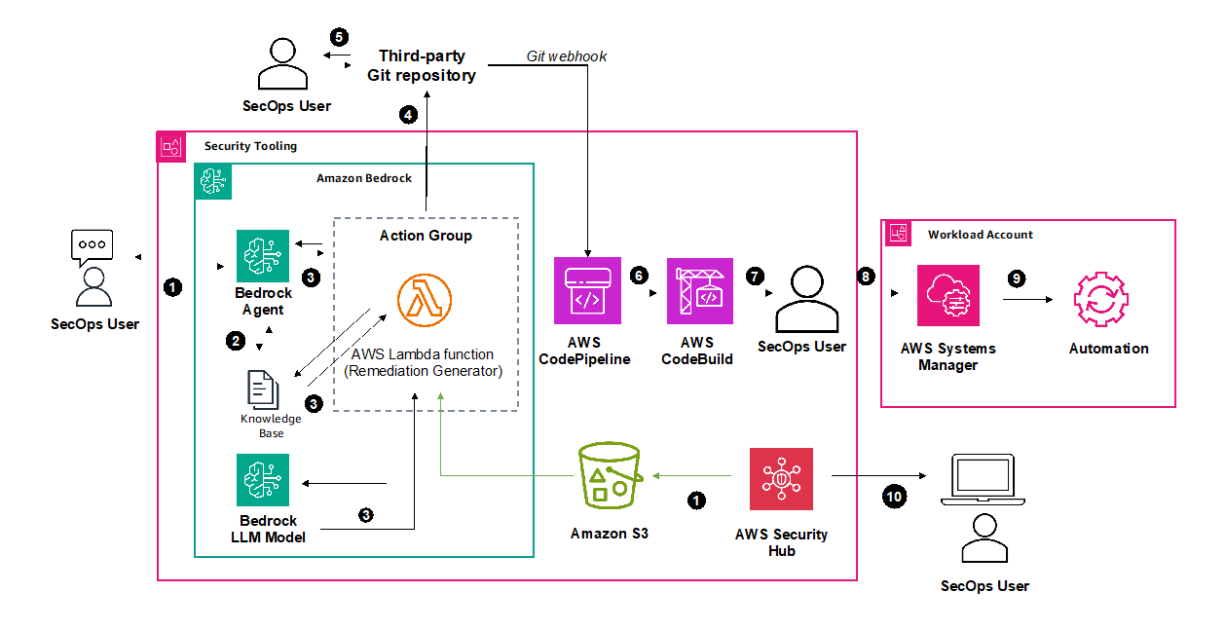
This solution follows prescriptive guidance for automating remediation for AWS Security Hub standard findings. Before delving into the deployment, let’s review the key steps of the solution architecture, as shown in the following figure.
Figure 1 : AWS Security Hub control remediation using Amazon Bedrock and AWS Systems Manager
Note: The folder structure of the Git repository is based on AWS services, and there is a parameters file under each parent AWS service folder.
In this post, we focus on remediating the following two example security findings:
The example findings demonstrate the two potential paths the actions group can take for remediation. It also showcases the capabilities of action groups with Retrieval Augmented Generation (RAG) and how you can use Amazon Bedrock Knowledge Bases to automate security remediation.
For the first finding, AWS has an existing Systems Manager runbook to remediate the S3.5 finding. The solution uses the existing runbook (through a knowledge base) and renders an AWS CloudFormation template as automation.
The second finding has no AWS provided runbook or playbook. The solution will generate a CloudFormation template that creates an AWS Systems Manager document to remediate the DMS.1 finding.
Below are the prerequisites that are needed before you can deploy the solution.
There are four main steps in order to deploy the solution.
Configuring a knowledge base enables your Amazon Bedrock agents to access a repository of information for AWS account provisioning. Follow these steps to set up your knowledge base.
Prepare the data sources:
Create the knowledge base:
Note: After successful creation, copy the knowledge base ID because you will need to reference it in the next step.
Sync the data source:
IMPORTANT: The following steps are required for GitHub integration. If you choose to use a different source control provider, you may do so, but you will need to edit the committer class accordingly. This is crucial for the proper functioning of the solution with your chosen source control system.
GitHub Setup
This command will deploy all the necessary resources, including the Lambda function, the CodePipeline, and the Amazon SNS notification.
Create an action group linked to the Lambda function that was created in the CDK app. This action group is launched by the agent after the user inputs the Security Hub finding ID or finding title, and outputs a CloudFormation template in the Code Commit repository.
Note: For this solution, openapischema.json is provided to you in the Git repository. Upload the JSON into the S3 bucket created in Step 1 and reference the S3 URI when selecting the API schema in this step.
In order to validate the solution, follow the below steps :

Figure 2 : AWS Security Hub finding title
If a finding already has an AWS remediation runbook available, the agent will output its details. That is, it will not create a new runbook. When automation through a Systems Manager runbook isn’t possible, the agent will output a message similar to “Unable to automate remediation for this finding.”
Figure 3 : An example Bedrock Agent Interaction
Note: Bedrock_Generated_Template_Name refers to the name of the YAML file that has been output by Amazon Bedrock.
Figure 4 : An example Bedrock generated YAML file

To avoid unnecessary charges, delete the resources created during testing. To delete the resources, perform the following steps:
The integration of generative AI for remediating security findings is an effective approach, allowing SecOps teams to scale better and remediate findings in a timely manner. Using the generative AI capabilities of Amazon Bedrock alongside AWS services such as AWS Security Hub and automation, a capability of AWS Systems Manager, allows organizations to quickly remediate security findings by building automations that align with best practices while minimizing development effort. This approach not only streamlines security operations but also embeds a CI/CD approach for remediating security findings.
The solution in this post equips you with a plausible pattern of AWS Security Hub and AWS Systems Manager integrated with Amazon Bedrock, deployment code, and instructions to help remediate security findings efficiently and securely according to AWS best practices.
Ready to start your cloud migration process with generative AI in Amazon Bedrock? Begin by exploring the Amazon Bedrock User Guide to understand how you can use Amazon Bedrock to streamline your organization’s cloud journey. For further assistance and expertise, consider using AWS Professional Services to help you accelerate remediating AWS Security Hub findings and maximize the benefits of Amazon Bedrock.
Shiva Vaidyanathan is a Principal Cloud Architect at AWS. He provides technical guidance for customers ensuring their success on AWS. His primary expertise include Migrations, Security, GenAI and works towards making AWS cloud adoption simpler for everyone. Prior to joining AWS, he has worked on several NSF funded research initiatives on performing secure computing in public cloud infrastructures. He holds a MS in Computer Science from Rutgers University and a MS in Electrical Engineering from New York University.
Huzaifa Zainuddin is a Senior Cloud Infrastructure Architect at AWS, specializing in designing, deploying, and scaling cloud solutions for a diverse range of clients. With a deep expertise in cloud infrastructure and a passion for leveraging the latest AWS technologies, he is eager to help customers embrace generative AI by building innovative automations that drive operational efficiency. Outside of work, Huzaifa enjoys traveling, cycling, and exploring the evolving landscape of AI.

Loading comments…

source

Posted on Leave a comment

Mega Millions Jackpot Grows To $843M For Fridays Drawing: What To Know In MI – Patch

The jackpot for Friday’s Mega Millions drawing has grown to the eighth-highest in the game’s history. At $843 million, the prize is fueling ticket sales among regular lottery players in Michigan and others dreaming about what they’d do if they became overnight multimillionaires.
The massive jackpot, which has a cash value of $391.7 million, grew after no one matched all six numbers in Tuesday’s drawing: the white balls 11, 14, 17, 50 and 57, plus the gold Mega Ball 6.
To play the lottery game in Michigan, all in-store and online tickets must be bought before 9:45 p.m.
You can buy Powerball tickets both online and at local Michigan Lottery retailers, such as grocery stores, convenient stores and gas stations. You can sign up and play online here.
Tickets are $5 each, with a built-in multiplier feature added in April that automatically increases non-jackpot prizes by 2, 3, 4, 5, or 10 times. Previously, the base ticket was $2, and the multiplier was an optional $1 add-on in most states.
The rule changes were designed to produce larger, faster-growing jackpots and more non-jackpot prizes The changes slightly improved the odds of winning the jackpot, from 1 in 302,575,350 to 1 in 290,472,336, achieved by decreasing the gold Mega Ball pool from 25 to 24 numbers.
The odds of winning any prize also improved, from 1 in 24 to 1 in 23.
Friday’s drawing is the 38th since the jackpot was last won in Virginia on June 27. It’s the longest streak without a jackpot winner since the game began in 2002, and the previous record of 37 drawings was set in January 2021, when a $1.050 billion jackpot was won in Michigan.
Mega Millions said 606,046 winning tickets valued at more than $12.2 million were sold across all prize tiers in Tuesday’s drawing, including 12 tickets that matched four white balls plus the Mega Ball to win third-tier prizes ranging from $20,000 to $40,000, depending on their multiplier. Those tickets were sold in Arkansas, California, Colorado, Florida, Michigan, New Hampshire, New Jersey, Pennsylvania, Texas, Virginia and Wyoming.
In this jackpot run to date, there have been almost 11.7 million winning tickets at all levels, with total prizes exceeding $274 million due to significant enhancements to lower-tier prizes in changes made to the game last April, Mega Millions said.
Get more local news delivered straight to your inbox. Sign up for free Patch newsletters and alerts.

source

Posted on Leave a comment

Lotto results live: National Lottery and Thunderball numbers for Wednesday, November 5 – Wales Online

It is a rollover on the Lotto tonight and we'll be bringing you the numbers on the dot as they come in.
There is a £5 million jackpot up for grabs in the National Lottery game and a top prize of £500,000 can also be won on the Thunderball.
The Lotto draw is at 8pm and the Thunderball draw is at 8.15pm.
We will bring you the results of the draws right here as soon as they're available, which you can see below. Good luck!
Get the results:
6, 11, 13, 19, 39 and the Thunderball is 5.
5
19
6
11
39
13
It is less than 15 minutes until the Thunderball results. We will be bringing you all the numbers, live.
2, 15, 20, 42, 43 and 59. The bonus ball is 16.
16
59
2
42
20
15
43
Five minutes to go until the lottery results, we will be bringing yoy live updates.
15 minutes until the live Lotto draw.
It is half an hour to go until the live Lotto results. We will be bringing you all the numbers.

source

Posted on Leave a comment

Crypto Market Predictions: Where Will XRP, Pi Coin, and Shiba Inu Head Today? – InvestX

The crypto market sees a 3.5% correction on Monday, November 3, driven by substantial outflows from Bitcoin and Ethereum ETFs. XRP, Pi Coin, and Shiba Inu are among the hardest-hit altcoins, but technical indicators hint at a potential major rebound ahead. These tokens now show rare oversold signals, a setup typically preceding notable bullish corrections.
Written by Simon Dumoulin
Translated on November 4, 2025 at 09:48 by Simon Dumoulin
The XRP price currently stands at $2.40 after a 5% decline over the last 24 hours. Its weekly performance shows a 8% drop, while the monthly decline reaches 20%. These figures might seem alarming, but they mask a much more encouraging reality: the altcoin still maintains a 375% increase over the year, demonstrating that its underlying momentum remains intact.
The market is now anticipating the imminent launch of several XRP ETFs in the United States. Some analysts suggest a possible approval in the coming weeks, which would generate massive institutional demand. Technical analysis confirms this bullish hypothesis: The XRP RSI has been trading below the 30 level since August, while the MACD has maintained a negative position for several months. These two indicators are converging toward a rare buy signal, seldom observed since the beginning of the year.
The bullish pennant structure formed on the daily chart suggests a technical target of $3 by the end of November. If Ripple’s growth continues, particularly through the expansion of its cross-border payment solutions, XRP could break through $4 before the end of December. The solid trading volumes despite the correction indicate that whales are accumulating during this consolidation phase.
Join the best crypto trading bot platform!
Pi Network shows a price of $0.2397, down 3% over 24 hours and 11% over seven days. Paradoxically, the token records a 15% increase over two weeks, driven by encouraging fundamental news. The Pi Network team revealed that 2.69 million Pioneers have migrated to the mainnet, while 3.36 million have completed the mandatory KYC verifications.
These figures are reassuring after doubts about the management of the mainnet deployment. Pi Network reached a historical peak of $2.99 at the end of February before a sharp correction. The RSI has crossed the 50 threshold, confirming a bullish reversal. The current momentum could intensify if altcoin ETF launches create a climate of widespread optimism in the market.
The main constraint remains the absence of the token on major exchange platforms like Binance, Coinbase, or Kraken, limiting its institutional exposure. A major listing would likely trigger a violent bullish rally. Projections place PI at $1 by December, with potential toward $2 if the macro context improves.
The SHIB price stands at $0.000009564, down 5% over 24 hours, 8.5% over a week, and 23% over a month. More concerning, the meme coin has declined by 44% over a year, a disappointing performance while the majority of the top 50 are advancing. This decoupling reflects a lack of interest from whales and institutional traders, who are turning to new meme tokens like Fartcoin.
Unlike Dogecoin, which benefits from ETF applications under review, no ETF is planned for SHIB. This absence of an institutional catalyst deprives the token of sustainable structural demand. Technical indicators (RSI and MACD) are evolving at historically low levels, signaling extreme oversold conditions. Paradoxically, this configuration could signal a significant technical rebound.
SHIB’s daily trading volume of $145M remains far below Dogecoin’s ($1.8B), illustrating its loss of momentum. Initiatives like Shibarium, its layer-2 solution, have yet to convince. Short-term projections target $0.000020 by December, with an objective of $0.000040 if a major catalyst emerges.
On the same topic:
Passionate about cryptocurrencies since 2019, I cover the latest news through clear and accessible articles. My goal is to make crypto understandable for everyone, with reliable and well-researched content.

DISCLAIMER
This article is for informational purposes only and should not be considered as investment advice. Trading cryptocurrencies involves risks, and it is important not to invest more than you can afford to lose.
InvestX is not responsible for the quality of the products or services presented on this page and cannot be held liable, directly or indirectly, for any damage or loss caused by the use of any product or service featured in this article. Investments in crypto assets are inherently risky; readers should conduct their own research before taking any action and invest only within their financial means. This article does not constitute investment advice.
Risk Warning : Trading financial instruments and/or cryptocurrencies carries a high level of risk, including the possibility of losing all or part of your investment. It may not be suitable for all investors. Cryptocurrency prices are highly volatile and can be influenced by external factors such as financial, regulatory, or political events. Margin trading increases financial risks.
CFDs (Contracts for Difference) are complex instruments with a high risk of rapid capital loss due to leverage. Between 74% and 89% of retail investor accounts lose money when trading CFDs. You should assess whether you understand how CFDs work and whether you can afford to take the high risk of losing your money.
Before engaging in financial or cryptocurrency trading, you must be fully informed about the associated risks and fees, carefully evaluate your investment objectives, level of experience, and risk tolerance, and seek professional advice if needed. InvestX.fr and the InvestX application may provide general market commentary, which does not constitute investment advice and should not be interpreted as such. Please consult an independent financial advisor for any investment-related questions. InvestX.fr disclaims any liability for errors, misinvestments, inaccuracies, or omissions and does not guarantee the accuracy or completeness of the information, texts, graphics, links, or other materials provided.
Some of the partners featured on this site may not be regulated in your country. It is your responsibility to verify the compliance of these services with local regulations before using them.
© InvestX 2025

source